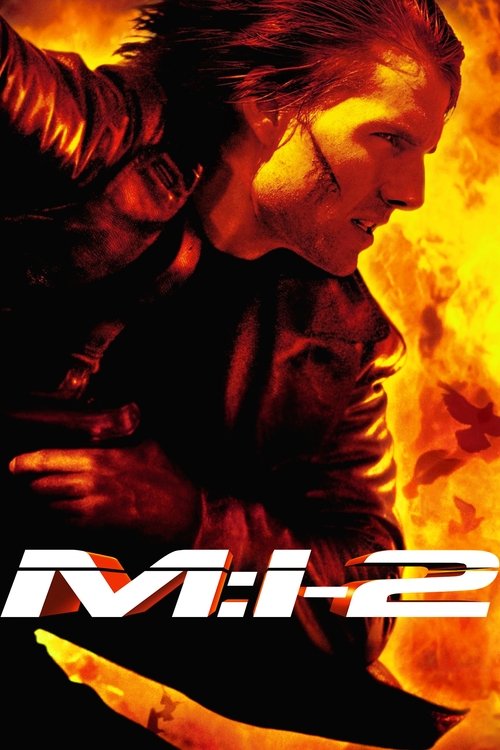
Mission: Impossible II
2000 · Directed by John Woo
Woke Score
CriticCritic Score
Audience
Ultra Based
Critics rated this 51 points above its woke score. Among Ultra Based films, this critic score ranks #936 of 1469.
Representation Casting
Score: 28/100
Thandiwe Newton and Ving Rhames provide racial diversity in the cast, but both are supporting characters without significant narrative agency or complexity.
LGBTQ+ Themes
Score: 0/100
No LGBTQ+ themes, characters, or representation present in the film.
Feminist Agenda
Score: 8/100
Nyah Hall is a capable action character but remains fundamentally defined by her romantic relationship to the male protagonist and serves largely as a plot object.
Racial Consciousness
Score: 12/100
While the cast includes actors of color, the film contains no meaningful exploration of racial themes or consciousness.
Climate Crusade
Score: 0/100
Climate crisis receives no attention or acknowledgment in the narrative.
Eat the Rich
Score: 0/100
The film contains no critique of capitalism, corporate power, or wealth inequality.
Body Positivity
Score: 0/100
Body positivity is not a theme or concern of this action film.
Neurodivergence
Score: 0/100
No representation of neurodivergence or disability is present in the film.
Revisionist History
Score: 0/100
The film contains no historical narrative or revisionist historical claims.
Lecture Energy
Score: 5/100
The film occasionally includes exposition-heavy dialogue typical of action films but contains no preachy social messaging.


Synopsis
With computer genius Luther Stickell at his side and a beautiful thief on his mind, agent Ethan Hunt races across Australia and Spain to stop a former IMF agent from unleashing a genetically engineered biological weapon called Chimera. This mission, should Hunt choose to accept it, plunges him into the center of an international crisis of terrifying magnitude.
Consciousness Assessment
Mission: Impossible II arrives as a monument to spectacle divorced from any engagement with contemporary social consciousness. John Woo's directorial debut on American soil is a film of motorcycle chases, slow-motion doves, and the kind of kinetic excess that demands no intellectual labor from its audience. The presence of Thandiwe Newton and Ving Rhames in the cast provides a baseline level of racial representation, though neither character is written with particular depth or agency. Newton's Nyah Hall exists primarily as a romantic objective to be secured rather than a fully realized character with her own narrative arc.
The film's ideological commitments extend no further than the most conventional action movie frameworks: good guys stop bad guys, individualist heroism triumphs, and the existing power structures of the IMF remain unquestioned and unexamined. There is no climate consciousness, no interrogation of capitalism or American imperialism, no engagement with gender politics beyond the deployment of a female character as romantic interest and occasional plot device. The body positivity, neurodivergence representation, and revisionist historical impulses that characterize contemporary progressive cinema are entirely absent. We are not lectured, because there is nothing here to lecture about.
This is a film made in the year 2000 by a director known for balletic violence and operatic action sequences. It succeeds entirely on its own terms as a technical exercise in kinetic filmmaking, asking nothing of culture and offering nothing to cultural discourse. To score it heavily on modern progressive markers would be to misunderstand what it is: a pre-9/11 action picture concerned only with motion, impact, and visual sensation.
Analysis generated by our Consciousness Algorithm
Critic Reviews
“Moves with terrific energy, alternating riveting action sequences with intimate material in a manner that's pure Woo.”
“The real deity of the movie is director Woo, who takes complete command of the latest technology -- hyperspeed editing, breathtaking cinematography, 10-out-of-10 stunt work -- to create brilliant action sequences.”
“Mostly, you get a pain in the head from the assault on your senses and déjà vu as thick as heartburn after an anchovy pizza.”
Consciousness Markers
Thandiwe Newton and Ving Rhames provide racial diversity in the cast, but both are supporting characters without significant narrative agency or complexity.
No LGBTQ+ themes, characters, or representation present in the film.
Nyah Hall is a capable action character but remains fundamentally defined by her romantic relationship to the male protagonist and serves largely as a plot object.
While the cast includes actors of color, the film contains no meaningful exploration of racial themes or consciousness.
Climate crisis receives no attention or acknowledgment in the narrative.
The film contains no critique of capitalism, corporate power, or wealth inequality.
Body positivity is not a theme or concern of this action film.
No representation of neurodivergence or disability is present in the film.
The film contains no historical narrative or revisionist historical claims.
The film occasionally includes exposition-heavy dialogue typical of action films but contains no preachy social messaging.