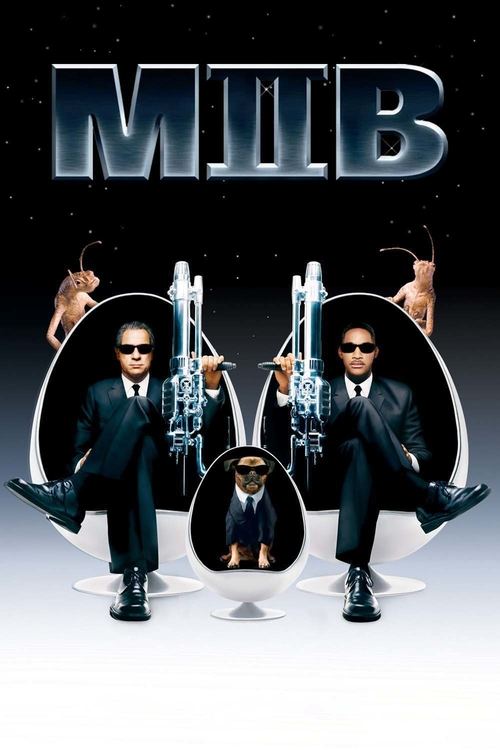
Men in Black II
2002 · Directed by Barry Sonnenfeld
Woke Score
CriticCritic Score
Audience
Ultra Based
Critics rated this 34 points above its woke score. Among Ultra Based films, this critic score ranks #1185 of 1469.
Representation Casting
Score: 25/100
Will Smith and Rosario Dawson are cast in lead and supporting roles respectively, representing standard blockbuster diversity without explicit progressive framing. The casting appears organic to the narrative rather than ideologically motivated.
LGBTQ+ Themes
Score: 0/100
No LGBTQ+ representation or themes present. The film contains no characters, relationships, or storylines addressing sexual orientation or gender identity.
Feminist Agenda
Score: 5/100
The female villain Serleena is presented as a standard action-movie antagonist without feminist subtext. No progressive gender commentary or feminist critique informs the narrative.
Racial Consciousness
Score: 10/100
The film features actors of color in prominent roles but demonstrates no engagement with racial themes or systemic racial issues. Casting reflects 2002 blockbuster norms rather than progressive racial consciousness.
Climate Crusade
Score: 0/100
Climate change and environmental catastrophe play no role in the narrative. The alien threat is presented as a generic extraterrestrial problem unrelated to ecological concerns.
Eat the Rich
Score: 0/100
The film contains no critique of capitalism, corporate power, or wealth inequality. The MIB operates as a government agency without satirical commentary on institutional structures.
Body Positivity
Score: 0/100
Body positivity plays no role in the film's themes or characterization. Physical appearance is treated as standard for action-comedy conventions of the era.
Neurodivergence
Score: 0/100
No representation of neurodivergent characters or conditions. The film contains no engagement with autism, ADHD, mental health, or cognitive diversity.
Revisionist History
Score: 0/100
As a science fiction comedy set in a fictional present, the film contains no historical narrative to revise or recontextualize. Historical revisionism is not applicable.
Lecture Energy
Score: 15/100
The film prioritizes entertainment and comedy over social messaging. While light-hearted in tone, it occasionally edges toward buddy-cop banter that could approach preachiness, though this is minimal and not ideologically charged.


Synopsis
Kay and Jay reunite to provide our best, last and only line of defense against a sinister seductress who levels the toughest challenge yet to the MIB's untarnished mission statement – protecting Earth from the scum of the universe. It's been four years since the alien-seeking agents averted an intergalactic disaster of epic proportions. Now it's a race against the clock as Jay must convince Kay – who not only has absolutely no memory of his time spent with the MIB, but is also the only living person left with the expertise to save the galaxy – to reunite with the MIB before the earth submits to ultimate destruction.
Consciousness Assessment
Men in Black II arrives as a relic of a simpler time, when summer blockbusters could be about aliens and quips without the burden of cultural consciousness. Barry Sonnenfeld's 2002 sequel features Will Smith and Tommy Lee Jones in roles that required no particular ideological commitment beyond the provision of charisma and comedic timing. The supporting cast includes Rosario Dawson and Tony Shalhoub, both talented performers cast in their respective roles, though the film demonstrates no apparent interest in exploring or celebrating their identities as anything other than component parts of the narrative machinery. This is not a criticism. It is merely an observation about what the film is.
The picture exists in a cultural moment predating the crystallization of contemporary progressive markers. There are no lectures on systemic inequality, no celebrations of neurodivergence, no climate catastrophism woven into the plot. The female villain is simply a villain. The humor derives from fish-out-of-water scenarios and physical comedy rather than from the film's awareness of its own social positioning. One watches agents in sunglasses fight aliens and encounters nothing that resembles the particular sensibilities that have come to define cultural consciousness in the 2020s.
What emerges from this analysis is the portrait of a film that has aged not because it offends contemporary values, but because it precedes them entirely. The opening weekend gross of 54.1 million dollars suggests audiences received it as competent summer entertainment, which remains its primary achievement. There is a kind of purity in this indifference to the cultural concerns that now dominate discourse. Whether this constitutes a virtue or a limitation depends entirely on one's perspective.
Analysis generated by our Consciousness Algorithm
Critic Reviews
“Delivers a quick buzz, lots of stuff to look at, and a totally nonnutritious joy that can only be attained with the aid of artificial flavorings and Yellow #5. In a nutshell, it's the perfect summer movie.”
“Retains the earlier film's ability to delight the viewer with surprise effects and flights of fancy, only now the effects are better.”
“The hang-loose grodiness of these films has its charms, and the Ray-Banned team of Will Smith and Tommy Lee Jones, at its best, is good vaudeville.”
“If it isn't the worst sequel ever made, it's only because it has too much competition: Impersonal and frenetic, it's a landmark Hollywood disgrace.”
Consciousness Markers
Will Smith and Rosario Dawson are cast in lead and supporting roles respectively, representing standard blockbuster diversity without explicit progressive framing. The casting appears organic to the narrative rather than ideologically motivated.
No LGBTQ+ representation or themes present. The film contains no characters, relationships, or storylines addressing sexual orientation or gender identity.
The female villain Serleena is presented as a standard action-movie antagonist without feminist subtext. No progressive gender commentary or feminist critique informs the narrative.
The film features actors of color in prominent roles but demonstrates no engagement with racial themes or systemic racial issues. Casting reflects 2002 blockbuster norms rather than progressive racial consciousness.
Climate change and environmental catastrophe play no role in the narrative. The alien threat is presented as a generic extraterrestrial problem unrelated to ecological concerns.
The film contains no critique of capitalism, corporate power, or wealth inequality. The MIB operates as a government agency without satirical commentary on institutional structures.
Body positivity plays no role in the film's themes or characterization. Physical appearance is treated as standard for action-comedy conventions of the era.
No representation of neurodivergent characters or conditions. The film contains no engagement with autism, ADHD, mental health, or cognitive diversity.
As a science fiction comedy set in a fictional present, the film contains no historical narrative to revise or recontextualize. Historical revisionism is not applicable.
The film prioritizes entertainment and comedy over social messaging. While light-hearted in tone, it occasionally edges toward buddy-cop banter that could approach preachiness, though this is minimal and not ideologically charged.