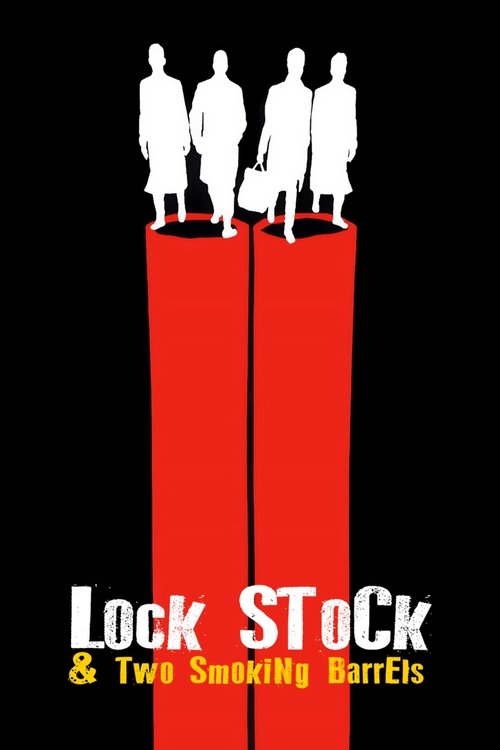
Lock, Stock and Two Smoking Barrels
1998 · Directed by Guy Ritchie
Woke Score
CriticCritic Score
Audience
Ultra Based
Critics rated this 65 points above its woke score. Among Ultra Based films, this critic score ranks #713 of 1469.
Representation Casting
Score: 5/100
The cast is almost entirely male with minimal female roles. No attempt at ethnic or demographic diversity in a London setting.
LGBTQ+ Themes
Score: 0/100
No LGBTQ+ characters, themes, or representation present in the film.
Feminist Agenda
Score: 0/100
Female characters are peripheral and decorative with no feminist messaging or agenda.
Racial Consciousness
Score: 0/100
All-white cast with no engagement with racial themes or consciousness of diversity.
Climate Crusade
Score: 0/100
No environmental or climate-related messaging or themes present.
Eat the Rich
Score: 0/100
The film celebrates criminal entrepreneurship and hustling rather than critiquing capitalist systems.
Body Positivity
Score: 0/100
No commentary on body diversity or body positivity; standard action-comedy casting practices.
Neurodivergence
Score: 0/100
No representation or acknowledgment of neurodivergence in the film.
Revisionist History
Score: 0/100
Not a historical film; set in contemporary 1998 London with no historical revisionism.
Lecture Energy
Score: 0/100
The film is driven by entertainment, plot mechanics, and style rather than preachy messaging or lectures.


Synopsis
A card shark and his unwillingly-enlisted friends need to make a lot of cash quick after losing a sketchy poker match. To do this they decide to pull a heist on a small-time gang who happen to be operating out of the flat next door.
Consciousness Assessment
Lock, Stock and Two Smoking Barrels arrives as a monument to the British crime comedy of the late 1990s, a film so thoroughly committed to its ensemble of working-class male archetypes that the very concept of social consciousness appears to have been left on the cutting room floor. Guy Ritchie's directorial debut presents London's underworld as a boys' club where women are decoration, minorities are absent, and the primary moral framework involves who hustles whom most effectively. The film's cultural moment is entirely concerned with style, wit, and the mechanics of overlapping con games; progressive sensibility registers not as a concern but as an irrelevance.
What makes Lock, Stock worthy of consideration is not any engagement with contemporary social questions but its celebration of criminal entrepreneurship as a form of masculine ingenuity. The characters scheme, lie, and steal their way through the narrative with the moral framework of a video game where winning matters and consequences dissolve into the next clever gambit. The film's representation of gender is pre-millennial in its casualness about female absence. Women appear briefly in decorative roles, their presence justified by nothing more than the fact that the male characters occasionally interact with them. There is no awareness here of representation as a value, no calculation of casting to achieve diversity, merely the default assumption that a heist film belongs to men.
The film's cultural position in 1998 was one of pure entertainment commodity, a vehicle for launching careers and generating box office returns through word-of-mouth momentum. It remains a competent example of its genre and era, notable for its visual inventiveness and narrative complexity, but it inhabits a cultural moment before such questions as representation and social consciousness had become embedded in the machinery of film criticism and industry practice. It is what it is: a period piece about crime told by men, for men, with the social awareness of a brick.
Analysis generated by our Consciousness Algorithm
Critic Reviews
“A dynamite bundle from British writer-director Guy Ritchie. Even when the accents are as indecipherable as the plot, Ritchie keeps the action percolating and the humor on high.”
“The acting, mostly by a bunch of unknowns, is equally fresh and funny, and Ritchie keeps the movie moving faster than you can say, "bludgeoned to death by a 15-inch black rubber dildo."”
“Dark, dangerous and a great deal of wicked, amoral fun. A film that manages to be as clever, playful and mock violent as its title, Lock, Stock was a major hit in its native Britain and its cheeky tone, simultaneously calculated and off the cuff, is as hip as anyone could want. [5 Mar 1999]”
“The tediously convoluted plot involves the foursome’s attempt to pay him back, a labored venture that involves crooks with names like Dog and Plank, a man on fire, some fine cinematography, plenty of gore though no real point.”
Consciousness Markers
The cast is almost entirely male with minimal female roles. No attempt at ethnic or demographic diversity in a London setting.
No LGBTQ+ characters, themes, or representation present in the film.
Female characters are peripheral and decorative with no feminist messaging or agenda.
All-white cast with no engagement with racial themes or consciousness of diversity.
No environmental or climate-related messaging or themes present.
The film celebrates criminal entrepreneurship and hustling rather than critiquing capitalist systems.
No commentary on body diversity or body positivity; standard action-comedy casting practices.
No representation or acknowledgment of neurodivergence in the film.
Not a historical film; set in contemporary 1998 London with no historical revisionism.
The film is driven by entertainment, plot mechanics, and style rather than preachy messaging or lectures.