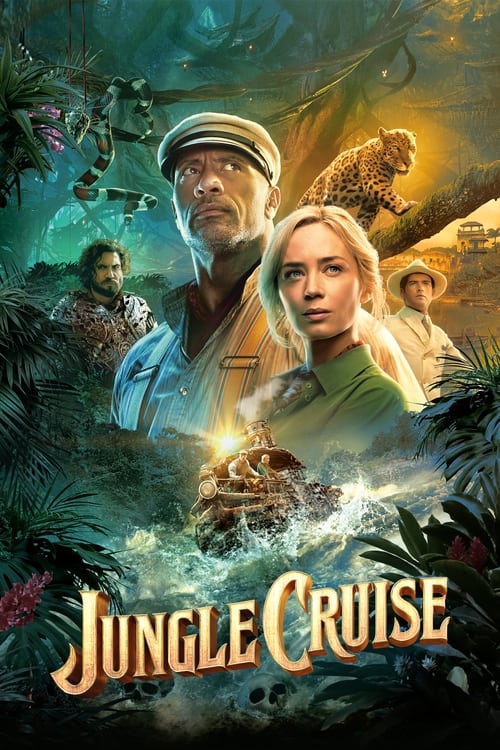
Jungle Cruise
2021 · Directed by Jaume Collet-Serra
Woke Score
CriticCritic Score
Audience
Based
Critics rated this 28 points above its woke score. Among Based films, this critic score ranks #302 of 345.
Representation Casting
Score: 45/100
Supporting cast includes Latino actors like Edgar Ramírez and Veronica Falcón, though lead roles remain with established white/mixed-race stars. Diversity is present but not reflective of the film's Amazonian setting.
LGBTQ+ Themes
Score: 0/100
No LGBTQ+ themes, characters, or relationships of any significance appear in the film. The central romantic subplot is heterosexual.
Feminist Agenda
Score: 35/100
Emily Blunt's Dr. Houghton is portrayed as intelligent and capable, seeking scientific advancement. However, the character operates within conventional adventure movie frameworks without meaningful interrogation of gender dynamics.
Racial Consciousness
Score: 20/100
Indigenous peoples and the Amazon appear in the film but serve as exotic backdrop. No meaningful exploration of colonialism, indigenous sovereignty, or historical exploitation occurs.
Climate Crusade
Score: 15/100
A mystical healing tree in the Amazon provides tangential environmental connection, but no explicit environmental messaging or climate consciousness is demonstrated.
Eat the Rich
Score: 0/100
No critique of capitalism, wealth inequality, or corporate exploitation appears in the narrative. The film is purely adventure entertainment with no economic consciousness.
Body Positivity
Score: 0/100
The film features conventionally attractive leads and does not engage with body diversity or body positivity themes.
Neurodivergence
Score: 0/100
No representation of neurodivergent characters or engagement with neurodiversity appears in the film.
Revisionist History
Score: 25/100
The film takes creative liberties with Amazonian history and indigenous mythology, though it operates more as appropriation than meaningful revisionism. Historical accuracy is sacrificed for plot convenience.
Lecture Energy
Score: 10/100
While exposition about the Amazon and the tree's properties occurs, the film prioritizes entertainment and action over preachy messaging. Lecture moments are minimal and subservient to spectacle.


Synopsis
Dr. Lily Houghton enlists the aid of wisecracking skipper Frank Wolff to take her down the Amazon in his dilapidated boat. Together, they search for an ancient tree that holds the power to heal – a discovery that will change the future of medicine.
Consciousness Assessment
Jungle Cruise arrives as a monument to the pre-woke blockbuster, a film so committed to the adventure movie template that it barely notices the world has shifted around it. The film presents an ethnically diverse supporting cast against the backdrop of the Amazon, yet treats indigenous peoples and their culture as set dressing rather than subject. Dr. Lily Houghton's intelligence and agency are acknowledged, but within the safe confines of the romantic adventure narrative where her scientific ambitions exist primarily to justify the plot mechanics. There is no interrogation of colonialism, no examination of corporate extraction, no hint that the quest for a miraculous healing tree might raise uncomfortable questions about Western exploitation of the Global South. The film's commitment to entertainment is absolute and its commitment to progressive sensibility is nonexistent. It is a pure Disney product, calculated to offend no one and challenge nothing, a film that mistakes casting diversity for cultural consciousness and mistakes a female scientist protagonist for feminist critique. The Amazon itself remains a mystery to be solved, not a place with its own sovereignty and history worth considering.
Analysis generated by our Consciousness Algorithm
Critic Reviews
“Jungle Cruise packs in everything satisfying about an adventure movie, with some of its own twists.”
“Jungle Cruise is a rollicking adventure full of humor and heart anchored by Dwayne Johnson and Emily Blunt's winning heroes.”
“Dwayne Johnson may not be the world’s most nuanced actor, but he’s a marvelous showman. His and co-star Emily Blunt’s combined “it” factor transcends the sillier stretches of this somewhat forgettable but still chuckling good-times ride.”
“To their credit, by the time the movie ends, Blunt and Johnson have made the sale. I believed them and liked seeing them together. They don’t make Jungle Cruise worth seeing or even worth tolerating. But for scattered minutes across this wasteland, they make it less painful.”
Consciousness Markers
Supporting cast includes Latino actors like Edgar Ramírez and Veronica Falcón, though lead roles remain with established white/mixed-race stars. Diversity is present but not reflective of the film's Amazonian setting.
No LGBTQ+ themes, characters, or relationships of any significance appear in the film. The central romantic subplot is heterosexual.
Emily Blunt's Dr. Houghton is portrayed as intelligent and capable, seeking scientific advancement. However, the character operates within conventional adventure movie frameworks without meaningful interrogation of gender dynamics.
Indigenous peoples and the Amazon appear in the film but serve as exotic backdrop. No meaningful exploration of colonialism, indigenous sovereignty, or historical exploitation occurs.
A mystical healing tree in the Amazon provides tangential environmental connection, but no explicit environmental messaging or climate consciousness is demonstrated.
No critique of capitalism, wealth inequality, or corporate exploitation appears in the narrative. The film is purely adventure entertainment with no economic consciousness.
The film features conventionally attractive leads and does not engage with body diversity or body positivity themes.
No representation of neurodivergent characters or engagement with neurodiversity appears in the film.
The film takes creative liberties with Amazonian history and indigenous mythology, though it operates more as appropriation than meaningful revisionism. Historical accuracy is sacrificed for plot convenience.
While exposition about the Amazon and the tree's properties occurs, the film prioritizes entertainment and action over preachy messaging. Lecture moments are minimal and subservient to spectacle.