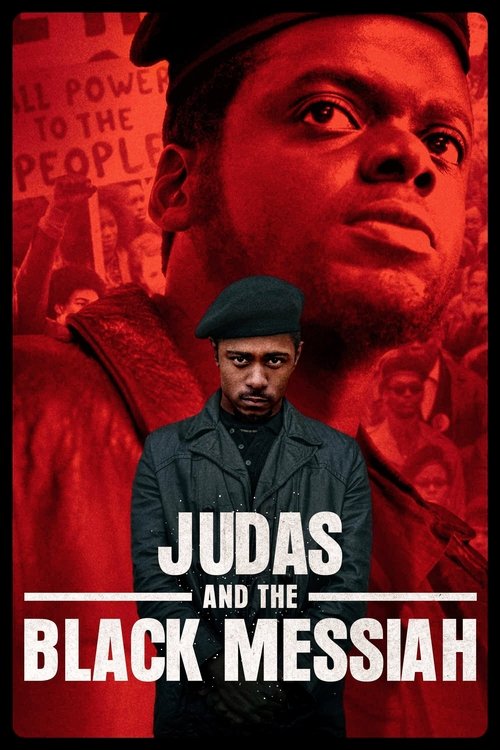
Judas and the Black Messiah
2021 · Directed by Shaka King
Woke Score
CriticCritic Score
Audience
Woke
Critics rated this 16 points above its woke score. Among Woke films, this critic score ranks #20 of 88.
Representation Casting
Score: 85/100
The cast is predominantly Black with a Black director and significant behind-the-scenes representation. The film centers Black voices and experiences in telling a Black historical narrative.
LGBTQ+ Themes
Score: 0/100
No LGBTQ+ themes or representation are present in the film.
Feminist Agenda
Score: 15/100
Female characters exist in the narrative but receive limited development. Dominique Fishback's character has romantic involvement but minimal agency in the central conflict.
Racial Consciousness
Score: 88/100
The film centers on racial oppression, FBI targeting of Black activists, and systemic racism as documented historical fact. It examines state violence against Black revolutionary leadership with considerable specificity.
Climate Crusade
Score: 0/100
No climate-related themes or messaging appear in the film.
Eat the Rich
Score: 25/100
The Black Panthers' anti-capitalist ideology is present in the historical context, but the film does not elaborate on economic systems or pursue explicit critique of capitalism.
Body Positivity
Score: 0/100
No body positivity messaging or themes are evident in this historical drama.
Neurodivergence
Score: 0/100
Neurodivergence is not addressed or represented in the film.
Revisionist History
Score: 35/100
The film presents a sympathetic reframing of the Black Panthers and Fred Hampton, correcting historical narratives that demonized them, though it is based on documented events rather than revisionism.
Lecture Energy
Score: 20/100
The film trusts its historical subject matter and does not rely heavily on expository dialogue or preachy messaging to convey its themes.


Synopsis
Bill O'Neal infiltrates the Black Panthers on the orders of FBI Agent Mitchell and J. Edgar Hoover. As Black Panther Chairman Fred Hampton ascends—falling for a fellow revolutionary en route—a battle wages for O'Neal's soul.
Consciousness Assessment
Shaka King's meticulous recreation of the 1969 FBI infiltration of the Black Panther Party arrives precisely when contemporary discourse demands it, a timing that shapes rather than determines its significance. The film presents a narrative of state violence, institutional racism, and moral compromise through the perspective of two men caught in an impossible geometry of loyalty and survival. Kaluuya and Stanfield inhabit their roles with such precision that we are forced to contend with the machinery of oppression rather than merely observe it from a comfortable distance.
The film's primary strength lies in its unflinching depiction of FBI surveillance, coercion, and the systematic assassination of revolutionary leadership. It does not ask for sympathy but demands recognition of a historical atrocity. The predominantly Black cast and creative team represent a shift in whose stories get told and how, though this structural choice functions more as representation than as interrogation of power. The film examines institutional racism as a documented fact rather than an abstraction, grounding political analysis in specific moments of betrayal and state action.
However, the film's engagement with progressive sensibilities remains largely implicit rather than explicit. It is a tragedy about individuals caught in systems larger than themselves, not a manifesto. The gender dynamics receive minimal attention, the economic analysis of capitalism's role in state repression stays peripheral, and there is no particular effort to educate the audience through preachy dialogue. This is a film that trusts its subject matter to carry its own weight, which is both its restraint and its limitation.
Analysis generated by our Consciousness Algorithm
Critic Reviews
“Though it’s early in the year, it doesn’t feel like a stretch to name it one of 2021’s best films.”
“Led by sensational performances from Daniel Kaluuya as Hampton and LaKeith Stanfield as William O'Neal, the FBI informant who infiltrated his inner circle, this is a scalding account of oppression and revolution, coercion and betrayal, rendered more shocking by the undiminished currency of its themes.”
“This is a throwback movie in the best sense of the term, asking the audience to consider the not-too-distant past of anti-Black racism as prologue to its similarly murderous present. It’s also a return to a brand of muscular, serious-minded filmmaking that has been virtually forgotten in recent years.”
“Judas and the Black Messiah is missing that deeper personal aspect, some sense of the emotional force yoking O’Neal and Hampton together, dragging them toward ruin. The film is resonant regardless. Still, there’s such an opportunity presented here—to see these two sterling actors really working in harmony—that goes frustratingly unseized. As is, Judas and the Black Messiah is richer and more engaging than a standard biopic, but is not quite the Shakespearean tragedy of double allegiances and backstabbing that it could have been. ”
Consciousness Markers
The cast is predominantly Black with a Black director and significant behind-the-scenes representation. The film centers Black voices and experiences in telling a Black historical narrative.
No LGBTQ+ themes or representation are present in the film.
Female characters exist in the narrative but receive limited development. Dominique Fishback's character has romantic involvement but minimal agency in the central conflict.
The film centers on racial oppression, FBI targeting of Black activists, and systemic racism as documented historical fact. It examines state violence against Black revolutionary leadership with considerable specificity.
No climate-related themes or messaging appear in the film.
The Black Panthers' anti-capitalist ideology is present in the historical context, but the film does not elaborate on economic systems or pursue explicit critique of capitalism.
No body positivity messaging or themes are evident in this historical drama.
Neurodivergence is not addressed or represented in the film.
The film presents a sympathetic reframing of the Black Panthers and Fred Hampton, correcting historical narratives that demonized them, though it is based on documented events rather than revisionism.
The film trusts its historical subject matter and does not rely heavily on expository dialogue or preachy messaging to convey its themes.