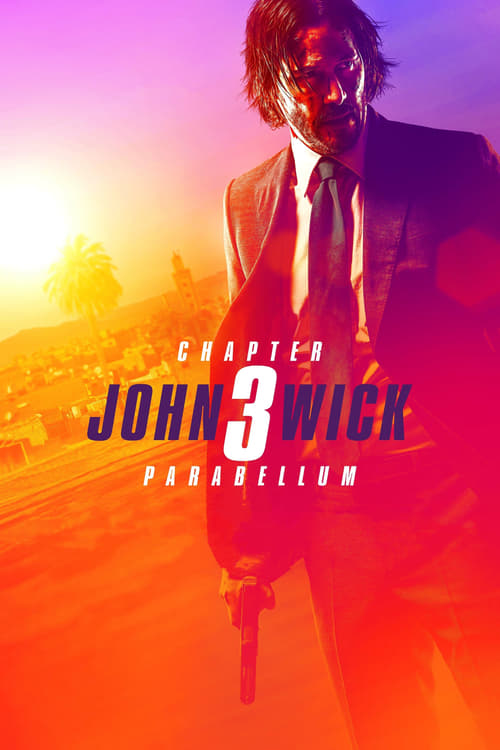
John Wick: Chapter 3 - Parabellum
2019 · Directed by Chad Stahelski
Woke Score
CriticCritic Score
Audience
Ultra Based
Critics rated this 58 points above its woke score. Among Ultra Based films, this critic score ranks #520 of 1469.
Representation Casting
Score: 55/100
The film casts Halle Berry in a significant action role and includes multiple actors of color in positions of authority within the narrative. Asia Kate Dillon appears as a nonbinary character. However, these casting choices exist without narrative acknowledgment or thematic development.
LGBTQ+ Themes
Score: 15/100
Asia Kate Dillon plays a nonbinary character (The Adjudicator), and the actor specifically requested the character be written as nonbinary. However, the film makes no narrative point of this identity and treats it as an unremarkable fact.
Feminist Agenda
Score: 0/100
The film contains no feminist agenda or commentary. Female characters exist as capable assassins and operatives, but this is presented as simple professional competence rather than any critique of gender dynamics.
Racial Consciousness
Score: 0/100
The film contains no racial consciousness or commentary. Characters of various ethnicities populate the narrative, but race is treated as an unremarkable demographic fact with no thematic significance.
Climate Crusade
Score: 0/100
There is no climate-related messaging or environmental consciousness in this film.
Eat the Rich
Score: 0/100
The film contains no critique of capitalism or wealth. The assassin's guild economy is presented as a neutral backdrop for action sequences.
Body Positivity
Score: 0/100
There is no body positivity messaging. The film does not engage with questions of physical appearance or body standards.
Neurodivergence
Score: 0/100
No neurodivergent characters or representation are present in the film.
Revisionist History
Score: 0/100
The film contains no historical revisionism or reinterpretation of historical events.
Lecture Energy
Score: 0/100
The film contains no preachy or lecture-like social messaging. It is purely focused on narrative action and spectacle.


Synopsis
Super-assassin John Wick returns with a $14 million price tag on his head and an army of bounty-hunting killers on his trail. After killing a member of the shadowy international assassin's guild, the High Table, John Wick is excommunicado, but the world's most ruthless hit men and women await his every turn.
Consciousness Assessment
John Wick: Chapter 3 - Parabellum arrives as a purely mechanistic exercise in action filmmaking, a movie so devoted to the geometry of violence that it barely pauses to consider the world it depicts. The film's cultural consciousness emerges not through intent but through casting choices that the filmmakers appear to have accepted as simple logistics. Asia Kate Dillon plays The Adjudicator as a nonbinary character, a role the actor actively requested, and the film grants this decision roughly the same narrative weight as one might grant a wardrobe change. It exists. It is not commented upon. This approach could be read as progressive or simply neutral, depending on one's appetite for reading intentions into empty spaces.
Halle Berry receives more substantial screen time as Sofia Al-Azwar, a former assassin and current manager of the Casablanca Continental. Berry's presence carries the weight of her own celebrity and her age, factors that make her casting in an action role of this magnitude something that genuinely breaks from Hollywood's customary practices. She performs her own stunts. She trains intensely. The film, however, shows no interest in examining what it means to cast a 52-year-old Black woman in this position, nor does it require her character to navigate any particular complications rooted in her identity. Sofia exists as a fully capable operative within a world where gender and race appear to be merely demographic facts, neither barriers nor sources of narrative friction.
The film's broader absence of social consciousness cannot be understated. There is no climate anxiety, no capitalism critique, no disability representation, no historical revisionism, no body positivity messaging, no feminist agenda, and no lecture energy. What remains is a franchise entry that happened to include marginalized actors and one deliberately nonbinary character, then proceeded to ignore all of these choices entirely in service of delivering what it actually cares about: elaborate fight choreography and the aesthetic of an assassin's underworld. This is not progressive filmmaking. It is filmmaking that is adjacent to progressivism by accident.
Analysis generated by our Consciousness Algorithm
Critic Reviews
“There are moments of unexpected humor that blindside you.”
“Precision, energy, and innovation move the components of John Wick, but the synergy that comes from their singular motion transcends mechanistic clockwork into vital, aesthetic flow.”
“I don’t mean to give the impression that John Wick 3 is anything grander than a gorgeously choreographed, gratuitously violent action movie. But as gorgeously choreographed, gratuitously violent action movies go, it’s high art.”
“In “Chapter 3,” the violence has been supercharged, and so has the virtuosity. At a certain point, though, the carnage becomes deadening, its consequences no more than soulless tableaus of damage that encourage disengagement.”
Consciousness Markers
The film casts Halle Berry in a significant action role and includes multiple actors of color in positions of authority within the narrative. Asia Kate Dillon appears as a nonbinary character. However, these casting choices exist without narrative acknowledgment or thematic development.
Asia Kate Dillon plays a nonbinary character (The Adjudicator), and the actor specifically requested the character be written as nonbinary. However, the film makes no narrative point of this identity and treats it as an unremarkable fact.
The film contains no feminist agenda or commentary. Female characters exist as capable assassins and operatives, but this is presented as simple professional competence rather than any critique of gender dynamics.
The film contains no racial consciousness or commentary. Characters of various ethnicities populate the narrative, but race is treated as an unremarkable demographic fact with no thematic significance.
There is no climate-related messaging or environmental consciousness in this film.
The film contains no critique of capitalism or wealth. The assassin's guild economy is presented as a neutral backdrop for action sequences.
There is no body positivity messaging. The film does not engage with questions of physical appearance or body standards.
No neurodivergent characters or representation are present in the film.
The film contains no historical revisionism or reinterpretation of historical events.
The film contains no preachy or lecture-like social messaging. It is purely focused on narrative action and spectacle.