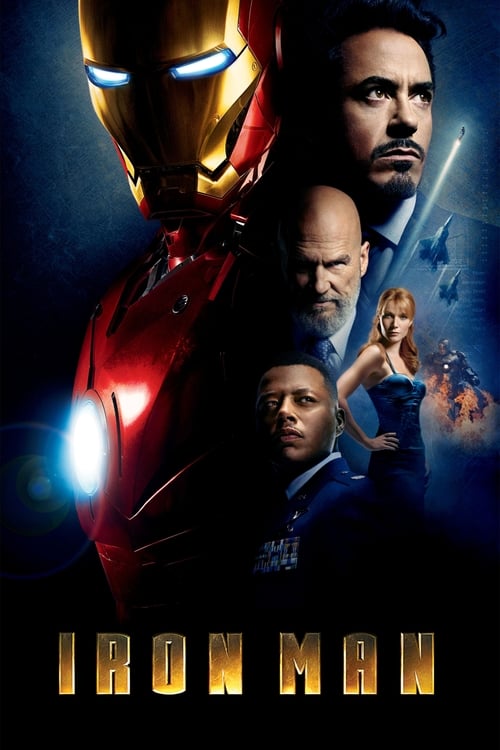
Iron Man
2008 · Directed by Jon Favreau
Woke Score
CriticCritic Score
Audience
Ultra Based
Critics rated this 71 points above its woke score. Among Ultra Based films, this critic score ranks #391 of 1469.
Representation Casting
Score: 15/100
The cast includes some diversity with Terrence Howard and Shaun Toub, but these characters serve functional roles with minimal agency or development. The film centers exclusively on its white male protagonist.
LGBTQ+ Themes
Score: 0/100
No LGBTQ+ representation, themes, or subtext present in the film.
Feminist Agenda
Score: 5/100
Pepper Potts is a capable assistant but exists primarily to support the male lead. She has no independent goals, agency in the plot, or character arc beyond romantic interest in Stark.
Racial Consciousness
Score: 8/100
Afghan characters are portrayed as terrorists and villains with no humanity or nuance. The film shows no awareness of American military involvement or its consequences on local populations.
Climate Crusade
Score: 0/100
No climate themes or environmental consciousness present in the film.
Eat the Rich
Score: 5/100
While Stark nominally rejects weapons manufacturing, he remains a billionaire whose wealth and lifestyle are never questioned. The film offers no systemic critique of capitalism or the arms trade.
Body Positivity
Score: 0/100
No body positivity themes or discussion of body image present in the film.
Neurodivergence
Score: 0/100
No representation of or engagement with neurodivergence or disability.
Revisionist History
Score: 0/100
The film does not attempt revisionist history but rather accepts mainstream historical narratives without question.
Lecture Energy
Score: 15/100
The film contains some moral exposition, particularly around Stark's rejection of weapons manufacturing, but this is presented as personal character growth rather than a lecture about systemic issues.


Synopsis
After being held captive in an Afghan cave, billionaire engineer Tony Stark creates a unique weaponized suit of armor to fight evil.
Consciousness Assessment
Iron Man arrives in 2008 as a fundamentally conservative enterprise, dressed in the armor of spectacle but harboring few progressive sensibilities. The film centers a white male billionaire as its protagonist and moral center, presenting his weapons manufacturing empire not as a system requiring critique but as a platform for personal redemption. Tony Stark's journey involves abandoning weapons manufacturing only after witnessing their consequences firsthand, a narrative that privileges individual conscience over systemic accountability. The film's only significant female character, Pepper Potts, exists primarily to admire the male lead and occasionally express concern. She possesses no agency in the plot, no professional ambitions beyond serving Stark, and her romantic entanglement is treated as inevitable rather than earned.
The film's treatment of Afghanistan and its people deserves particular attention. The opening sequence establishes Afghanistan as a lawless hellscape populated by vaguely defined terrorists and warlords. We witness a weapons test that kills American soldiers, prompting Stark's capture by those same generic militants. The cave sequence, meant to humanize Stark through suffering, accomplishes this by positioning Middle Eastern characters as brutal captors and nothing more. Shaun Toub's character, Yinsen, serves as the noble exception, a scientist whose humanity is measured by his willingness to help the American protagonist escape. The film never interrogates American military involvement in the region, the arms trade that created the conditions for conflict, or the lives of Afghan civilians. Instead, it presents American technological superiority and individual heroism as the solution to geopolitical problems.
Representation beyond these central figures remains thin. Terrence Howard appears as Rhodey, a military officer whose character exists primarily to facilitate plot mechanics. The film contains no LGBTQ+ representation, no exploration of gender beyond traditional roles, and no interest in disability or neurodivergence. Its anti-capitalist content hovers near zero, despite Stark's nominal rejection of weapons manufacturing. He remains obscenely wealthy, his lifestyle unchanged, his actual accountability limited to building a suit and fighting terrorists. The film is a product of the Bush era, comfortable with American military dominance and uninterested in critique. It is a competent action film, but one entirely at peace with the ideological status quo.
Analysis generated by our Consciousness Algorithm
Critic Reviews
“Ever-eclectic director Jon Favreau, who briefly pops up onscreen as a Stark minion, maintains a brisk but not frantic pace, and, in concert with lenser Matthew Libatique, production designer J. Michael Riva and the first-rate visual effects team, has made an unusually elegant looking film for the genre.”
“The gadgetry is absolutely dazzling, the action is mostly exhilarating, the comedy is scintillating and the whole enormous enterprise, spawned by Marvel comics, throbs with dramatic energy because the man inside the shiny red robotic rig is a daring choice for an action hero, and an inspired one.”
“You hire an actor for his strengths, and Downey would not be strong as a one-dimensional mighty-man. He is strong because he is smart, quick and funny, and because we sense his public persona masks deep private wounds. By building on that, Favreau found his movie, and it's a good one.”
“It succeeds only fitfully. Toggling between Stark's impish goatee and Iron Man's full-metal body condom, and amid so many generic fireballs, kill shots and earsplitting thumps, bumps and crunches, the film finally collapses under its own weight.”
Consciousness Markers
The cast includes some diversity with Terrence Howard and Shaun Toub, but these characters serve functional roles with minimal agency or development. The film centers exclusively on its white male protagonist.
No LGBTQ+ representation, themes, or subtext present in the film.
Pepper Potts is a capable assistant but exists primarily to support the male lead. She has no independent goals, agency in the plot, or character arc beyond romantic interest in Stark.
Afghan characters are portrayed as terrorists and villains with no humanity or nuance. The film shows no awareness of American military involvement or its consequences on local populations.
No climate themes or environmental consciousness present in the film.
While Stark nominally rejects weapons manufacturing, he remains a billionaire whose wealth and lifestyle are never questioned. The film offers no systemic critique of capitalism or the arms trade.
No body positivity themes or discussion of body image present in the film.
No representation of or engagement with neurodivergence or disability.
The film does not attempt revisionist history but rather accepts mainstream historical narratives without question.
The film contains some moral exposition, particularly around Stark's rejection of weapons manufacturing, but this is presented as personal character growth rather than a lecture about systemic issues.