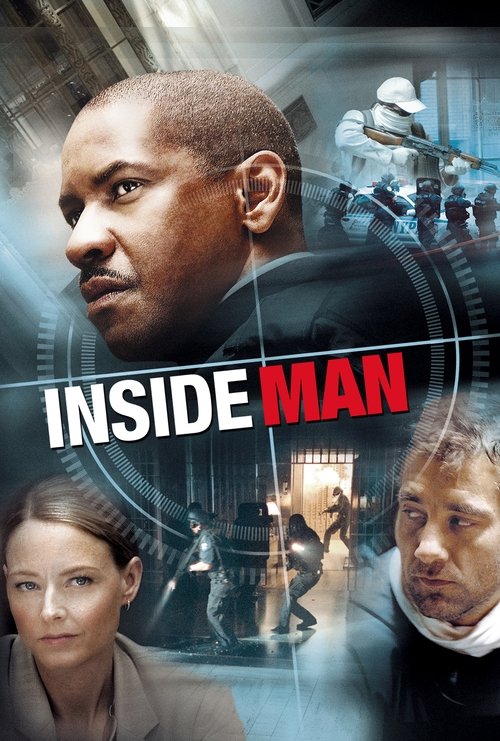
Inside Man
2006 · Directed by Spike Lee
Woke Score
CriticCritic Score
Audience
Based
Critics rated this 54 points above its woke score. Among Based films, this critic score ranks #108 of 345.
Representation Casting
Score: 45/100
The film features Denzel Washington as the lead detective and Chiwetel Ejiofor in a significant supporting role, reflecting genuine diversity in casting. However, this is presented as natural to the narrative rather than as a statement about representation politics.
LGBTQ+ Themes
Score: 0/100
No LGBTQ+ themes, characters, or content are present in the film. The narrative concerns itself entirely with a bank heist and institutional corruption.
Feminist Agenda
Score: 15/100
Jodie Foster appears in a significant role as an art expert and negotiator, but the film does not foreground feminist themes or gender consciousness. Her character is written as competent but is not positioned as a statement about women's agency.
Racial Consciousness
Score: 35/100
The film contains allegorical commentary on race and institutional power, particularly through the dynamic between Washington's detective and the criminal conspiracy. However, this operates at a thematic level rather than as explicit racial consciousness.
Climate Crusade
Score: 0/100
No climate-related themes, messaging, or environmental consciousness appears anywhere in the film. The narrative is entirely confined to urban crime and institutional corruption.
Eat the Rich
Score: 40/100
The film's central premise involves a heist targeting a major financial institution and contains implicit critique of capitalist power structures and corruption. However, this critique is embedded in genre convention rather than mobilized as explicit political messaging.
Body Positivity
Score: 0/100
No body positivity messaging, fat representation, or disability-conscious representation appears in the film. Physical appearance is not thematized in any progressive manner.
Neurodivergence
Score: 0/100
No characters are portrayed with neurodivergent conditions, and no representation of neurodiversity appears in the narrative.
Revisionist History
Score: 0/100
The film does not engage in historical revisionism or reframing of historical events. It is set in contemporary New York and involves a fictional crime narrative.
Lecture Energy
Score: 8/100
While the film contains social commentary about institutional corruption and power dynamics, it does not lecture the audience or pause the narrative to deliver explicit moral instruction. The commentary remains subtle and integrated.


Synopsis
When an armed, masked gang enter a Manhattan bank, lock the doors and take hostages, the detective assigned to effect their release enters negotiations preoccupied with corruption charges he is facing.
Consciousness Assessment
Spike Lee's Inside Man presents itself as a sleek heist thriller, all taut dialogue and narrative misdirection, yet beneath the surface lurks the director's characteristic preoccupation with institutional power and class stratification. The film operates primarily as a genre exercise, which is to say it succeeds on the terms of its own ambitions. The casting of Denzel Washington and Chiwetel Ejiofor in substantial roles reflects a certain sensibility toward representation, and the underlying narrative tension between the detective and the criminal does contain allegorical dimensions concerning race, capitalism, and urban corruption in the post-9/11 landscape.
However, we must be precise about what we are observing. This is a 2006 film directed by a politically engaged filmmaker, not a contemporary work shaped by the specific cultural markers of the 2020s. The social commentary operates at an implicit level, woven into the fabric of the narrative rather than foregrounded as conscious cultural intervention. The representation, while genuine, is not mobilized as a statement about casting politics or diversity consciousness. The critique of capitalism and institutional corruption, though present in the film's DNA, lacks the performative edge and explicit moralizing that characterizes modern progressive cinema.
Inside Man demonstrates that Lee has never been a filmmaker incapable of working within commercial constraints, and that his political sensibilities remain intact even when channeled through genre convention. This is a commendable achievement in its own right, but it is not, by contemporary standards, a particularly saturated expression of cultural awareness or progressive consciousness.
Analysis generated by our Consciousness Algorithm
Critic Reviews
“The thrills in Spike Lee's singularly savvy thriller are in small unexpected moments.”
“The jazzish score, by Lee's music man, Terence Blanchard, is typically intrusive. But the mood is right, the twists are new. And with one casting inspiration, Inside Man furthers the rising stardom of Chiwetel Ejiofor (Serenity).”
“This is the mother lode all action/suspense directors search for and Lee, who usually doesn't work in that genre, has hit it.”
“A fairly routine heist drama and a never especially believable puzzle film.”
Consciousness Markers
The film features Denzel Washington as the lead detective and Chiwetel Ejiofor in a significant supporting role, reflecting genuine diversity in casting. However, this is presented as natural to the narrative rather than as a statement about representation politics.
No LGBTQ+ themes, characters, or content are present in the film. The narrative concerns itself entirely with a bank heist and institutional corruption.
Jodie Foster appears in a significant role as an art expert and negotiator, but the film does not foreground feminist themes or gender consciousness. Her character is written as competent but is not positioned as a statement about women's agency.
The film contains allegorical commentary on race and institutional power, particularly through the dynamic between Washington's detective and the criminal conspiracy. However, this operates at a thematic level rather than as explicit racial consciousness.
No climate-related themes, messaging, or environmental consciousness appears anywhere in the film. The narrative is entirely confined to urban crime and institutional corruption.
The film's central premise involves a heist targeting a major financial institution and contains implicit critique of capitalist power structures and corruption. However, this critique is embedded in genre convention rather than mobilized as explicit political messaging.
No body positivity messaging, fat representation, or disability-conscious representation appears in the film. Physical appearance is not thematized in any progressive manner.
No characters are portrayed with neurodivergent conditions, and no representation of neurodiversity appears in the narrative.
The film does not engage in historical revisionism or reframing of historical events. It is set in contemporary New York and involves a fictional crime narrative.
While the film contains social commentary about institutional corruption and power dynamics, it does not lecture the audience or pause the narrative to deliver explicit moral instruction. The commentary remains subtle and integrated.