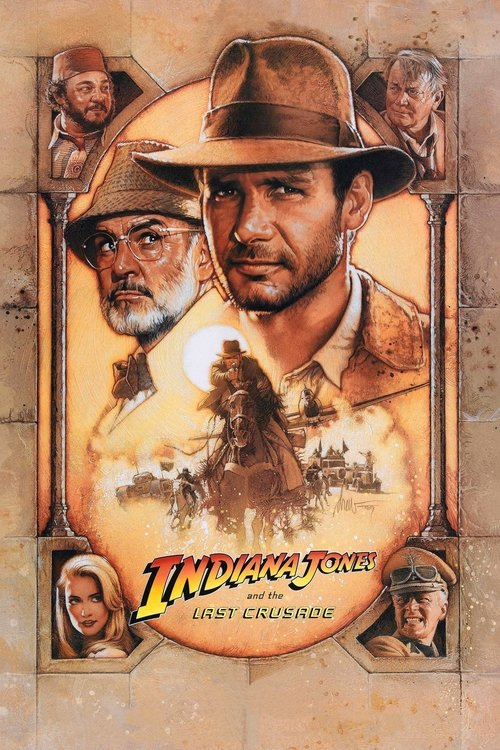
Indiana Jones and the Last Crusade
1989 · Directed by Steven Spielberg
Woke Score
CriticCritic Score
Audience
Ultra Based
Critics rated this 61 points above its woke score. Among Ultra Based films, this critic score ranks #778 of 1469.
Representation Casting
Score: 5/100
The cast is predominantly white and male-centered. The sole female character serves primarily as romantic interest and plot device. Supporting characters of color exist within orientalist frameworks without interrogation.
LGBTQ+ Themes
Score: 0/100
No LGBTQ+ themes, representation, or subtext present. The film operates within entirely heterosexual romantic and familial structures.
Feminist Agenda
Score: 3/100
Dr. Elsa Schneider is presented as educated and capable, but her agency remains subordinate to plot mechanics and male character arcs. Her ultimate role is betrayal and romantic complication.
Racial Consciousness
Score: 2/100
Characters of color appear primarily as supporting players within orientalist adventure tropes. No meaningful engagement with racial identity or power structures. Sallah is treated as a loyal sidekick within colonial framework.
Climate Crusade
Score: 0/100
No climate or environmental themes present. The natural world exists as backdrop for adventure rather than subject of concern.
Eat the Rich
Score: 0/100
No critique of capitalism or wealth accumulation. The plot concerns religious artifacts rather than economic systems. Art collecting is presented without moral judgment.
Body Positivity
Score: 0/100
No engagement with body positivity, disability representation, or physical diversity. Characters are conventionally attractive and able-bodied.
Neurodivergence
Score: 0/100
No representation of neurodivergence, mental health, or cognitive difference. All characters are neurotypical by narrative default.
Revisionist History
Score: 5/100
The film employs historical elements (Nazis, 1930s settings, religious history) but primarily as adventure narrative scaffolding rather than revisionist engagement. Treats historical facts relatively conventionally.
Lecture Energy
Score: 2/100
The film includes exposition about religious history and archaeology, but this emerges naturally from character expertise rather than as preachy messaging about social justice or progressive values.


Synopsis
In 1938, an art collector appeals to eminent archaeologist Dr. Indiana Jones to embark on a search for the Holy Grail. Indy learns that a medieval historian has vanished while searching for it, and the missing man is his own father, Dr. Henry Jones Sr.. He sets out to rescue his father by following clues in the old man's notebook, which his father had mailed to him before he went missing. Indy arrives in Venice, where he enlists the help of a beautiful academic, Dr. Elsa Schneider, along with Marcus Brody and Sallah. Together they must stop the Nazis from recovering the power of eternal life and taking over the world.
Consciousness Assessment
Indiana Jones and the Last Crusade arrives as a masterwork of late 1980s blockbuster cinema, which is to say it represents a cultural moment entirely innocent of progressive sensibilities as we understand them today. The film concerns itself with the pursuit of a religious artifact, the bonding of fathers and sons, and the defeat of Nazis, all rendered through the lens of classical adventure storytelling. These are not negligible pursuits, but neither do they engage with the specific constellation of social consciousness that emerged in the 2020s.
The casting remains thoroughly conventional for its era. Harrison Ford carries the picture as our white male protagonist, flanked by an ensemble that includes Sean Connery as his father, while the female lead, Alison Doody's Dr. Elsa Schneider, functions primarily as a romantic interest and narrative complication. She is competent enough, but her competence serves the plot rather than emerging from any genuine interest in her interiority or professional development. The supporting cast features John Rhys-Davies as Sallah, a character of Middle Eastern descent who exists within the framework of orientalist adventure tropes that the film does not interrogate. This is simply how adventure films were constructed in 1989, with minimal self-awareness regarding whose stories got told and from what perspective.
The film's relationship to Nazism deserves attention, though not the kind that inflates its progressive credentials. Spielberg depicts the Nazis as straightforward antagonists in pursuit of a powerful object, which is to say the film engages with World War II as historical backdrop rather than as an opportunity for deeper reckoning with fascism or its ideological foundations. The narrative suggests that certain truths, even religious ones, must be protected from the wrong hands, but this remains a fairly apolitical observation. We are left with a film of genuine technical accomplishment and entertainment value that simply does not register on the scales by which we now measure cultural awareness.
Analysis generated by our Consciousness Algorithm
Critic Reviews
“It's a beautiful machine, thought out and revved up to the last detail, with no other purpose but to delight - and it delights. [24 May 1989, Daily Notebook, p.E1]”
“The Harrison Ford-Sean Connery father-and-son team gives Last Crusade unexpected emotional depth, reminding us that real film magic is not in special effects.”
“Though it cannot regain the brash originality of ''Raiders of the Lost Ark,'' in its own way 'The Last Crusade' is nearly as good, matching its audience's wildest hopes.”
Consciousness Markers
The cast is predominantly white and male-centered. The sole female character serves primarily as romantic interest and plot device. Supporting characters of color exist within orientalist frameworks without interrogation.
No LGBTQ+ themes, representation, or subtext present. The film operates within entirely heterosexual romantic and familial structures.
Dr. Elsa Schneider is presented as educated and capable, but her agency remains subordinate to plot mechanics and male character arcs. Her ultimate role is betrayal and romantic complication.
Characters of color appear primarily as supporting players within orientalist adventure tropes. No meaningful engagement with racial identity or power structures. Sallah is treated as a loyal sidekick within colonial framework.
No climate or environmental themes present. The natural world exists as backdrop for adventure rather than subject of concern.
No critique of capitalism or wealth accumulation. The plot concerns religious artifacts rather than economic systems. Art collecting is presented without moral judgment.
No engagement with body positivity, disability representation, or physical diversity. Characters are conventionally attractive and able-bodied.
No representation of neurodivergence, mental health, or cognitive difference. All characters are neurotypical by narrative default.
The film employs historical elements (Nazis, 1930s settings, religious history) but primarily as adventure narrative scaffolding rather than revisionist engagement. Treats historical facts relatively conventionally.
The film includes exposition about religious history and archaeology, but this emerges naturally from character expertise rather than as preachy messaging about social justice or progressive values.