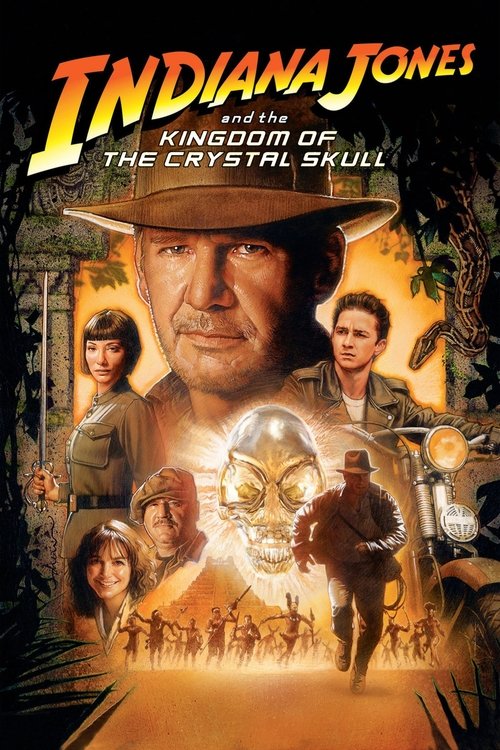
Indiana Jones and the Kingdom of the Crystal Skull
2008 · Directed by Steven Spielberg
Woke Score
CriticCritic Score
Audience
Ultra Based
Critics rated this 50 points above its woke score. Among Ultra Based films, this critic score ranks #770 of 1469.
Representation Casting
Score: 35/100
Cate Blanchett plays the main villain, a woman in a position of military authority. Karen Allen returns as Marion Ravenwood. However, the cast lacks diversity in other dimensions, and Peruvian/indigenous representation is minimal despite the setting.
LGBTQ+ Themes
Score: 0/100
No LGBTQ+ themes, characters, or subtext are present in the film. The narrative is entirely heteronormative.
Feminist Agenda
Score: 25/100
While Spalko is a female villain with agency and power, she is presented primarily as a threat rather than as a character whose femininity complicates traditional action narratives. Marion's role is largely passive.
Racial Consciousness
Score: 5/100
The film engages with Peru and indigenous mysticism purely as exotic backdrop. There is no meaningful engagement with colonial dynamics, indigenous representation, or racial consciousness.
Climate Crusade
Score: 0/100
No climate-related themes or environmental consciousness appears in the narrative.
Eat the Rich
Score: 10/100
The film presents Soviet communism as a threat, reflecting Cold War orthodoxy. There is no critique of capitalism or exploration of economic systems.
Body Positivity
Score: 0/100
The film presents conventionally attractive actors in glamorous roles. There is no engagement with body diversity or body positivity messaging.
Neurodivergence
Score: 0/100
No characters with neurodivergence or any exploration of neurodivergent perspectives appear in the film.
Revisionist History
Score: 5/100
While the film uses historical settings, it does not engage in revisionist reinterpretation of history. It simply deploys history as adventure scaffolding.
Lecture Energy
Score: 10/100
The film contains minimal preachy elements. It does not stop to lecture the audience about social issues or progressive values.


Synopsis
Set during the Cold War, the Soviets led by sword-wielding Irina Spalko are in search of a crystal skull which has supernatural powers related to a mystical Lost City of Gold. Indy is coerced to head to Peru at the behest of a young man whose friend and Indy's colleague Professor Oxley has been captured for his knowledge of the skull's whereabouts.
Consciousness Assessment
Indiana Jones and the Kingdom of the Crystal Skull arrives as a relic of early 2000s sensibilities, a time when Hollywood had not yet fully committed to the social consciousness metrics that would define the subsequent decade. The film's central narrative concerns itself with adventure and spectacle rather than cultural commentary, though it does present a Soviet antagonist in Irina Spalko, played with considerable menace by Cate Blanchett. This casting choice, pairing a woman in a position of power with a militaristic regime, represents a modest nod toward gender representation in action cinema, though it stops well short of interrogating the implications of such a choice with any depth.
The supporting cast includes Shia LaBeouf as a young greaser who becomes Indy's companion, alongside Karen Allen's return as Marion Ravenwood. The film's treatment of its Peruvian setting and indigenous culture is superficial at best, engaging with the location primarily as backdrop for set pieces rather than as a space requiring cultural sensitivity or meaningful representation. The narrative mechanics remain firmly rooted in 1980s adventure tropes, with little interest in complicating the power dynamics between Western explorers and the peoples whose lands they traverse.
The result is a film that predates the contemporary discourse around representation and cultural awareness in blockbuster cinema. The script contains no lectures on systemic injustice, no characters whose primary function is to articulate progressive values, and no particular investment in interrogating the colonial dimensions of its own narrative. By modern standards, this reads as a significant oversight. By the standards of 2008, it was simply business as usual. The film's score reflects this historical position: present enough mainstream gender representation to register on the scale, but sufficiently removed from contemporary sensibilities to avoid any genuine engagement with the frameworks that would later come to dominate cultural criticism of action cinema.
Analysis generated by our Consciousness Algorithm
Critic Reviews
“It's crammed full of the dash, filmmaking flair, swashbuckling magic, impossible stunts and tongue-in-cheek humor that made the series such a phenomenon of its time, and -- for those versed in its traditions -- almost every frame is enjoyable on some level.”
“It miraculously pulled off the effect of feeling like a surprise: The picture both fulfilled some vague, unexpressed hopes I didn't know I had and also left me with the sense that I'd just seen something I wasn't quite prepared for -- the kind of contradiction that great showmanship can bridge.”
“I can say that if you liked the other Indiana Jones movies, you will like this one, and that if you did not, there is no talking to you.”
“It's hard to tell whether Spielberg and Lucas are trying too hard or trying at all--the thing's such a mess, such an unmitigated disaster, that damned is the scholar stuck with the unfortunate task of deciphering this cynical, clinical gibberish in decades to come.”
Consciousness Markers
Cate Blanchett plays the main villain, a woman in a position of military authority. Karen Allen returns as Marion Ravenwood. However, the cast lacks diversity in other dimensions, and Peruvian/indigenous representation is minimal despite the setting.
No LGBTQ+ themes, characters, or subtext are present in the film. The narrative is entirely heteronormative.
While Spalko is a female villain with agency and power, she is presented primarily as a threat rather than as a character whose femininity complicates traditional action narratives. Marion's role is largely passive.
The film engages with Peru and indigenous mysticism purely as exotic backdrop. There is no meaningful engagement with colonial dynamics, indigenous representation, or racial consciousness.
No climate-related themes or environmental consciousness appears in the narrative.
The film presents Soviet communism as a threat, reflecting Cold War orthodoxy. There is no critique of capitalism or exploration of economic systems.
The film presents conventionally attractive actors in glamorous roles. There is no engagement with body diversity or body positivity messaging.
No characters with neurodivergence or any exploration of neurodivergent perspectives appear in the film.
While the film uses historical settings, it does not engage in revisionist reinterpretation of history. It simply deploys history as adventure scaffolding.
The film contains minimal preachy elements. It does not stop to lecture the audience about social issues or progressive values.