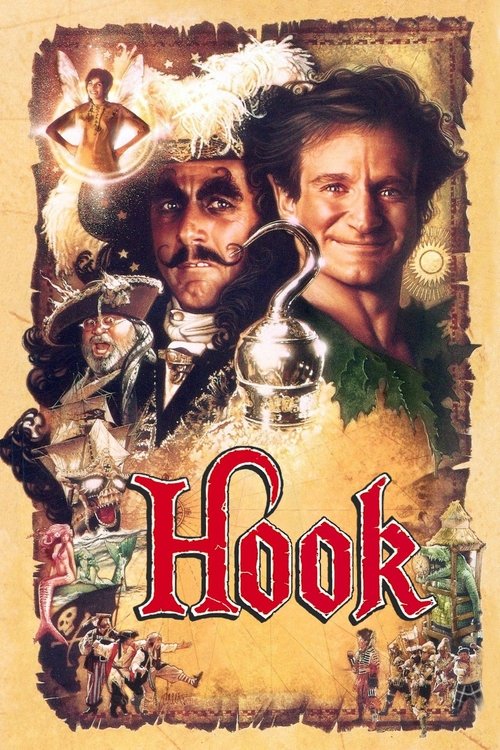
Hook
1991 · Directed by Steven Spielberg
Woke Score
CriticCritic Score
Audience
Ultra Based
Critics rated this 34 points above its woke score. Among Ultra Based films, this critic score ranks #1119 of 1469.
Representation Casting
Score: 8/100
The cast reflects 1991 Hollywood norms with primarily white actors in prominent roles. No intentional diversity or representation efforts are evident, and minority representation is minimal or absent.
LGBTQ+ Themes
Score: 0/100
No LGBTQ+ themes, characters, or representation. The film is heteronormative and treats traditional family structures as the default.
Feminist Agenda
Score: 12/100
Female characters exist primarily in support of male development. Julia Roberts as Tinkerbell is largely decorative, and the wife character accepts her husband's absence without question or agency.
Racial Consciousness
Score: 0/100
No engagement with racial themes or consciousness. The film does not address or acknowledge racial issues in any meaningful way.
Climate Crusade
Score: 0/100
No climate themes or environmental consciousness. The narrative has no concern with environmental issues or sustainability.
Eat the Rich
Score: 25/100
The film critiques corporate workaholism and Peter's lawyer career as emotionally corrupting, but only insofar as it interferes with family. The critique is personal rather than systemic.
Body Positivity
Score: 0/100
No particular engagement with body positivity or acceptance of diverse body types. The film follows conventional Hollywood aesthetics without commentary.
Neurodivergence
Score: 0/100
No representation of or engagement with neurodivergence. Characters do not have disabilities or neurodivergent traits that are acknowledged.
Revisionist History
Score: 0/100
No attempt to revise or reinterpret historical narratives. The film adapts Barrie's original text without interrogating its historical context or assumptions.
Lecture Energy
Score: 20/100
The film has some preachy quality in its emphasis on fatherhood lessons and moral growth, though it pursues these themes through narrative and character rather than explicit commentary.


Synopsis
The boy who wasn't supposed to grow up—Peter Pan—does just that, becoming a soulless corporate lawyer whose workaholism could cost him his wife and kids. During his trip to see Granny Wendy in London, the vengeful Capt. Hook kidnaps Peter's kids and forces Peter to return to Neverland.
Consciousness Assessment
Steven Spielberg's Hook arrives as a film caught between centuries, a lavish production from 1991 that reads as a distinctly pre-woke meditation on masculinity and family obligation. The film's central concern is the redemption of Peter Pan through fatherhood, a narrative thrust that privileges male emotional development and responsibility to the nuclear family unit. Dustin Hoffman's Peter must learn to abandon his corporate selfishness and reconnect with his paternal duties, a moral arc that feels as earnest as it is conventional. The story treats this transformation as something earned through physical combat and emotional authenticity rather than systemic critique.
The film's gender politics operate within a conservative framework despite its elaborate spectacle. Julia Roberts appears as Tinkerbell, a role that amounts to decoration and exposition rather than agency. The female characters exist primarily in relation to male development, whether as wives waiting at home or magical beings facilitating the hero's journey. Wendy, played by Maggie Smith, functions as a repository of wisdom and memory but remains passive. The narrative never questions whether Peter's wife (Caroline Goodall) should tolerate a husband who abandons his family to recapture his youth, instead positioning her acceptance as the appropriate feminine response to male growth.
In terms of representation and diversity, the film reflects 1991 Hollywood casting conventions without apology or complication. The ensemble consists primarily of white actors in a fantasy setting that makes no particular statement about racial consciousness or intentional inclusion. There is no engagement with climate themes, systemic economic critique, or any of the markers that would register as progressive social consciousness in a contemporary context. Hook is a film about learning to be a better father and man, which is a worthwhile theme, but it pursues this goal through entirely traditional storytelling methods and moral frameworks.
Analysis generated by our Consciousness Algorithm
Critic Reviews
“Spielberg and Co. have finally made their Disney movie -- or better yet, their film version of a theme park at Disneyland. It's sort of like "Pirates of the Caribbean" and "It's a Small World" rolled into one. It's a helluva contraption, and certainly one to be marveled at. It gives good ride.”
“It's a lot of fun to watch - over two hours of thrills, spills, elaborate sets and special effects, all tied together by a pleasingly varied (and lighter than usual) musical score by John Williams.”
“Spielberg hooks us again with state-of-the-art craft, the director taps into powerful myths, both primal and pop, and makes them seem new. He allows grownups to return to childhood, but manages to catch fish in all generational waters.”
“Hook touches neither fantasy nor soulfulness nor yearning. Mostly, it's benign spectacle in which the actors keep yielding the camera to some expensive playground or other. Hook is neither wistful nor primal. It's film's most expensive wind-up toy. [11 Dec. 1991. p.53]”
Consciousness Markers
The cast reflects 1991 Hollywood norms with primarily white actors in prominent roles. No intentional diversity or representation efforts are evident, and minority representation is minimal or absent.
No LGBTQ+ themes, characters, or representation. The film is heteronormative and treats traditional family structures as the default.
Female characters exist primarily in support of male development. Julia Roberts as Tinkerbell is largely decorative, and the wife character accepts her husband's absence without question or agency.
No engagement with racial themes or consciousness. The film does not address or acknowledge racial issues in any meaningful way.
No climate themes or environmental consciousness. The narrative has no concern with environmental issues or sustainability.
The film critiques corporate workaholism and Peter's lawyer career as emotionally corrupting, but only insofar as it interferes with family. The critique is personal rather than systemic.
No particular engagement with body positivity or acceptance of diverse body types. The film follows conventional Hollywood aesthetics without commentary.
No representation of or engagement with neurodivergence. Characters do not have disabilities or neurodivergent traits that are acknowledged.
No attempt to revise or reinterpret historical narratives. The film adapts Barrie's original text without interrogating its historical context or assumptions.
The film has some preachy quality in its emphasis on fatherhood lessons and moral growth, though it pursues these themes through narrative and character rather than explicit commentary.