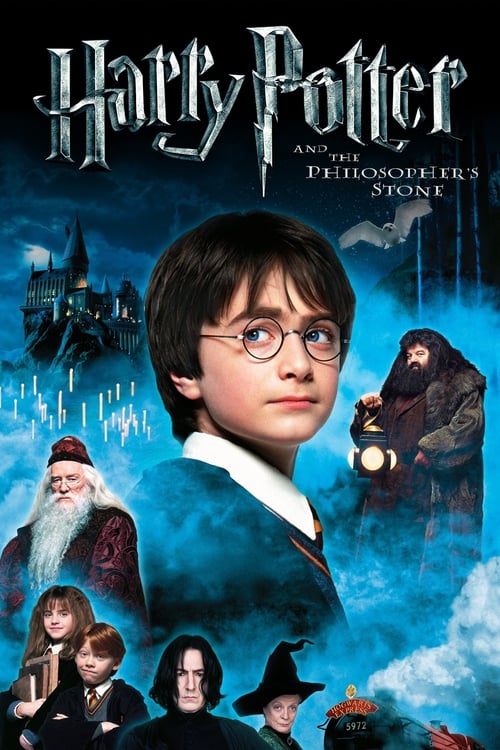
Harry Potter and the Philosopher's Stone
2001 · Directed by Chris Columbus
Ultra Based
Consciousness Score: 8%
Representation Casting
Score: 12/100
The main cast is predominantly white with minimal racial diversity. The supporting cast reflects 2001 mainstream casting norms rather than contemporary representation standards.
LGBTQ+ Themes
Score: 0/100
No LGBTQ+ themes or representation are present in the film. The wizarding world is presented as entirely heteronormative.
Feminist Agenda
Score: 15/100
Hermione Granger exists as an intelligent character but remains secondary to male protagonists. The narrative does not engage with gender as a meaningful category.
Racial Consciousness
Score: 8/100
Racial dynamics are not addressed or interrogated. The wizarding world's hierarchy and structure are presented as natural rather than as systems to be examined.
Climate Crusade
Score: 0/100
Climate or environmental concerns play no role in the narrative whatsoever.
Eat the Rich
Score: 5/100
The film presents wealth and privilege (particularly Harry's sudden access to inherited fortune) as desirable outcomes. No critique of economic systems is offered.
Body Positivity
Score: 0/100
Body diversity or body positivity themes are absent. Characters are presented according to conventional standards without commentary.
Neurodivergence
Score: 0/100
No representation of neurodivergence or neurodivergent characters appears in the film.
Revisionist History
Score: 0/100
The film does not engage in revisionist historical narratives. It presents its fantasy world as internally consistent rather than as commentary on real history.
Lecture Energy
Score: 20/100
The film occasionally features moments of moral instruction, particularly regarding friendship and standing against evil, but these feel organic to the narrative rather than preachy.


Synopsis
Harry Potter has lived under the stairs at his aunt and uncle's house his whole life. But on his 11th birthday, he learns he's a powerful wizard—with a place waiting for him at the Hogwarts School of Witchcraft and Wizardry. As he learns to harness his newfound powers with the help of the school's kindly headmaster, Harry uncovers the truth about his parents' deaths—and about the villain who's to blame.
Consciousness Assessment
Harry Potter and the Philosopher's Stone arrives at a peculiar historical moment for cultural assessment. Released in 2001, it predates the specific constellation of sensibilities that would define modern progressive discourse by roughly a decade and a half. The film is fundamentally a children's adventure fantasy, and it operates within those genre constraints with admirable craft, but it carries almost none of the markers that would characterize contemporary social consciousness.
The film's construction of its world is notably traditional in its approach to gender and diversity. Emma Watson's Hermione Granger is positioned as academically gifted but remains secondary to the male protagonists, a reflection of the source material's era rather than any deliberate modernization. The school's faculty and student body are rendered with little attention to representation beyond what the narrative demands. The wizarding world itself is presented as inherently meritocratic, which is to say that social hierarchy is never interrogated through any contemporary lens. Voldemort's crimes are positioned as personal evil rather than as manifestations of systemic oppression. The film asks us to accept the established order of its universe as natural and correct.
This is not to suggest the film is hostile to progressive values in a pre-2015 sense. It is simply indifferent to the specific forms of social consciousness that would emerge as markers of cultural discourse in the 2020s. It exists in a different era, one in which a children's film could present an entirely white supporting cast and a narrative centered on privilege and institutional belonging without these choices registering as deliberate statements. The film succeeds on its own terms as entertainment, but on the metric of contemporary cultural awareness, it registers as a period piece in the most literal sense.
Analysis generated by our Consciousness Algorithm
Critic Reviews
“It's still a very entertaining and spectacular movie, with a rush of nostalgia to go alongside the exhilaration of fun.”
“Even though a few of the book's scenes have been cut, fans probably couldn't hope for a better adaptation.”
“Chris Columbus' movie is an enchanting classic that does full justice to a story that was a daunting challenge.”
Consciousness Markers
The main cast is predominantly white with minimal racial diversity. The supporting cast reflects 2001 mainstream casting norms rather than contemporary representation standards.
No LGBTQ+ themes or representation are present in the film. The wizarding world is presented as entirely heteronormative.
Hermione Granger exists as an intelligent character but remains secondary to male protagonists. The narrative does not engage with gender as a meaningful category.
Racial dynamics are not addressed or interrogated. The wizarding world's hierarchy and structure are presented as natural rather than as systems to be examined.
Climate or environmental concerns play no role in the narrative whatsoever.
The film presents wealth and privilege (particularly Harry's sudden access to inherited fortune) as desirable outcomes. No critique of economic systems is offered.
Body diversity or body positivity themes are absent. Characters are presented according to conventional standards without commentary.
No representation of neurodivergence or neurodivergent characters appears in the film.
The film does not engage in revisionist historical narratives. It presents its fantasy world as internally consistent rather than as commentary on real history.
The film occasionally features moments of moral instruction, particularly regarding friendship and standing against evil, but these feel organic to the narrative rather than preachy.