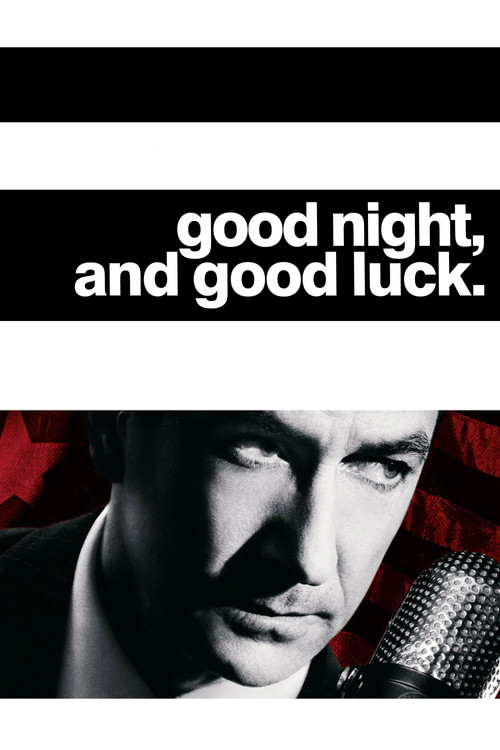
Good Night, and Good Luck.
2005 · Directed by George Clooney
Woke Score
CriticCritic Score
Audience
Ultra Based
Critics rated this 76 points above its woke score. Among Ultra Based films, this critic score ranks #368 of 1469.
Representation Casting
Score: 0/100
The cast is predominantly white men, reflecting the historical reality of 1950s broadcast journalism but showing no evidence of contemporary progressive casting consciousness.
LGBTQ+ Themes
Score: 0/100
No LGBTQ+ themes or representation present in the film.
Feminist Agenda
Score: 0/100
Patricia Clarkson appears in a supporting role, but there is no feminist framework or agenda to the narrative.
Racial Consciousness
Score: 0/100
The film does not address race or demonstrate racial consciousness in any form.
Climate Crusade
Score: 0/100
No climate-related themes or messaging present.
Eat the Rich
Score: 0/100
The film criticizes governmental overreach and authoritarianism, not capitalism or wealth inequality.
Body Positivity
Score: 0/100
No body positivity themes or messaging present.
Neurodivergence
Score: 0/100
No representation of or themes related to neurodivergence.
Revisionist History
Score: 0/100
The film presents a conventional historical account of the McCarthy era without revisionist reframing.
Lecture Energy
Score: 8/100
The film is structured as educational historical drama with significant expository dialogue about journalism ethics and political principles, though presented through dramatic scenes rather than explicit lecture format.


Synopsis
The story of journalist Edward R. Murrow's stand against Senator Joseph McCarthy's anti-communist witch-hunts in the early 1950s.
Consciousness Assessment
George Clooney's directorial debut presents a handsome, black-and-white recreation of Edward R. Murrow's battle against McCarthyism in 1950s television news. The film operates entirely within the grammar of prestige historical drama, treating its subject matter with the solemnity of a museum docent describing a particularly important artifact. David Strathairn gives a competent performance as Murrow, and the supporting ensemble (including Clooney himself and a surprisingly effective Robert Downey Jr.) performs the mechanics of period journalism with appropriate earnestness.
The film's political content centers on defending civil liberties against governmental persecution and the importance of institutional resistance to authoritarian impulses. These are genuinely important themes, and the film treats them seriously. However, these concerns predate modern progressive cultural consciousness by decades. The 1950s anti-communist witch-hunts were opposed by liberals of that era as violations of basic rights and due process, not through the lens of contemporary social justice frameworks. The film presents itself as a straightforward historical account, not as a contemporary political allegory with modern sensibilities embedded in it.
What distinguishes this film from more culturally engaged cinema is its deliberate retreat into historical distance. The black-and-white cinematography, the period-accurate newsroom, the archival footage of McCarthy himself, all create a sense of quarantine around the material. We are invited to admire Murrow's courage as a historical fact, not to see his struggle as a template for present activism or as commentary on current power structures. The film's modest engagement with progressive themes amounts to basic humanist values: institutional integrity, personal courage, and the importance of truth-telling. These are admirable but not contemporary markers of cultural consciousness.
Analysis generated by our Consciousness Algorithm
Critic Reviews
“The biggest little movie of the year - and one of the best ever about the news media.”
“Vividly re- creates TV news icon Edward R. Murrow's historic face-off with Sen. Joseph McCarthy in devastatingly low-key detail -- is the right movie at the right time.”
“It's a passionate, serious, impeccably crafted movie tackling a subject Clooney cares about deeply: the duty of journalism to speak truth to power. It also happens to be the most compelling American movie of the year so far.”
“Clooney has littered his film with such a high quantity of mistakes that it is hard to know where exactly to begin finding fault.”
Consciousness Markers
The cast is predominantly white men, reflecting the historical reality of 1950s broadcast journalism but showing no evidence of contemporary progressive casting consciousness.
No LGBTQ+ themes or representation present in the film.
Patricia Clarkson appears in a supporting role, but there is no feminist framework or agenda to the narrative.
The film does not address race or demonstrate racial consciousness in any form.
No climate-related themes or messaging present.
The film criticizes governmental overreach and authoritarianism, not capitalism or wealth inequality.
No body positivity themes or messaging present.
No representation of or themes related to neurodivergence.
The film presents a conventional historical account of the McCarthy era without revisionist reframing.
The film is structured as educational historical drama with significant expository dialogue about journalism ethics and political principles, though presented through dramatic scenes rather than explicit lecture format.