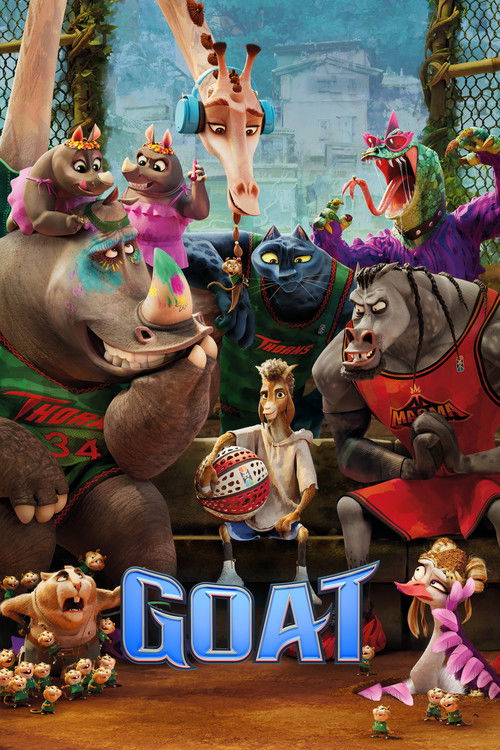
GOAT
2026 · Directed by Tyree Dillihay · $97.4M domestic
Woke Score
CriticCritic Score
Audience
Woke-Adjacent
Critics rated this 16 points above its woke score. Among Woke-Adjacent films, this critic score ranks #99 of 151.
Representation Casting
Score: 72/100
The film features a deliberately diverse voice cast spanning racial and ethnic backgrounds, with prominent roles for Black and Brown actors. Gabrielle Union, Aaron Pierre, and others signal a commitment to inclusive casting beyond tokenism.
LGBTQ+ Themes
Score: 15/100
No substantive LGBTQ+ themes or representation are apparent in available information about the film. The score reflects only the baseline possibility of incidental representation.
Feminist Agenda
Score: 48/100
The film emphasizes a co-ed sport with women competing equally alongside men, and features women in prominent voice roles. However, this appears more structural than thematically interrogated.
Racial Consciousness
Score: 42/100
The diverse casting and ensemble approach suggest racial awareness, but the narrative appears to treat diversity as an aesthetic rather than examining systemic racial dynamics within competitive spaces.
Climate Crusade
Score: 0/100
No evidence of climate consciousness or environmental themes in the film's plot or messaging.
Eat the Rich
Score: 28/100
The film depicts a professional sports league and capitalist competition for athletic success, presented without critique. The underdog narrative emphasizes individual achievement within existing systems.
Body Positivity
Score: 55/100
The concept of animals of all shapes and sizes competing equally suggests some body inclusivity messaging, though it remains at the level of metaphor rather than direct commentary.
Neurodivergence
Score: 0/100
No available information suggests substantive neurodivergent representation or themes in the film.
Revisionist History
Score: 0/100
As a contemporary animated fantasy sports film, GOAT contains no historical content to revise or reinterpret.
Lecture Energy
Score: 35/100
While the film carries motivational messaging about dreams and perseverance, it appears to deliver these themes through narrative rather than preachy exposition, keeping lecture energy relatively subdued.
Synopsis
A small goat with big dreams gets a once-in-a-lifetime shot to join the pros and play roarball, a high-intensity, co-ed, full-contact sport dominated by the fastest, fiercest animals in the world.
Consciousness Assessment
GOAT arrives as a dutiful animated sports film that understands the assignment of contemporary representation without necessarily transcending the formula. The film deploys a deliberately diverse ensemble cast across its animal kingdom roster, with particular attention to featuring women and people of color in prominent roles, though this casting choice operates more as a foundational baseline than as thematic substance. Gabrielle Union's presence signals an intentional commitment to representation in a family entertainment context, and the co-ed nature of the fictional roarball sport provides a surface-level gesture toward gender inclusion within competitive spaces.
The narrative itself, however, remains locked in the familiar underdog-makes-good trajectory that has sustained sports cinema for decades. While the film's thematic messaging around perseverance and self-actualization carries genuine warmth, these sentiments function as humanist values rather than as markers of the specific cultural consciousness one might expect. The sport is inclusive by design (animals of all shapes and sizes compete), yet this inclusivity reads as a metaphorical rather than ideological statement. We are watching a film that has absorbed the visual grammar of progressive representation without necessarily interrogating the systems it depicts or offering critique beyond the motivational.
What distinguishes GOAT's score from the lowest register is its consistent commitment to visual diversity and its apparent disinterest in gatekeeping. The film does not argue that certain bodies or identities are unsuitable for competition. This matters. Yet it falls short of the more pointed social consciousness that would elevate the score further, existing instead as a well-intentioned family film that acknowledges the world as it has shifted without necessarily pushing it forward.
Analysis generated by our Consciousness Algorithm
Critic Reviews
“Goat deals with masculinity, fraternities, and PTSD in equal doses, covering all of them with brutal precision and most importantly, success.”
“Along with an ending that some will find either enigmatic or unsatisfying, the movie could benefit from some minor re-editing. But there’s still much that works here, from the chillingly droning score to a uniformly strong cast.”
“The film is a pointed, astute and unflinching look at unbridled machismo and its consequences.”
“Perhaps it helps to think of Goat as a horror movie. There is a genre of horror film known as torture porn — films that revel in graphic depictions of torture, violence and sadism, mostly to defenseless victims. Think of Goat as hazing porn.”
Consciousness Markers
The film features a deliberately diverse voice cast spanning racial and ethnic backgrounds, with prominent roles for Black and Brown actors. Gabrielle Union, Aaron Pierre, and others signal a commitment to inclusive casting beyond tokenism.
No substantive LGBTQ+ themes or representation are apparent in available information about the film. The score reflects only the baseline possibility of incidental representation.
The film emphasizes a co-ed sport with women competing equally alongside men, and features women in prominent voice roles. However, this appears more structural than thematically interrogated.
The diverse casting and ensemble approach suggest racial awareness, but the narrative appears to treat diversity as an aesthetic rather than examining systemic racial dynamics within competitive spaces.
No evidence of climate consciousness or environmental themes in the film's plot or messaging.
The film depicts a professional sports league and capitalist competition for athletic success, presented without critique. The underdog narrative emphasizes individual achievement within existing systems.
The concept of animals of all shapes and sizes competing equally suggests some body inclusivity messaging, though it remains at the level of metaphor rather than direct commentary.
No available information suggests substantive neurodivergent representation or themes in the film.
As a contemporary animated fantasy sports film, GOAT contains no historical content to revise or reinterpret.
While the film carries motivational messaging about dreams and perseverance, it appears to deliver these themes through narrative rather than preachy exposition, keeping lecture energy relatively subdued.