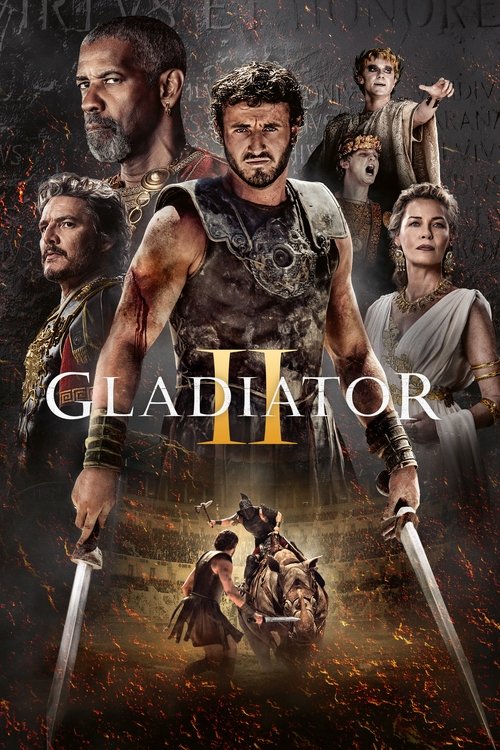
Gladiator II
2024 · Directed by Ridley Scott
Woke Score
CriticCritic Score
Audience
Ultra Based
Critics rated this 56 points above its woke score. Among Ultra Based films, this critic score ranks #784 of 1469.
Representation Casting
Score: 15/100
The film features a racially diverse cast including Denzel Washington and Pedro Pascal in significant roles, reflecting contemporary casting practices. However, this diversity is presented as unremarkable rather than as a deliberate statement of progressive representation politics.
LGBTQ+ Themes
Score: 0/100
No LGBTQ+ themes, characters, or representation are evident in the film. The story focuses entirely on heterosexual male power dynamics and revenge narratives.
Feminist Agenda
Score: 5/100
Female characters exist in the narrative (Connie Nielsen reprises her role) but occupy traditional supporting positions without agency or thematic importance. No feminist consciousness or commentary is present.
Racial Consciousness
Score: 10/100
While the cast includes actors of color in significant roles, the film does not engage in explicit commentary about race or use slavery themes as a lens for contemporary racial politics. The multiethnic casting exists but lacks conscious thematic engagement.
Climate Crusade
Score: 0/100
No climate-related themes, messaging, or environmental consciousness appears in this historical action film set in ancient Rome.
Eat the Rich
Score: 5/100
The film depicts corrupt imperial power and political intrigue, but this reflects timeless themes about tyranny rather than contemporary anti-capitalist critique. No systemic economic analysis or class consciousness is evident.
Body Positivity
Score: 0/100
The film features conventionally fit actors in action roles and contains no body positivity messaging or representation of diverse body types.
Neurodivergence
Score: 0/100
No neurodivergent characters or representation are present in the film.
Revisionist History
Score: 0/100
The film presents a fantastical version of Roman history without attempting to reinterpret historical events through a contemporary progressive lens. It is ahistorical adventure rather than revisionist history with modern consciousness.
Lecture Energy
Score: 0/100
The film contains no preachy dialogue about contemporary social issues, systemic injustice, or moral lessons. It is a straightforward revenge narrative focused on plot mechanics.


Synopsis
Years after witnessing the death of the revered hero Maximus at the hands of his uncle, Lucius is forced to enter the Colosseum after his home is conquered by the tyrannical Emperors who now lead Rome with an iron fist. With rage in his heart and the future of the Empire at stake, Lucius must look to his past to find strength and honor to return the glory of Rome to its people.
Consciousness Assessment
Gladiator II arrives as a competent sequel to a Best Picture winner, which is to say it arrives burdened by impossible expectations and a narrative premise that requires considerable suspension of disbelief. Ridley Scott marshals his considerable technical expertise to deliver spectacle and violence in roughly equal measure, and the film succeeds entirely on those terms. It is a film about swords, sand, and the politics of imperial Rome, concerns that have remained largely consistent since 79 AD.
The cast is notably diverse, with Denzel Washington serving as the film's most commanding presence as Macrinus, a scheming power broker operating within Rome's ruthless power structures. This diversity reads as incidental rather than intentional, which is to say the film treats its multiethnic Rome as an unremarkable fact rather than as a statement of contemporary consciousness. Paul Mescal carries the lead role with adequate brooding intensity, though the screenplay provides him little opportunity for complexity. The supporting cast functions competently within the boundaries of their archetypal roles.
What emerges from Gladiator II is a film content to be a film, uninterested in contemporary debates about representation, gender, climate, or systemic power. It is neither progressive nor regressive, merely indifferent to such classifications. One watches it for the combat choreography and the production design, not for moral clarity or cultural commentary. In this respect, it represents a kind of refreshing minimalism, though whether that constitutes a virtue depends entirely on one's appetite for spectacle divorced from significance.
Analysis generated by our Consciousness Algorithm
Critic Reviews
“As with its predecessor, what elevates Gladiator II in the cinematic arena is the ways its themes and dialogue underpin its outrageous spectacle. David Scarpa's script is also fiercely intelligent.”
“The film is long, a shade under two and a half hours, but Scott knows how to pace things so they don’t drag. ”
“Like Scott’s filmmaking in this pleasurably immersive spectacle — with its foreign ancients and mentalities, exotic animals and equally unfamiliar calls to human nobility — Washington’s performance has skill, intensity and absolute confidence.”
“At nearly 2½ hours, the movie is fun to watch until it’s not, and then it becomes a chore.”
Consciousness Markers
The film features a racially diverse cast including Denzel Washington and Pedro Pascal in significant roles, reflecting contemporary casting practices. However, this diversity is presented as unremarkable rather than as a deliberate statement of progressive representation politics.
No LGBTQ+ themes, characters, or representation are evident in the film. The story focuses entirely on heterosexual male power dynamics and revenge narratives.
Female characters exist in the narrative (Connie Nielsen reprises her role) but occupy traditional supporting positions without agency or thematic importance. No feminist consciousness or commentary is present.
While the cast includes actors of color in significant roles, the film does not engage in explicit commentary about race or use slavery themes as a lens for contemporary racial politics. The multiethnic casting exists but lacks conscious thematic engagement.
No climate-related themes, messaging, or environmental consciousness appears in this historical action film set in ancient Rome.
The film depicts corrupt imperial power and political intrigue, but this reflects timeless themes about tyranny rather than contemporary anti-capitalist critique. No systemic economic analysis or class consciousness is evident.
The film features conventionally fit actors in action roles and contains no body positivity messaging or representation of diverse body types.
No neurodivergent characters or representation are present in the film.
The film presents a fantastical version of Roman history without attempting to reinterpret historical events through a contemporary progressive lens. It is ahistorical adventure rather than revisionist history with modern consciousness.
The film contains no preachy dialogue about contemporary social issues, systemic injustice, or moral lessons. It is a straightforward revenge narrative focused on plot mechanics.