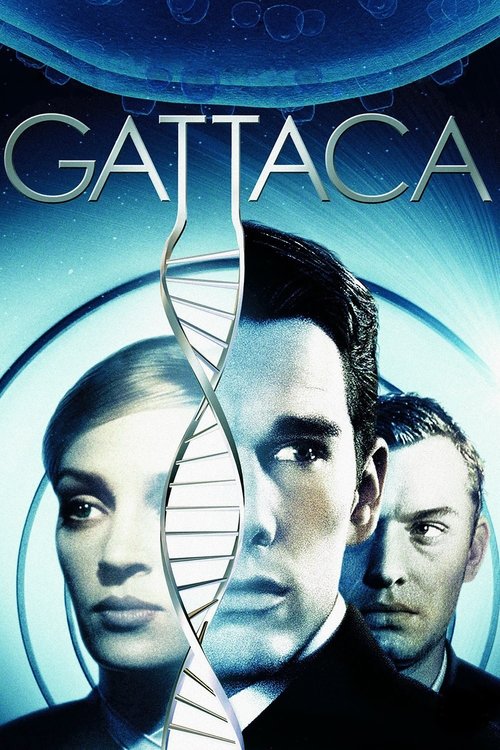
Gattaca
1997 · Directed by Andrew Niccol
Woke Score
CriticCritic Score
Audience
Ultra Based
Critics rated this 46 points above its woke score. Among Ultra Based films, this critic score ranks #806 of 1469.
Representation Casting
Score: 15/100
The cast is predominantly white with minimal representation of people of color beyond tokenistic appearances. Blair Underwood has a minor role, but central positions of authority and narrative focus remain uniformly pale.
LGBTQ+ Themes
Score: 0/100
No LGBTQ+ themes, characters, or subtext present in the film. The romantic storyline is exclusively heterosexual.
Feminist Agenda
Score: 5/100
Uma Thurman's character Irene is a love interest whose agency is limited to supporting the male protagonist's narrative. She is not developed as an independent character with her own arc or perspective.
Racial Consciousness
Score: 0/100
The film contains no racial consciousness or engagement with race as a social category. Discrimination in the film is about genetic status, not race, and the film never explores how these systems might intersect.
Climate Crusade
Score: 0/100
No climate or environmental themes are present in the film's narrative or visual language.
Eat the Rich
Score: 20/100
The film critiques meritocratic corporate systems and genetic discrimination as tools of social control, but does not articulate anti-capitalist ideology. The critique remains individualist rather than systemic.
Body Positivity
Score: 0/100
The film's entire premise is built on genetic perfectionism and physical hierarchy. Vincent's natural body is positioned as inferior, and the narrative celebrates transcending bodily limitations through deception rather than acceptance.
Neurodivergence
Score: 25/100
Vincent's genetic status could be read as a metaphor for neurodivergence or disability, and the film implicitly critiques ableist systems. However, this is never explicitly articulated, and the film does not center neurodivergent perspectives or voices.
Revisionist History
Score: 0/100
The film is set in a fictional dystopian future and contains no historical revisionism or reframing of actual historical events.
Lecture Energy
Score: 10/100
While the film has thematic depth, it presents its ideas through narrative and character action rather than explicit exposition or preachy dialogue. The lecture energy is minimal.


Synopsis
Vincent is an all-too-human man who dares to defy a system obsessed with genetic perfection. He is an "In-Valid" who assumes the identity of a member of the genetic elite to pursue his goal of traveling into space with the Gattaca Aerospace Corporation.
Consciousness Assessment
Gattaca arrives as a curious temporal artifact, a 1997 meditation on systemic discrimination that predates contemporary social consciousness frameworks by decades. The film's central premise, a dystopia organized around genetic hierarchy, functions as a metaphorical critique of discrimination, though one grounded in the language of science fiction rather than identity politics. Vincent's struggle against genetic determinism contains echoes of disability advocacy and anti-ableist thinking, yet the film never explicitly frames this discourse in modern progressive vocabulary. The narrative itself remains fundamentally humanist in its appeal: a story about an underdog overcoming unjust systems through determination and heart.
What limits Gattaca's contemporary woke credentials is its essential apoliticism. The film critiques systemic oppression without naming it as such, and crucially, it never centers marginalized voices or perspectives. Vincent, our protagonist and guide through this discriminatory world, is portrayed by Ethan Hawke as an unmarked, sympathetic everyman. The film's vision of injustice is abstract and philosophical rather than grounded in the specific experiences of actually marginalized communities. There are no conversations about identity, no moments where the system's victims speak to their own oppression with cultural awareness. The romantic subplot with Uma Thurman's character Irene similarly avoids any contemporary progressive framing, instead positioning their relationship as a timeless love story that transcends circumstance.
The film's representation casting is uniformly pale and unremarkable for a major studio production of the 1990s. Blair Underwood appears briefly in a minor role, but the film's central power structures, corporate hierarchies, and narrative focus remain whitewashed. Gattaca is ultimately a parable about merit and human spirit, themes that predate modern progressive sensibilities by generations. It is important cinema about discrimination, but it is not progressive cinema in the contemporary sense. A genuinely contemporary retelling of this story would interrogate power structures explicitly, center the voices of the genetically "invalid," and complicate Vincent's individual triumph with systemic critique. This film does none of those things.
Analysis generated by our Consciousness Algorithm
Critic Reviews
“A handsome and fully imagined work of cautionary futuristic fiction.”
“Niccol's futuristic fable is a gorgeous construct, from its cast on down to the brilliant, clinical nature of the set design that reflects a future in which even a particle of saliva can be one's undoing.”
“This is one of the smartest and most provocative of science fiction films, a thriller with ideas.”
“The moody images and Michael Nyman's score aren't enough to salvage this banal 1997 science fiction story.”
Consciousness Markers
The cast is predominantly white with minimal representation of people of color beyond tokenistic appearances. Blair Underwood has a minor role, but central positions of authority and narrative focus remain uniformly pale.
No LGBTQ+ themes, characters, or subtext present in the film. The romantic storyline is exclusively heterosexual.
Uma Thurman's character Irene is a love interest whose agency is limited to supporting the male protagonist's narrative. She is not developed as an independent character with her own arc or perspective.
The film contains no racial consciousness or engagement with race as a social category. Discrimination in the film is about genetic status, not race, and the film never explores how these systems might intersect.
No climate or environmental themes are present in the film's narrative or visual language.
The film critiques meritocratic corporate systems and genetic discrimination as tools of social control, but does not articulate anti-capitalist ideology. The critique remains individualist rather than systemic.
The film's entire premise is built on genetic perfectionism and physical hierarchy. Vincent's natural body is positioned as inferior, and the narrative celebrates transcending bodily limitations through deception rather than acceptance.
Vincent's genetic status could be read as a metaphor for neurodivergence or disability, and the film implicitly critiques ableist systems. However, this is never explicitly articulated, and the film does not center neurodivergent perspectives or voices.
The film is set in a fictional dystopian future and contains no historical revisionism or reframing of actual historical events.
While the film has thematic depth, it presents its ideas through narrative and character action rather than explicit exposition or preachy dialogue. The lecture energy is minimal.