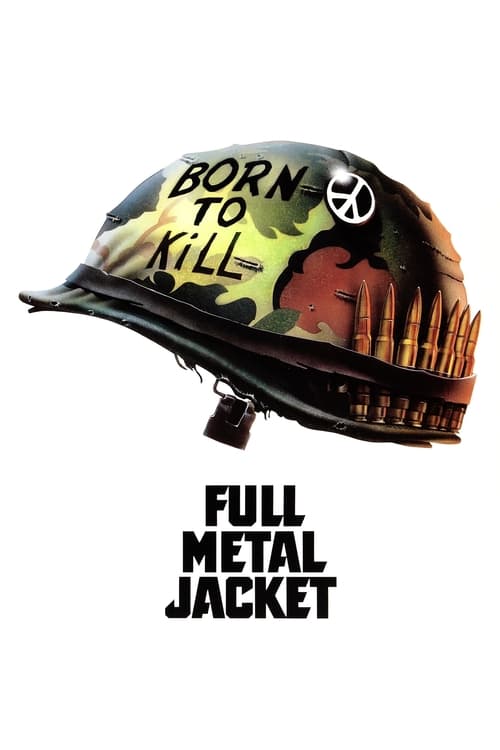
Full Metal Jacket
1987 · Directed by Stanley Kubrick
Woke Score
CriticCritic Score
Audience
Ultra Based
Critics rated this 74 points above its woke score. Among Ultra Based films, this critic score ranks #426 of 1469.
Representation Casting
Score: 5/100
The film features Dorian Harewood as a Black Marine, but the cast remains predominantly white and male. The creative decision-makers were entirely white men, and the film does not engage with representation as a thematic concern.
LGBTQ+ Themes
Score: 0/100
No LGBTQ+ characters, themes, or storylines present in the film.
Feminist Agenda
Score: 0/100
The film is notable for its limited female presence and misogynistic framing. The only significant female character, a Vietnamese sniper, is presented as a threat rather than a complex person. No feminist themes are explored.
Racial Consciousness
Score: 2/100
While Harewood's character appears in the narrative, the film does not meaningfully explore race or racism. Vietnamese people are depicted through an American-centric lens without nuance or complexity.
Climate Crusade
Score: 0/100
No climate-related themes, messaging, or environmental consciousness present in the film.
Eat the Rich
Score: 3/100
The film critiques militarism and the machinery of war as an institution, but this is framed as anti-war sentiment rather than anti-capitalist critique. No systemic economic analysis present.
Body Positivity
Score: 0/100
The film emphasizes physical conditioning, military uniformity, and bodily discipline. No body diversity or body positivity messaging is present.
Neurodivergence
Score: 0/100
No representation of or engagement with neurodivergent characters or experiences in the film.
Revisionist History
Score: 0/100
The film is based on true events and offers a critical perspective on the Vietnam War, but it does not reframe historical events through a modern social justice lens.
Lecture Energy
Score: 2/100
While Gunnery Sergeant Hartman delivers intense monologues, these emerge organically from the narrative rather than as external lectures. The film shows dehumanization rather than explaining it.


Synopsis
A pragmatic U.S. Marine observes the dehumanizing effects the U.S.-Vietnam War has on his fellow recruits from their brutal boot camp training to the bloody street fighting in Hue.
Consciousness Assessment
Full Metal Jacket arrives as a relic of 1980s sensibilities, a film whose cultural moment has definitively passed. Kubrick's unflinching examination of military dehumanization and the machinery of war remains intellectually rigorous and cinematically commanding, yet the film operates entirely within a pre-2015 framework of social consciousness. The narrative concerns itself with the transformation of young men into killers and the absurdity of combat, questions of genuine moral weight that do not require modern progressive markers to retain their power.
The film's deficiencies become apparent when examined through contemporary frameworks. The Vietnamese are rendered as faceless antagonists, the female sniper reduced to a symbol of threat rather than a human being with interiority. The creative infrastructure, from Kubrick through the writing and production, consisted entirely of white men, a fact that shapes every frame. The cast, while featuring Dorian Harewood in a supporting role, does not center or interrogate questions of racial experience within the military apparatus. These are not flaws in the film's anti-war message, but rather limitations of its historical moment.
The dehumanization depicted is real, the critique valid, the execution masterful. Yet none of this translates to the particular constellation of progressive sensibilities that define modern cultural awareness. Full Metal Jacket remains an important war film, a meditation on how societies transform civilians into instruments of death. It simply does not speak in the language of 2020s social consciousness.
Analysis generated by our Consciousness Algorithm
Critic Reviews
“Elliptical, full of subtle inner rhymes...and profoundly moving, this is the most tightly crafted Kubrick film since "Dr. Strangelove," as well as the most horrific; the first section alone accomplishes most of what "The Shining" failed to do.”
“As brutally unsparing as "Platoon" was, it was ultimately warm and embracing. Kubrick's film is about as embracing as a full-metal-jacketed bullet in the gut. [29 June 1987]”
“Kubrick's harrowing, beautiful and characteristically eccentric new film about Vietnam, is going to puzzle, anger and (I hope) fascinate audiences as much as any film he has made to date... A film of immense and very rare imagination.”
“What happened to the Kubrick who used to slip in sly, subtle jokes and little editing tricks? This may be his worst movie. He probably believes he's numbing us by the power of his vision, but he's actually numbing us by its emptiness. [13 July 1987, p.75]”
Consciousness Markers
The film features Dorian Harewood as a Black Marine, but the cast remains predominantly white and male. The creative decision-makers were entirely white men, and the film does not engage with representation as a thematic concern.
No LGBTQ+ characters, themes, or storylines present in the film.
The film is notable for its limited female presence and misogynistic framing. The only significant female character, a Vietnamese sniper, is presented as a threat rather than a complex person. No feminist themes are explored.
While Harewood's character appears in the narrative, the film does not meaningfully explore race or racism. Vietnamese people are depicted through an American-centric lens without nuance or complexity.
No climate-related themes, messaging, or environmental consciousness present in the film.
The film critiques militarism and the machinery of war as an institution, but this is framed as anti-war sentiment rather than anti-capitalist critique. No systemic economic analysis present.
The film emphasizes physical conditioning, military uniformity, and bodily discipline. No body diversity or body positivity messaging is present.
No representation of or engagement with neurodivergent characters or experiences in the film.
The film is based on true events and offers a critical perspective on the Vietnam War, but it does not reframe historical events through a modern social justice lens.
While Gunnery Sergeant Hartman delivers intense monologues, these emerge organically from the narrative rather than as external lectures. The film shows dehumanization rather than explaining it.