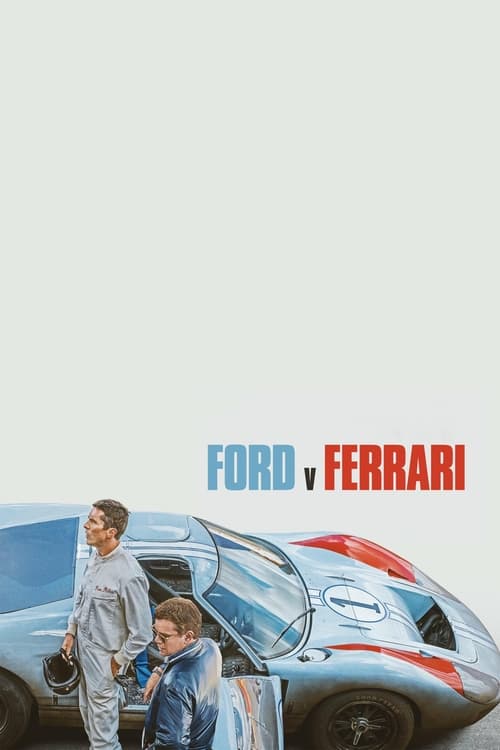
Ford v Ferrari
2019 · Directed by James Mangold
Woke Score
CriticCritic Score
Audience
Ultra Based
Critics rated this 77 points above its woke score. Among Ultra Based films, this critic score ranks #331 of 1469.
Representation Casting
Score: 5/100
The cast is predominantly white and male. Caitríona Balfe appears as Ken Miles' wife but is confined to supporting scenes that emphasize her role as emotional anchor rather than fully realized character.
LGBTQ+ Themes
Score: 0/100
No LGBTQ+ representation, themes, or content appears in the film.
Feminist Agenda
Score: 0/100
Female characters exist peripherally to support the male narrative and provide domestic grounding. No feminist critique or consciousness is present.
Racial Consciousness
Score: 0/100
Set in 1966 America, the film entirely sidesteps racial dimensions of the era and presents a sanitized, race-neutral version of history.
Climate Crusade
Score: 0/100
The film celebrates high-performance automobiles and American manufacturing with no climate consciousness or environmental awareness.
Eat the Rich
Score: 0/100
The narrative is fundamentally pro-corporate and pro-capitalist, valorizing entrepreneurial drive and depicting Ford Motor Company sympathetically.
Body Positivity
Score: 0/100
No engagement with body image or body positivity themes.
Neurodivergence
Score: 0/100
No representation of or thematic engagement with neurodivergence.
Revisionist History
Score: 0/100
The film takes dramatic liberties but does not engage in progressive reinterpretation of history, instead offering straightforward historical dramatization.
Lecture Energy
Score: 0/100
The film tells its story without preachy moral messaging or attempts to instruct the audience about social issues.


Synopsis
American car designer Carroll Shelby and the British-born driver Ken Miles work together to battle corporate interference, the laws of physics, and their own personal demons to build a revolutionary race car for Ford Motor Company and take on the dominating race cars of Enzo Ferrari at the 24 Hours of Le Mans in France in 1966.
Consciousness Assessment
Ford v Ferrari is a film of considerable technical achievement that exists in a carefully maintained bubble of historical irrelevance. The narrative focuses exclusively on the personal drama between two white men competing to build a faster car, with the social upheaval of 1966 America rendered completely invisible. Caitríona Balfe and other female characters serve decorative functions, present primarily to express concern or provide domestic texture. The film celebrates corporate ambition, American manufacturing prowess, and the triumph of individual will over institutional resistance, never pausing to interrogate whether such interrogation might be warranted.
The film's relationship to history is fundamentally uninterested in complication. Set during the height of the civil rights era and the Vietnam War, it presents American society as an uncomplicated backdrop for masculine achievement. Shelby and Miles overcome obstacles through talent and determination, but those obstacles are entirely interpersonal or technical rather than structural. No awareness of the broader historical moment intrudes upon the narrative. The film operates as pure entertainment, a streamlined drama about competition and friendship that could have been set in any decade without significant alteration.
This is not a condemnation. The film succeeds brilliantly at what it attempts, which is to tell a gripping story about two men building a race car. It simply makes no attempt to engage with the contemporary moment through any framework of progressive consciousness. It is a film that exists outside such considerations entirely, which is precisely the point. One watches it and finds no lecture, no diversity quota, no climate messaging, no ideological content whatsoever. It is a historical drama in the classical sense, indifferent to the demands of modern cultural awareness.
Analysis generated by our Consciousness Algorithm
Critic Reviews
“The chemistry between Bale and Damon is what makes the movie move the way it does, along with the script. Bale alone in the race car figuring out how to win and survive is where the film really sings.”
“It stands with the greatest racing movies ever, and it’s certainly the most entertaining. But there is no doubt about one last superlative. Ford v Ferrari is one of the best pictures of the year.”
“Ultimately, Ford v Ferrari is about art versus commerce, devotion versus cynicism, and inspiration versus deadness. It’s one of the year’s great films, and of all the great films so far, the most accessible.”
“It is crammed with unearned emotional moments and factory-built male characters whose dedication to their sport we are expected to find adorable and heroic by turns.”
Consciousness Markers
The cast is predominantly white and male. Caitríona Balfe appears as Ken Miles' wife but is confined to supporting scenes that emphasize her role as emotional anchor rather than fully realized character.
No LGBTQ+ representation, themes, or content appears in the film.
Female characters exist peripherally to support the male narrative and provide domestic grounding. No feminist critique or consciousness is present.
Set in 1966 America, the film entirely sidesteps racial dimensions of the era and presents a sanitized, race-neutral version of history.
The film celebrates high-performance automobiles and American manufacturing with no climate consciousness or environmental awareness.
The narrative is fundamentally pro-corporate and pro-capitalist, valorizing entrepreneurial drive and depicting Ford Motor Company sympathetically.
No engagement with body image or body positivity themes.
No representation of or thematic engagement with neurodivergence.
The film takes dramatic liberties but does not engage in progressive reinterpretation of history, instead offering straightforward historical dramatization.
The film tells its story without preachy moral messaging or attempts to instruct the audience about social issues.