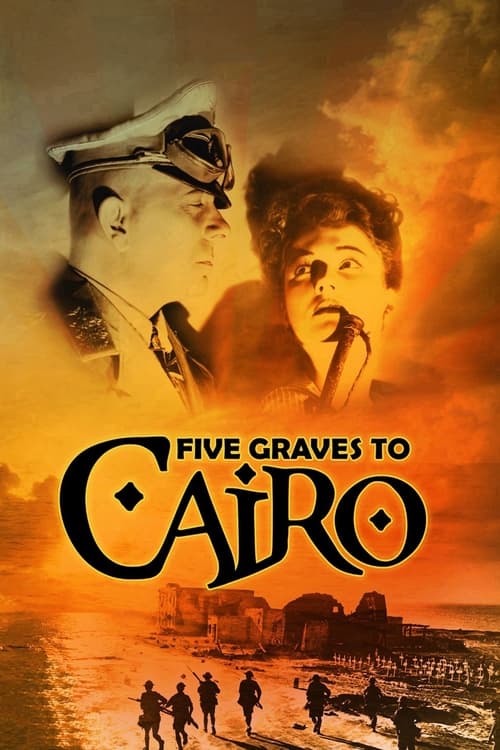
Five Graves to Cairo
1943 · Directed by Billy Wilder
Ultra Based
Consciousness Score: 2%
Representation Casting
Score: 0/100
The cast is entirely white with no apparent consideration for diverse representation. Casting appears based solely on availability and star power of the era.
LGBTQ+ Themes
Score: 0/100
No LGBTQ+ themes, characters, or subtext appear in the film. The narrative is entirely heterosexual in its romantic and social dimensions.
Feminist Agenda
Score: 0/100
Anne Baxter's character exists purely as a romantic interest with no agency or voice. There is no feminist consciousness or examination of gender roles.
Racial Consciousness
Score: 0/100
The film contains no engagement with racial themes or consciousness. Characters exist without reference to race as a social category.
Climate Crusade
Score: 0/100
There is no environmental messaging or climate consciousness. The desert setting is purely a backdrop for military action.
Eat the Rich
Score: 0/100
No anti-capitalist sentiment or critique of economic systems appears in the narrative. The film accepts the existing social order without question.
Body Positivity
Score: 0/100
Body positivity discourse is entirely absent. Characters are presented according to conventional Hollywood standards of the era with no commentary.
Neurodivergence
Score: 0/100
There is no representation of or engagement with neurodivergence. No characters display or are identified with any neurodivergent conditions.
Revisionist History
Score: 0/100
The film presents historical events in straightforward wartime narrative form without attempting to revise or reexamine historical understanding.
Lecture Energy
Score: 2/100
The film contains minimal preachy content, though its basic wartime message that British soldiers are resourceful and Germans are enemies constitutes a light pedagogical element.


Synopsis
During the 1942 North African campaign, a British straggler passes as a waiter at the hotel commandeered as Erwin Rommel's headquarters. He has thoughts of assassinating Rommel but his cover may provide an even better use.
Consciousness Assessment
Five Graves to Cairo stands as a perfectly serviceable wartime thriller, the kind of picture one might catch on a Saturday afternoon with no particular expectations of social consciousness. Produced during the height of World War II, the film concerns itself with military espionage and masculine heroics rather than the messy business of cultural awareness. Billy Wilder directs with professional competence, delivering a narrative that moves efficiently from one plot point to the next without lingering on anything resembling social commentary.
The cast performs its duties adequately within a conventional framework. Franchot Tone carries the film as a resourceful British soldier, while Anne Baxter provides romantic interest without any suggestion that her character might possess agency or voice beyond her function in the plot. The supporting cast of German officers, including Erich von Stroheim, are presented as military antagonists rather than subjects of any deeper examination. No one in this film appears particularly concerned with representation, diversity, or any progressive sensibility beyond the basic patriotic impulse to see the Allies prevail.
The film's complete absence of social consciousness is not a failing so much as a period artifact. It represents the entertainment values of 1943 without apology or self-awareness. There is no attempt to grapple with gender, race, class, or any other marker of modern progressive sensibility. What we encounter is straightforward escapism, the cinematic equivalent of a well-executed military maneuver. In this sense, it succeeds entirely on its own modest terms.
Analysis generated by our Consciousness Algorithm
Consciousness Markers
The cast is entirely white with no apparent consideration for diverse representation. Casting appears based solely on availability and star power of the era.
No LGBTQ+ themes, characters, or subtext appear in the film. The narrative is entirely heterosexual in its romantic and social dimensions.
Anne Baxter's character exists purely as a romantic interest with no agency or voice. There is no feminist consciousness or examination of gender roles.
The film contains no engagement with racial themes or consciousness. Characters exist without reference to race as a social category.
There is no environmental messaging or climate consciousness. The desert setting is purely a backdrop for military action.
No anti-capitalist sentiment or critique of economic systems appears in the narrative. The film accepts the existing social order without question.
Body positivity discourse is entirely absent. Characters are presented according to conventional Hollywood standards of the era with no commentary.
There is no representation of or engagement with neurodivergence. No characters display or are identified with any neurodivergent conditions.
The film presents historical events in straightforward wartime narrative form without attempting to revise or reexamine historical understanding.
The film contains minimal preachy content, though its basic wartime message that British soldiers are resourceful and Germans are enemies constitutes a light pedagogical element.