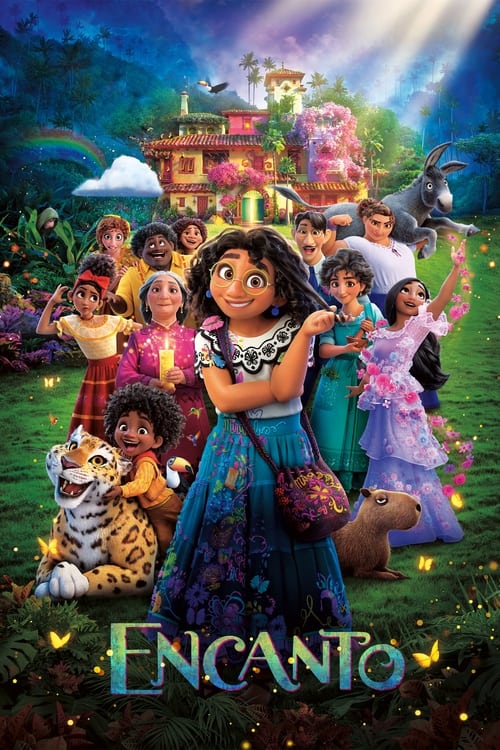
Encanto
2021 · Directed by Byron Howard
Woke Score
Critic Score
Woke
Critics rated this 7 points above its woke score. Among Woke films, this critic score ranks #45 of 57.
Representation Casting
Score: 85/100
The entire cast is Latinx with significant cultural specificity in names, accents, and cultural details. The film centers Colombian culture and magical realism as a primary aesthetic rather than as exoticized backdrop.
LGBTQ+ Themes
Score: 0/100
No explicit LGBTQ+ themes or characters. The film contains no same-sex relationships or queer representation of any kind.
Feminist Agenda
Score: 65/100
The protagonist is female and the narrative centers on female agency and rejecting familial pressure. However, the feminism is individualistic rather than structural, focusing on personal acceptance rather than challenging systemic gender dynamics.
Racial Consciousness
Score: 50/100
The film celebrates Colombian culture through music, architecture, and family dynamics, but does not engage with racial consciousness in a critical sense. Representation is aesthetic rather than interrogative.
Climate Crusade
Score: 0/100
No environmental themes or climate consciousness present in the narrative. The magical world exists outside any material relationship to environmental concerns.
Eat the Rich
Score: 10/100
The film contains no critique of capitalism or wealth inequality. The family's magical house and abilities are presented as personal blessings rather than resources that raise questions about distribution or justice.
Body Positivity
Score: 40/100
The film features characters of varying body types, but body positivity is not a thematic concern. Body diversity exists incidentally rather than as a deliberate statement about beauty standards.
Neurodivergence
Score: 20/100
Mirabel's experience of not fitting in could be read as neurodivergent alienation, but the film does not explicitly engage with neurodiversity or disability representation.
Revisionist History
Score: 5/100
The film contains no historical content or revisionist history. It exists in a magical, ahistorical space divorced from Colombia's actual political and colonial history.
Lecture Energy
Score: 35/100
The film communicates its themes through character arcs and emotional moments rather than explicit messaging. However, the resolution involves a family conversation about generational trauma that borders on therapeutic exposition.


Synopsis
The tale of an extraordinary family, the Madrigals, who live hidden in the mountains of Colombia, in a magical house, in a vibrant town, in a wondrous, charmed place called an Encanto. The magic of the Encanto has blessed every child in the family—every child except one, Mirabel. But when she discovers that the magic surrounding the Encanto is in danger, Mirabel decides that she, the only ordinary Madrigal, might just be her exceptional family's last hope.
Consciousness Assessment
Encanto arrives as a meticulously calibrated instrument of contemporary cultural representation, a film so attuned to the frequencies of modern progressive sensibility that one might suspect it was assembled in a laboratory rather than emerged from the traditional Disney pipeline. The casting is entirely Latinx, the narrative centers on female agency and family dysfunction rather than romantic conquest, and the film dedicates considerable screen time to unpacking generational trauma, maternal pressure, and the pathology of perfectionism. These are not incidental flourishes. They are the skeleton of the story itself.
The film's approach to representation, however, demonstrates a certain strategic calculation that prevents it from achieving a higher score. Encanto does not interrogate structural inequality or systemic oppression in any meaningful way. The magic family's isolation is presented as charming rather than suggestive of marginalization. The film's feminism is present but not particularly aggressive, centering on individual self-acceptance rather than challenging patriarchal structures. The music, despite its cultural specificity, operates within the Disney formula of emotional catharsis through song. There is no material critique here, no examination of colonialism or economic exploitation, no acknowledgment that the Madrigals exist in a specific geopolitical context with a history.
What we have instead is a film that deploys the aesthetics and emotional vocabulary of progressive culture without the ideological teeth. It is competent, charming, and sufficiently conscious of contemporary social sensibilities to avoid offense. It represents a particular moment in corporate cultural production where diversity and representation became a selling point rather than an afterthought. The film is, in its own way, perfectly calibrated for its moment: progressive enough to feel meaningful, safe enough to generate no serious controversy, and entertaining enough that one's children will watch it repeatedly while the parents nod along, satisfied that they have exposed their offspring to appropriate cultural values.
Analysis generated by our Consciousness Algorithm
Critic Reviews
“Surface Pressure unlocked the movie for me and made it more compelling than what I thought it would be.”
“Miranda gives this Oscar favorite a heart that sings and a spirit that soars.”
“Story of a magical house and family in Colombia is a glorious celebration of kindness and everyday life.”
“A heartfelt watch that families will undoubtedly latch onto.”
“This whimsical dose of magic realism set amid the lush greenery of the Colombian mountains benefits as much from the purity of the storytelling as the stunning vibrancy of the visuals.”
“The computer animation, some of the best from any major studio in the last several years, presents a dazzling confabulation of hues and a meticulous weaving of precious details.”
Consciousness Markers
The entire cast is Latinx with significant cultural specificity in names, accents, and cultural details. The film centers Colombian culture and magical realism as a primary aesthetic rather than as exoticized backdrop.
No explicit LGBTQ+ themes or characters. The film contains no same-sex relationships or queer representation of any kind.
The protagonist is female and the narrative centers on female agency and rejecting familial pressure. However, the feminism is individualistic rather than structural, focusing on personal acceptance rather than challenging systemic gender dynamics.
The film celebrates Colombian culture through music, architecture, and family dynamics, but does not engage with racial consciousness in a critical sense. Representation is aesthetic rather than interrogative.
No environmental themes or climate consciousness present in the narrative. The magical world exists outside any material relationship to environmental concerns.
The film contains no critique of capitalism or wealth inequality. The family's magical house and abilities are presented as personal blessings rather than resources that raise questions about distribution or justice.
The film features characters of varying body types, but body positivity is not a thematic concern. Body diversity exists incidentally rather than as a deliberate statement about beauty standards.
Mirabel's experience of not fitting in could be read as neurodivergent alienation, but the film does not explicitly engage with neurodiversity or disability representation.
The film contains no historical content or revisionist history. It exists in a magical, ahistorical space divorced from Colombia's actual political and colonial history.
The film communicates its themes through character arcs and emotional moments rather than explicit messaging. However, the resolution involves a family conversation about generational trauma that borders on therapeutic exposition.