Emerald ▣
2025 · Directed by Andrew Burke
Peak Woke
Consciousness Score: 82%
Representation Casting
Score: 50/100
The work features credited performers but operates as video art installation rather than narrative cinema. Representation functions through archival footage and documented participants rather than traditional character casting.
LGBTQ+ Themes
Score: 95/100
The entire work centers on LGBTQ+ cultural history, specifically invoking Emerald City TV, a foundational gay television program, alongside experimental queer cinema (Genet) and queer labor documentation. This is the core organizing principle of the work.
Feminist Agenda
Score: 40/100
While the work engages with labor struggle and institutional critique, there is no explicit feminist content or women-centered narrative. The feminist dimensions are implicit in the labor politics rather than foregrounded.
Racial Consciousness
Score: 35/100
The work does not explicitly address racial dynamics or feature racial consciousness as a primary concern. The focus remains on queer cultural history and labor struggle without racial analysis.
Climate Crusade
Score: 0/100
There is no climate content or environmental consciousness present in this work. The focus is historical and archival rather than ecological.
Eat the Rich
Score: 75/100
The work explicitly juxtaposes community cultural production with commercial media and mall construction documentation, critiquing the displacement of queer spaces by consumer capitalism. The title itself references 'Gay Capitalism' as something to escape.
Body Positivity
Score: 25/100
While the work includes bodies (the mylar-clad figure, archival performers), body positivity is not a thematic concern. The bodies function as historical documents rather than sites of celebration or affirmation.
Neurodivergence
Score: 5/100
There is no engagement with neurodivergence or disability representation in this work. The focus remains on queer history and media archivalism.
Revisionist History
Score: 60/100
The work engages in historical reclamation and archival recovery of marginalized queer cultural production, though it does not explicitly revise dominant historical narratives so much as surface suppressed ones.
Lecture Energy
Score: 30/100
While the work is conceptually dense and requires interpretive labor from viewers, it does not adopt a didactic or pedagogical tone. It presents materials without explicit explanation or moral instruction.
Synopsis
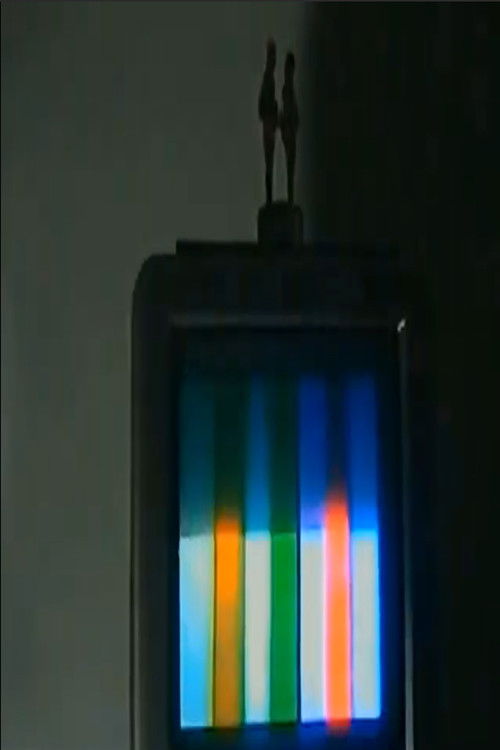
A continuously running installation of two video monitors on pedestals, overlooked by a green Kit-Cat clock. A small and large monitor display two different video collages of footage from the Emerald Square Mall and the strike during its 1989 construction with interferences of Channel J's Emerald City TV (1976-1979): the self-proclaimed "world's first television show for gay men and women", Huge Video's Heat in the Night (1989), Genet's Un Chant D'Amour (1950), cigarette commercials, The Wizard of Oz, and a performance of a mylar-clad figure wrapping up the television in videotape.
Consciousness Assessment
Emerald ▣ functions as a relentless archive of queer cultural memory, layering archival footage from Emerald City TV (1976-1979), the pioneering cable access show that claimed the title of first television program by and for gay men and women, with documentation of the 1989 Emerald Square Mall construction strike and experimental cinema including Jean Genet's Un Chant D'Amour. Burke's installation does not offer analysis or commentary in any traditional sense. Rather, it presents a densely collaged temporal collapse where cigarette commercials, The Wizard of Oz, and a mylar-wrapped figure bundling television itself sit alongside these foundational queer documents, all watched over by a green Kit-Cat clock that marks time with relentless indifference.
The work engages directly with what one might call the archaeology of gay capitalism and institutional forgetting. By placing Emerald City TV footage adjacent to commercial ephemera and construction site documentation, Burke creates friction between community cultural production and the forces that displace and erase it. The 1989 mall opening represents the moment of maximum commercial confidence in suburban consumption, positioned here alongside documentation of labor struggle and the self-organized media production that preceded it. The work does not lecture about this juxtaposition. It simply holds these materials in suspension, allowing viewers to sit with the contradictions.
This is genuinely progressive cultural work rooted in queer historical consciousness and the politics of archival practice. However, the work exists primarily as a gallery installation, not as a narrative film with characters, plot, or traditional representation dynamics. Its progressive sensibilities operate at the level of curatorial intention and historical reclamation rather than through casting decisions or character development. The work speaks to insiders familiar with these specific histories and operates within art world discourse rather than attempting mass cultural address.
Analysis generated by our Consciousness Algorithm
Consciousness Markers
The work features credited performers but operates as video art installation rather than narrative cinema. Representation functions through archival footage and documented participants rather than traditional character casting.
The entire work centers on LGBTQ+ cultural history, specifically invoking Emerald City TV, a foundational gay television program, alongside experimental queer cinema (Genet) and queer labor documentation. This is the core organizing principle of the work.
While the work engages with labor struggle and institutional critique, there is no explicit feminist content or women-centered narrative. The feminist dimensions are implicit in the labor politics rather than foregrounded.
The work does not explicitly address racial dynamics or feature racial consciousness as a primary concern. The focus remains on queer cultural history and labor struggle without racial analysis.
There is no climate content or environmental consciousness present in this work. The focus is historical and archival rather than ecological.
The work explicitly juxtaposes community cultural production with commercial media and mall construction documentation, critiquing the displacement of queer spaces by consumer capitalism. The title itself references 'Gay Capitalism' as something to escape.
While the work includes bodies (the mylar-clad figure, archival performers), body positivity is not a thematic concern. The bodies function as historical documents rather than sites of celebration or affirmation.
There is no engagement with neurodivergence or disability representation in this work. The focus remains on queer history and media archivalism.
The work engages in historical reclamation and archival recovery of marginalized queer cultural production, though it does not explicitly revise dominant historical narratives so much as surface suppressed ones.
While the work is conceptually dense and requires interpretive labor from viewers, it does not adopt a didactic or pedagogical tone. It presents materials without explicit explanation or moral instruction.