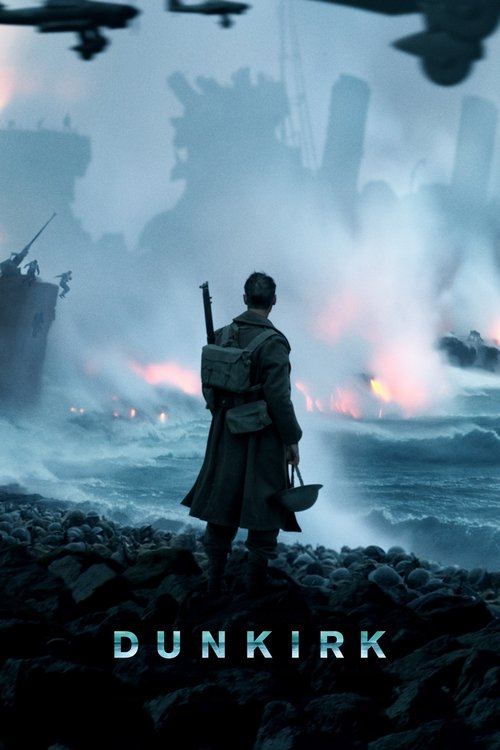
Dunkirk
2017 · Directed by Christopher Nolan
Woke Score
CriticCritic Score
Audience
Ultra Based
Critics rated this 90 points above its woke score. Among Ultra Based films, this critic score ranks #64 of 1469.
Representation Casting
Score: 5/100
The cast is predominantly white and male, reflecting the historical military composition of the era. While this is historically accurate, the film makes no effort to expand or diversify representation beyond the historical record.
LGBTQ+ Themes
Score: 0/100
No LGBTQ+ themes, characters, or representation are present in the film. The narrative focuses entirely on military operations and survival.
Feminist Agenda
Score: 0/100
No feminist themes or female perspectives are present. The film contains almost no female characters and does not engage with gender as a subject.
Racial Consciousness
Score: 0/100
The film contains no exploration of race, colonialism, or racial dynamics despite the historical context involving British Commonwealth forces.
Climate Crusade
Score: 0/100
No climate-related themes or environmental consciousness are present in the narrative.
Eat the Rich
Score: 0/100
The film contains no critique of capitalism or economic systems. It focuses entirely on military conflict and evacuation.
Body Positivity
Score: 0/100
No body positivity messaging or discussion of body diversity is present. The film treats bodies as instruments of survival rather than sites of identity.
Neurodivergence
Score: 0/100
No representation of neurodivergence or disability is present in the film.
Revisionist History
Score: 2/100
The film adheres closely to historical events but presents them with a conventional heroic framing focused on British evacuation rather than exploring alternative perspectives or complications.
Lecture Energy
Score: 3/100
The film occasionally includes expository dialogue explaining military strategy and decisions, though it generally trusts viewers to understand events through action and visuals rather than preachy explanation.


Synopsis
The story of the miraculous evacuation of Allied soldiers from Belgium, Britain, Canada and France, who were cut off and surrounded by the German army from the beaches and harbour of Dunkirk between May 26th and June 4th 1940 during World War II.
Consciousness Assessment
Dunkirk presents a historical military evacuation with the social consciousness of a World War II veteran who has long since stopped caring about such matters. The film concerns itself almost exclusively with the mechanics of wartime logistics and survival, treating the story as a technical and tactical problem rather than a vehicle for contemporary cultural messaging. This is, one might argue, precisely what a film about 1940 should be: a documentation of historical events without the apparatus of modern ideological interpretation. The cast is predominantly white and male, which reflects the historical composition of the British Expeditionary Force but also conveniently absolves the film of any obligation to interrogate representation or inclusion. Harry Styles appears as one soldier among many, his presence neither progressive nor regressive, simply present.
The film's approach to its subject matter is one of aesthetic formalism rather than social commentary. Nolan employs a fragmented temporal structure across three timelines, focusing viewer attention on the visceral experience of combat, evacuation, and the peculiar moral calculus of wartime command decisions. There is no discussion of systemic inequality, no exploration of how the war affected colonial subjects, and certainly no meditation on what modern audiences might learn about social responsibility from historical trauma. The film exists in a space of studied neutrality regarding its characters' interior lives beyond their immediate circumstances. A soldier is not a repository of identity markers; he is a function within a larger strategic narrative.
This studied indifference to progressive sensibilities, combined with the film's historical specificity and lack of contemporary moral preaching, results in a score that reflects genuine absence rather than active opposition. The absence of progressive framing is not itself progressive, but neither is it a deliberate rejection of such frameworks. It is simply a film about soldiers and survival, made by a director whose primary concern has never been social consciousness. In this regard, Dunkirk achieves a kind of innocence that only historical distance and technical mastery can provide.
Analysis generated by our Consciousness Algorithm
Critic Reviews
“Great directors make great movies. And with Dunkirk, Christopher Nolan has made his second masterpiece, thrilling history retold, remembered and relished.”
“Few movies have so palpably conveyed the sheer isolation of fear, and the extent to which history is often made by people who are just trying to survive it — few movies have so vividly illustrated that one man can only do as much for his country as a country can do for one of its men.”
“There have been countless films this summer that have engaged in endless spectacle but Dunkirk is the rare blockbuster that will leave a bruise. ”
“In devoting so much time to the dull, counterproductive mechanics of the action assembly, Dunkirk dispenses with nearly all other elements of drama. ”
Consciousness Markers
The cast is predominantly white and male, reflecting the historical military composition of the era. While this is historically accurate, the film makes no effort to expand or diversify representation beyond the historical record.
No LGBTQ+ themes, characters, or representation are present in the film. The narrative focuses entirely on military operations and survival.
No feminist themes or female perspectives are present. The film contains almost no female characters and does not engage with gender as a subject.
The film contains no exploration of race, colonialism, or racial dynamics despite the historical context involving British Commonwealth forces.
No climate-related themes or environmental consciousness are present in the narrative.
The film contains no critique of capitalism or economic systems. It focuses entirely on military conflict and evacuation.
No body positivity messaging or discussion of body diversity is present. The film treats bodies as instruments of survival rather than sites of identity.
No representation of neurodivergence or disability is present in the film.
The film adheres closely to historical events but presents them with a conventional heroic framing focused on British evacuation rather than exploring alternative perspectives or complications.
The film occasionally includes expository dialogue explaining military strategy and decisions, though it generally trusts viewers to understand events through action and visuals rather than preachy explanation.