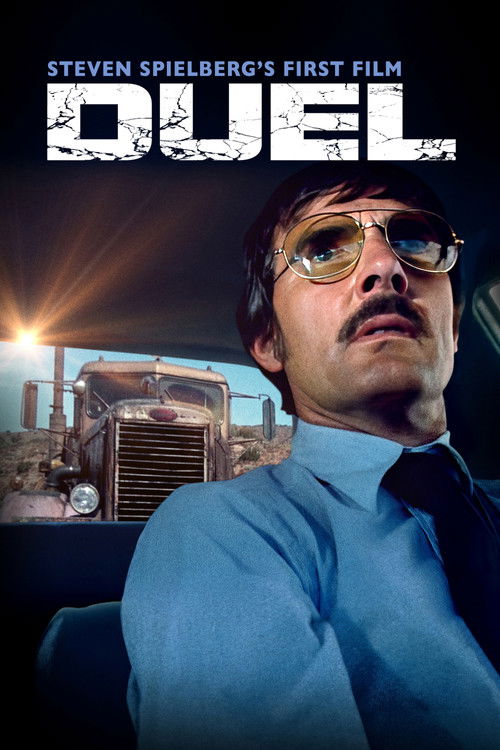
Duel
1971 · Directed by Steven Spielberg
Woke Score
CriticCritic Score
Audience
Ultra Based
Critics rated this 77 points above its woke score. Among Ultra Based films, this critic score ranks #345 of 1469.
Representation Casting
Score: 0/100
The cast is entirely white and male-dominated, with female characters appearing only briefly in non-central roles. No deliberate effort toward representation is evident in casting choices.
LGBTQ+ Themes
Score: 0/100
No LGBTQ+ themes, characters, or representation appear in the film. Sexuality is entirely absent from the narrative.
Feminist Agenda
Score: 0/100
The film contains no feminist commentary or gender-critical messaging. Female characters exist only peripherally as the protagonist's wife and others, with no agency or thematic weight.
Racial Consciousness
Score: 0/100
Race is never addressed, explored, or referenced in any manner. The film operates in a color-blind vacuum where racial dynamics are entirely absent.
Climate Crusade
Score: 0/100
No environmental themes or climate consciousness appear in the narrative. The desert setting is merely a backdrop for mechanical suspense.
Eat the Rich
Score: 0/100
Despite featuring a traveling salesman protagonist, the film contains no critique of capitalism, corporate structures, or economic systems.
Body Positivity
Score: 0/100
Body positivity or body-related commentary does not appear. Physical appearance is treated as narratively irrelevant.
Neurodivergence
Score: 0/100
No neurodivergent representation or themes appear. The protagonist's fear and vulnerability are treated as normal human responses to threat, not as neurodiverse identity.
Revisionist History
Score: 0/100
The film contains no historical narrative or revisionist reframing of historical events. It is entirely set in the present day with no historical component.
Lecture Energy
Score: 2/100
The film occasionally edges toward existential commentary through its depiction of Mann's psychological unraveling and his confrontation with his own limitations, though this falls far short of preachy instruction.


Synopsis
Traveling businessman David Mann angers the driver of a rusty tanker while crossing the California desert. A simple trip turns deadly, as Mann struggles to stay on the road while the tanker plays cat and mouse with his life.
Consciousness Assessment
Duel is a masterclass in what happens when a talented director applies himself to the simple, the urgent, and the entirely apolitical. Spielberg's 1971 television debut concerns itself with a single proposition: a man in a car being menaced by another man in a truck. There are no grievances to air, no systems to critique, no demographic boxes to tick. David Mann, played with endearing timidity by Dennis Weaver, is simply a traveling salesman who has incurred the inexplicable wrath of an unseen truck driver. The narrative is aggressively indifferent to questions of identity, representation, or social consciousness.
What we observe in Mann's ordeal is pure suspense divorced from any cultural commentary. He is terrorized, humiliated, and forced to confront his own cowardice and limitations, but these trials serve no purpose beyond the mechanical accumulation of tension. The film makes no effort to suggest that his vulnerability as a protagonist is a statement about masculinity, nor does it offer any reflection on class, labor, or the American road. The truck driver remains faceless and inscrutable, a force of nature rather than a vessel for thematic significance. Even Mann's eventual triumph contains no moral weight or social lesson.
This is precisely what exempts Duel from the markers we assess. It is a work of pure genre entertainment, made by a director in his creative prime but not yet interested in using his gifts for any purpose beyond mechanics. The film is effective, even brilliant in its restraint, but it speaks to nothing beyond itself. One might say this is the film's greatest strength. In an era where everything becomes a platform, Duel remains stubbornly, almost defiantly silent on matters of progressive sensibility.
Analysis generated by our Consciousness Algorithm
Critic Reviews
“This expertly sustained 1971 suspense classic established Steven Spielberg's reputation as a director. [23 Dec 1993, p.E7]”
“This is a film stripped back to its bare essentials, and Spielberg thrives in having to get creative to make each moment feel as fresh and energised as the last.”
“It takes less than a minute of watching Duel, Steven Spielberg's feature-length debut, to realize you're in the hands of a master director.”
“The existential allegories are pretty blunt—star Dennis Weaver’s character, a symbol for all mankind, is literally named Mann—but the filmmaking is electric, an early testament to Spielberg’s prowess.”
Consciousness Markers
The cast is entirely white and male-dominated, with female characters appearing only briefly in non-central roles. No deliberate effort toward representation is evident in casting choices.
No LGBTQ+ themes, characters, or representation appear in the film. Sexuality is entirely absent from the narrative.
The film contains no feminist commentary or gender-critical messaging. Female characters exist only peripherally as the protagonist's wife and others, with no agency or thematic weight.
Race is never addressed, explored, or referenced in any manner. The film operates in a color-blind vacuum where racial dynamics are entirely absent.
No environmental themes or climate consciousness appear in the narrative. The desert setting is merely a backdrop for mechanical suspense.
Despite featuring a traveling salesman protagonist, the film contains no critique of capitalism, corporate structures, or economic systems.
Body positivity or body-related commentary does not appear. Physical appearance is treated as narratively irrelevant.
No neurodivergent representation or themes appear. The protagonist's fear and vulnerability are treated as normal human responses to threat, not as neurodiverse identity.
The film contains no historical narrative or revisionist reframing of historical events. It is entirely set in the present day with no historical component.
The film occasionally edges toward existential commentary through its depiction of Mann's psychological unraveling and his confrontation with his own limitations, though this falls far short of preachy instruction.