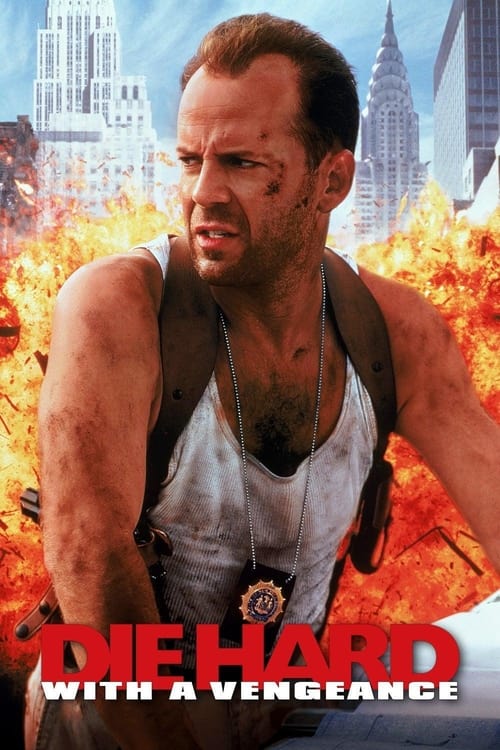
Die Hard: With a Vengeance
1995 · Directed by John McTiernan
Woke Score
CriticCritic Score
Audience
Woke-Adjacent
Critics rated this 16 points above its woke score. Among Woke-Adjacent films, this critic score ranks #121 of 151.
Representation Casting
Score: 55/100
Samuel L. Jackson is cast as a co-lead in a major studio action film, a significant choice for 1995. However, he remains secondary to Willis's protagonist, and the casting serves the buddy-cop dynamic rather than challenging narrative hierarchy.
LGBTQ+ Themes
Score: 0/100
No LGBTQ+ characters or themes present in the film. The villain's sexuality is never addressed or relevant to the plot.
Feminist Agenda
Score: 5/100
Female characters are minimal and serve functional roles. No meaningful engagement with gender politics or female agency beyond traditional action film supporting roles.
Racial Consciousness
Score: 60/100
The film explicitly centers on racial tension between its two protagonists and opens with a white supremacist bombing. It acknowledges racial conflict as real and consequential, though it does not interrogate systemic causes.
Climate Crusade
Score: 0/100
No engagement with environmental themes or climate-related concerns. The film is entirely indifferent to ecological issues.
Eat the Rich
Score: 10/100
The villain's motivation involves gold and wealth, but the film treats this as a criminal plot rather than as systemic critique. No examination of capitalism or class structures beyond individual greed.
Body Positivity
Score: 0/100
Standard action film physiques and no commentary on body diversity. The film reinforces conventional action hero body standards without interrogation.
Neurodivergence
Score: 0/100
No representation of neurodivergent characters or themes. The villain's intelligence is presented as exceptional rather than neurodivergent.
Revisionist History
Score: 0/100
The film contains no revisionist historical narratives. It is set in contemporary 1995 New York and does not reframe historical events.
Lecture Energy
Score: 15/100
While the film addresses racial tension through dialogue and action, it does not lecture the audience. The themes emerge organically from the plot, though without depth.


Synopsis
New York detective John McClane is back and kicking bad-guy butt in the third installment of this action-packed series, which finds him teaming with civilian Zeus Carver to prevent the loss of innocent lives. McClane thought he'd seen it all, until a genius named Simon engages McClane, his new "partner" -- and his beloved city -- in a deadly game that demands their concentration.
Consciousness Assessment
Die Hard: With a Vengeance arrives in 1995 as a curiously prescient examination of racial tension, opening with a white supremacist bombing and forcing its white protagonist into reluctant partnership with a Black civilian. The film does not shy away from the awkwardness and hostility that defines their initial dynamic, nor does it pretend that a single action film can resolve decades of systemic inequality. This is refreshingly honest, if limited in scope. The movie treats its racial subtext with the seriousness of a summer blockbuster that happened to stumble into something resembling cultural consciousness. Yet it remains fundamentally a product of its era: the racial commentary serves the plot rather than the reverse, and the film offers no sustained interrogation of the systems that produced the bomber or the inequality that makes Zeus skeptical of authority. Samuel L. Jackson's character is well-written and heroic, but he exists primarily to make John McClane's journey more complicated. The film deserves credit for acknowledging that complications exist, but not for resolving them. By modern standards, this registers as mildly progressive rather than genuinely engaged with structural analysis. It is a 1995 action film that noticed race and decided to make it part of the entertainment. For a mainstream blockbuster of that era, this represented a meaningful choice. For contemporary cultural assessment, it remains arrested at the level of acknowledgment.
Analysis generated by our Consciousness Algorithm
Critic Reviews
“Despite a final, tacked-on helicopter denouement, it remains a gripping, relentless, supercharged slab of fun that knows no bounds - New York is its playground and the sky's the limit.”
“Die Hard With a Vengeance is basically a wind-up action toy, cleverly made, and delivered with high energy. It delivers just what it advertises, with a vengeance.”
“It's a tense, terrifically funny action dazzler with a wow level in special effects that will be hard to top.”
“But Die Hard WAV lacks the freshness of its two predecessors: we've had it with gassy police psychiatrists and supersmart terrorists.”
Consciousness Markers
Samuel L. Jackson is cast as a co-lead in a major studio action film, a significant choice for 1995. However, he remains secondary to Willis's protagonist, and the casting serves the buddy-cop dynamic rather than challenging narrative hierarchy.
No LGBTQ+ characters or themes present in the film. The villain's sexuality is never addressed or relevant to the plot.
Female characters are minimal and serve functional roles. No meaningful engagement with gender politics or female agency beyond traditional action film supporting roles.
The film explicitly centers on racial tension between its two protagonists and opens with a white supremacist bombing. It acknowledges racial conflict as real and consequential, though it does not interrogate systemic causes.
No engagement with environmental themes or climate-related concerns. The film is entirely indifferent to ecological issues.
The villain's motivation involves gold and wealth, but the film treats this as a criminal plot rather than as systemic critique. No examination of capitalism or class structures beyond individual greed.
Standard action film physiques and no commentary on body diversity. The film reinforces conventional action hero body standards without interrogation.
No representation of neurodivergent characters or themes. The villain's intelligence is presented as exceptional rather than neurodivergent.
The film contains no revisionist historical narratives. It is set in contemporary 1995 New York and does not reframe historical events.
While the film addresses racial tension through dialogue and action, it does not lecture the audience. The themes emerge organically from the plot, though without depth.