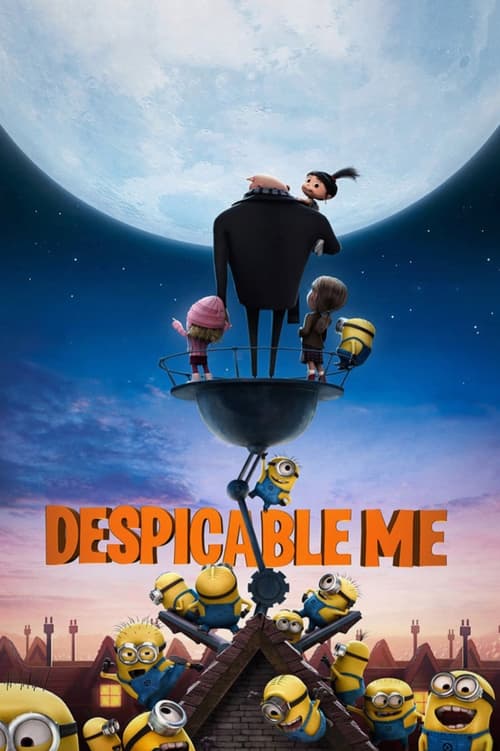
Despicable Me
2010 · Directed by Pierre Coffin
Woke Score
CriticCritic Score
Audience
Ultra Based
Critics rated this 64 points above its woke score. Among Ultra Based films, this critic score ranks #561 of 1469.
Representation Casting
Score: 28/100
The cast reflects mainstream Hollywood demographics of 2010. While the three girls are present and central to the emotional arc, their casting appears driven by vocal talent rather than representation considerations.
LGBTQ+ Themes
Score: 0/100
No LGBTQ+ themes are present in the film. The narrative focuses on heterosexual family formation and contains no queer subtext or representation.
Feminist Agenda
Score: 15/100
The three girls are sympathetic characters, but the film treats them primarily as objects of Gru's emotional development rather than as agents with their own feminist consciousness or agency.
Racial Consciousness
Score: 18/100
The film contains characters of various backgrounds, but this appears incidental rather than intentional. No racial themes are explored, and diversity seems to reflect casting choices rather than cultural awareness.
Climate Crusade
Score: 0/100
No climate-related themes or messaging appear in the film. The environmental impact of stealing the Moon is not explored.
Eat the Rich
Score: 5/100
While Gru's character involves villainy and scheming, the film treats capitalism and wealth as backdrop rather than critique. The narrative arc involves redemption, not systemic critique.
Body Positivity
Score: 10/100
The film depicts characters of various body types in a family-friendly context, but contains no explicit body positivity messaging or commentary on appearance standards.
Neurodivergence
Score: 0/100
No neurodivergent representation or themes are present in the film.
Revisionist History
Score: 0/100
The film contains no historical content or revisionist historical engagement.
Lecture Energy
Score: 5/100
The film maintains a light, comedic tone throughout. While emotional moments exist, the film avoids preachy messaging or lectures about social issues.


Synopsis
Gru is a supervillain determined to prove he's the greatest by stealing the Moon. To pull off his plan, he adopts three orphaned girls—Margo, Edith, and Agnes—intending to use them as part of his scheme. However, as Gru bonds with the girls, his cold, villainous exterior begins to melt.
Consciousness Assessment
Despicable Me exists in that pre-awakening moment of 2010 when animated family comedies could simply be entertaining without bearing the weight of cultural representation studies. The film centers on an unconventional family formation, yes, but approaches it with the naive charm of a time when depicting adoption was treated as a heartwarming plot device rather than a statement of progressive values. The three girls adopted by Gru are allowed to exist primarily as characters in a story about villainy and redemption, not as vessels for representing marginalized experiences or demonstrating the film's credentials.
The casting reflects the mainstream animation industry of its era. Steve Carell voices the protagonist with his familiar comedic cadence, while the supporting cast includes established names like Julie Andrews and Will Arnett. The three girls are voiced by younger actors in roles that require little beyond delivering lines with age-appropriate charm. Russell Brand's appearance as Dr. Nefario reads as the kind of quirky celebrity cameo that studios deployed without particular concern for representation metrics. The minions, those yellow creatures who would become franchise mascots, speak in an incomprehensible gibberish and function as comic relief, which is to say they function exactly as comic relief was permitted to function in 2010.
The film contains no discernible engagement with contemporary social consciousness. There are no lectures about systemic inequality, no climate messaging, no body positivity commentary, no neurodivergent representation, no revisionist historical awareness. The adoption of the girls happens and then the film moves forward with its heist plot, treating emotional connection as motivation rather than as an opportunity to explore the complexities of foster care systems or institutional failures. This is not cynicism on the film's part. This is simply what family comedies did before the cultural moment demanded otherwise.
Analysis generated by our Consciousness Algorithm
Critic Reviews
“Like the best kids' entertainment, this creates a daffy little world all its own.”
“The effect is Chaplinesque if Chaplin had the latest in gadgetry, because the entire picture is also shot in 3-D that, for once, puts all 3 of the Ds to imaginative use.”
“To hell with that childlike sense-of-wonder crap: Despicable Me, instead of trying to return adults to a false state of innocence, reminds us that we all started out as ill-mannered little savages.”
“Despicable Me cannot be faulted for lack of trying. If anything, it tries much too hard, stuffing great gobs of second-rate action, secondhand humor and warmed-over sentiment into every nook and cranny of its relentlessly busy 3-D frames.”
Consciousness Markers
The cast reflects mainstream Hollywood demographics of 2010. While the three girls are present and central to the emotional arc, their casting appears driven by vocal talent rather than representation considerations.
No LGBTQ+ themes are present in the film. The narrative focuses on heterosexual family formation and contains no queer subtext or representation.
The three girls are sympathetic characters, but the film treats them primarily as objects of Gru's emotional development rather than as agents with their own feminist consciousness or agency.
The film contains characters of various backgrounds, but this appears incidental rather than intentional. No racial themes are explored, and diversity seems to reflect casting choices rather than cultural awareness.
No climate-related themes or messaging appear in the film. The environmental impact of stealing the Moon is not explored.
While Gru's character involves villainy and scheming, the film treats capitalism and wealth as backdrop rather than critique. The narrative arc involves redemption, not systemic critique.
The film depicts characters of various body types in a family-friendly context, but contains no explicit body positivity messaging or commentary on appearance standards.
No neurodivergent representation or themes are present in the film.
The film contains no historical content or revisionist historical engagement.
The film maintains a light, comedic tone throughout. While emotional moments exist, the film avoids preachy messaging or lectures about social issues.