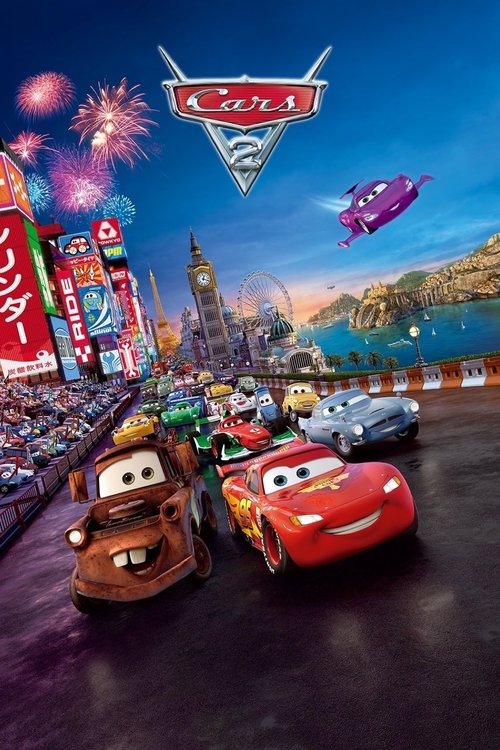
Cars 2
2011 · Directed by John Lasseter
Woke Score
CriticCritic Score
Audience
Ultra Based
Critics rated this 49 points above its woke score. Among Ultra Based films, this critic score ranks #989 of 1469.
Representation Casting
Score: 15/100
International cars appear in minor roles, but female characters are scarce and underdeveloped. The cast is overwhelmingly male.
LGBTQ+ Themes
Score: 0/100
No LGBTQ+ themes, characters, or representation present in the film.
Feminist Agenda
Score: 5/100
Female characters exist but serve minimal narrative functions. No feminist messaging or themes are evident.
Racial Consciousness
Score: 10/100
International settings and diverse car characters exist without substantive engagement with cultural themes or commentary.
Climate Crusade
Score: 0/100
A film centered on racing cars contains no environmental messaging or climate consciousness whatsoever.
Eat the Rich
Score: 5/100
The plot involves corporate villainy but does not critique capitalist systems. It is a straightforward action adventure narrative.
Body Positivity
Score: 0/100
No body positivity themes or messaging present. All characters are sleek vehicles with standardized designs.
Neurodivergence
Score: 10/100
Mater's quirky personality could be read as eccentric but contains no explicit neurodivergence representation or awareness.
Revisionist History
Score: 0/100
The film makes no claims about or revisions to historical events.
Lecture Energy
Score: 5/100
A few moral lessons about friendship appear, but the film prioritizes entertainment over preachy messaging.


Synopsis
Star race car Lightning McQueen and his pal Mater head overseas to compete in the World Grand Prix race. But the road to the championship becomes rocky as Mater gets caught up in an intriguing adventure of his own: international espionage.
Consciousness Assessment
Cars 2 occupies a peculiar position in Pixar's catalog as the franchise's most aggressively apolitical entry, a film so committed to spectacle and spy-thriller conventions that it seems to actively avoid any engagement with the contemporary world. Released in 2011, it arrives at a moment when progressive sensibilities had not yet become the default setting for major studio animation, and the film gleefully exploits this window. The narrative centers almost entirely on male characters engaged in international espionage, with female cars appearing only to provide occasional plot exposition or romantic interest. The film's treatment of global locations and characters remains entirely superficial, a postcard tourism that mistakes visual diversity for substantive cultural engagement.
What proves most distinctive is the film's profound disinterest in any form of social consciousness. A film premised on cars competing in races contains zero environmental messaging. A story set across multiple countries engages in no meaningful examination of cultural difference or international relations. The cast includes characters voiced by performers of various backgrounds, yet this casting serves only as window dressing for an action-adventure narrative that could have been set anywhere, starring anyone. The film's only concession to progressive sensibility appears in the form of Eddie Izzard's minor character, whose presence is treated as mere novelty rather than representation.
The overall score registers as negligible, which is not to say the film is offensive, merely that it operates in a pre-consciousness framework entirely. This is animation as pure entertainment, unconcerned with the ideological burdens that would come to define the medium within the next decade. In retrospect, Cars 2 reads as an artifact of a simpler time, when a Pixar film could prioritize action sequences and buddy comedy without constant interrogation of its social implications. The film's minimal score reflects not moral failure but rather temporal displacement, a product of its era that would be nearly unimaginable under contemporary studio practices.
Analysis generated by our Consciousness Algorithm
Critic Reviews
“The rare sequel that not only improves on but retroactively justifies its predecessor, this lightning-paced caper-comedy shifts the franchise into high gear with international intrigue, spy-movie spoofery and more automotive puns than you can shake a stickshift at, handling even its broader stretches with sophistication, speed and effortless panache.”
“Cars 2 is fun. Whether that's because John Lasseter is in touch with his inner child or mine, I cannot say. ”
“Lasseter is back behind the wheel, and you can feel his love for all things automotive in every frame. No humans blot this anthropomorphic romp. Cars do all the talking.”
“A crass and uncharacteristically threadbare cash-grab.”
Consciousness Markers
International cars appear in minor roles, but female characters are scarce and underdeveloped. The cast is overwhelmingly male.
No LGBTQ+ themes, characters, or representation present in the film.
Female characters exist but serve minimal narrative functions. No feminist messaging or themes are evident.
International settings and diverse car characters exist without substantive engagement with cultural themes or commentary.
A film centered on racing cars contains no environmental messaging or climate consciousness whatsoever.
The plot involves corporate villainy but does not critique capitalist systems. It is a straightforward action adventure narrative.
No body positivity themes or messaging present. All characters are sleek vehicles with standardized designs.
Mater's quirky personality could be read as eccentric but contains no explicit neurodivergence representation or awareness.
The film makes no claims about or revisions to historical events.
A few moral lessons about friendship appear, but the film prioritizes entertainment over preachy messaging.