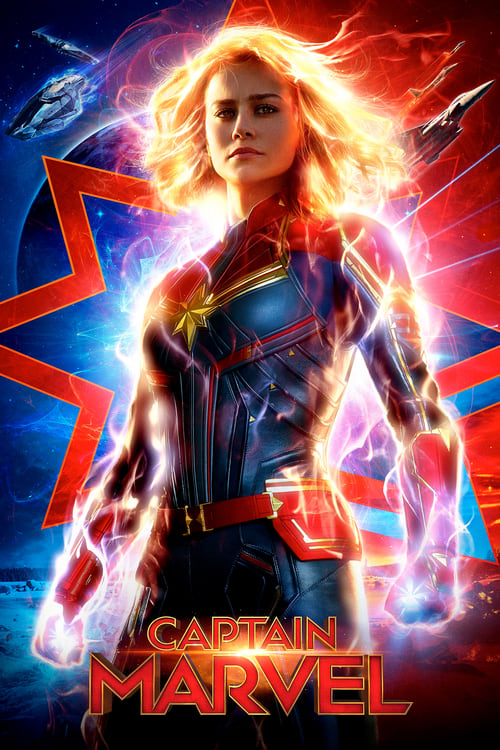
Captain Marvel
2019 · Directed by Ryan Fleck
Woke Score
Critic Score
Audience
Woke-Adjacent
Critics rated this 38 points above its woke score. Among Woke-Adjacent films, this critic score ranks #50 of 94.
Representation Casting
Score: 75/100
Female protagonist in a major MCU lead role, with supporting Black female character (Lashana Lynch) and other diverse cast members. Representation is present but narratively secondary.
LGBTQ+ Themes
Score: 0/100
No LGBTQ+ themes, representation, or subtext present in the film.
Feminist Agenda
Score: 65/100
Carol's arc involves rejecting male manipulation and gaslighting to claim her own power. Female empowerment is central, though framed as personal rather than systemic.
Racial Consciousness
Score: 30/100
Black characters present but not meaningfully integrated into narrative. The 1990s setting is not examined through any racial historical lens.
Climate Crusade
Score: 0/100
No climate-related themes or messaging.
Eat the Rich
Score: 10/100
Alien imperialism serves as antagonism, but this is framed as abstract cosmic conflict rather than capitalism or economic critique.
Body Positivity
Score: 15/100
Conventionally fit female lead with no body diversity messaging or body positivity content.
Neurodivergence
Score: 0/100
No representation or thematic engagement with neurodivergence.
Revisionist History
Score: 20/100
Set in 1990s but does not engage meaningfully with historical events or narratives of that era.
Lecture Energy
Score: 45/100
Some expository dialogue about female empowerment and trusting oneself, but restrained compared to more explicitly message-driven films.


Synopsis
The story follows Carol Danvers as she becomes one of the universe's most powerful heroes when Earth is caught in the middle of a galactic war between two alien races. Set in the 1990s, Captain Marvel is an all-new adventure from a previously unseen period in the history of the Marvel Cinematic Universe.
Consciousness Assessment
Captain Marvel arrives as a curious artifact of late 2010s Hollywood: a film that satisfied neither progressive audiences seeking genuine cultural commentary nor traditionalists seeking familiar narrative structures. The film's central conceit, that of a female fighter pilot reclaiming her identity and power against manipulative male authority figures, carries a certain contemporary resonance. Carol Danvers learns to trust her instincts and reject the gaslighting of those who claim to protect her, which functions as a kind of metaphorical empowerment narrative. Yet the film wraps this in the familiar trappings of space opera spectacle and MCU continuity, diluting any sharper edge the material might possess.
The supporting cast includes Lashana Lynch as Maria Rambeau, a Black female pilot and Carol's closest friend, and Djimon Hounsou in a minor role, but these casting choices read as representation without narrative weight. The film makes no effort to interrogate its 1990s setting through any lens of historical consciousness, treating the era as mere aesthetic window dressing rather than a period worthy of examination. Likewise, the film contains no discernible engagement with climate, economic, or systemic concerns. Its antagonists are alien imperialists, a framing that gestures toward military critique but remains safely abstract.
What emerges is a film content to be a straightforward superhero origin story that happens to feature a woman in the lead role. The progressive elements are present but largely incidental to the machinery of blockbuster filmmaking. One might characterize it as a film that benefits from progressive sensibilities without committing to them in any meaningful way. It satisfied commercial imperatives while generating cultural debate that the film itself did not particularly earn.
Analysis generated by our Consciousness Algorithm
Critic Reviews
“Boden and Fleck are low-key American neorealists, and in Captain Marvel they barely retain a vestige of their signature style. Yet they have brought off something exciting, embracing the Marvel house style and, within that, crafting a tale with enough tricks and moods and sleight-of-hand layers to keep us honestly absorbed.”
“Watching Danvers' story play out, complete with boggling plot twists and a scene-stealing friendly feline, is hugely entertaining, and it can't be over-emphasized how central Larson, about to become the most recognized woman on the planet, is to the enterprise.”
“It rises to the occasion with strong performances and with its directors' willingness to slow down and take their story seriously, balancing humor, action, and exposition in a carefully calibrated package.”
“Captain Marvel, the first Marvel adaptation both to star a woman and to be co-directed by a woman, is an obvious, crude, and transparent film. And it's also quite enjoyable and evocative — most of the time.”
“This isn't the greatest Marvel movie ever made, but it's definitely one of the funniest — and one of the sweetest.”
“Boden and Fleck do deliver a crackerjack, climactic comic-book sequence that stands as one of my favorite moments in all of the MCU.”
Consciousness Markers
Female protagonist in a major MCU lead role, with supporting Black female character (Lashana Lynch) and other diverse cast members. Representation is present but narratively secondary.
No LGBTQ+ themes, representation, or subtext present in the film.
Carol's arc involves rejecting male manipulation and gaslighting to claim her own power. Female empowerment is central, though framed as personal rather than systemic.
Black characters present but not meaningfully integrated into narrative. The 1990s setting is not examined through any racial historical lens.
No climate-related themes or messaging.
Alien imperialism serves as antagonism, but this is framed as abstract cosmic conflict rather than capitalism or economic critique.
Conventionally fit female lead with no body diversity messaging or body positivity content.
No representation or thematic engagement with neurodivergence.
Set in 1990s but does not engage meaningfully with historical events or narratives of that era.
Some expository dialogue about female empowerment and trusting oneself, but restrained compared to more explicitly message-driven films.