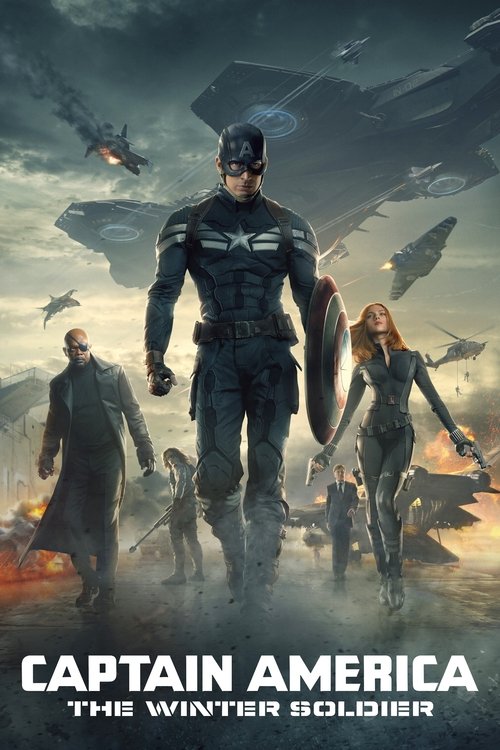
Captain America: The Winter Soldier
2014 · Directed by Joe Russo
Woke Score
CriticCritic Score
Audience
Based
Critics rated this 48 points above its woke score. Among Based films, this critic score ranks #158 of 345.
Representation Casting
Score: 52/100
Strong female lead in Scarlett Johansson's Black Widow and diverse supporting cast including Samuel L. Jackson and Anthony Mackie. Representation is present but not foregrounded as a thematic concern.
LGBTQ+ Themes
Score: 0/100
No LGBTQ+ representation or themes present in the film.
Feminist Agenda
Score: 35/100
Black Widow is competent and central to the narrative without romantic subordination, but the film does not engage with feminist critique or gender politics as thematic material.
Racial Consciousness
Score: 15/100
Characters of color occupy significant roles and positions of authority, but racial themes are not examined or foregrounded. Their presence is naturalized rather than discussed.
Climate Crusade
Score: 0/100
No climate-related themes or messaging present.
Eat the Rich
Score: 18/100
The film critiques institutional corruption and government overreach, but this reflects civil libertarian concerns rather than anti-capitalist ideology. Corporate critique is absent.
Body Positivity
Score: 0/100
No body positivity messaging or representation of diverse body types present.
Neurodivergence
Score: 0/100
No representation of neurodivergence or related themes.
Revisionist History
Score: 0/100
The film does not engage in historical revisionism. Its critique of S.H.I.E.L.D. operates as fiction rather than reinterpreting actual history.
Lecture Energy
Score: 10/100
Political themes are integrated into narrative and action rather than delivered through expository dialogue. The film trusts viewers to understand its critique without explicit statements.


Synopsis
After the cataclysmic events in New York with The Avengers, Steve Rogers, aka Captain America is living quietly in Washington, D.C. and trying to adjust to the modern world. But when a S.H.I.E.L.D. colleague comes under attack, Steve becomes embroiled in a web of intrigue that threatens to put the world at risk. Joining forces with the Black Widow, Captain America struggles to expose the ever-widening conspiracy while fighting off professional assassins sent to silence him at every turn. When the full scope of the villainous plot is revealed, Captain America and the Black Widow enlist the help of a new ally, the Falcon. However, they soon find themselves up against an unexpected and formidable enemy, the Winter Soldier.
Consciousness Assessment
Captain America: The Winter Soldier presents itself as a politically conscious thriller, though its preoccupations belong more to civil libertarian anxieties about surveillance and institutional corruption than to contemporary progressive sensibilities. The film's critique of government overreach and its portrayal of fascist infiltration within authority structures carry a skeptical-of-power message that feels more aligned with post-2001 security state critiques than with the specific cultural frameworks that would emerge as dominant in the 2020s. Its political content is earnest but fundamentally non-preachy, woven into narrative rather than announced through character speeches.
The film's approach to representation is quietly competent rather than demonstratively progressive. Scarlett Johansson's Black Widow operates as a co-lead action hero without fetishization or romantic subordination, which was genuinely noteworthy for mainstream action cinema in 2014. Samuel L. Jackson's Nick Fury occupies a position of authority and strategic intelligence. Anthony Mackie's Falcon represents the beginning of his integration into the MCU's ensemble, though his role remains supporting. These casting choices reflect a basic commitment to diverse casting without announcing this commitment as a statement or positioning diversity as the film's primary concern.
The film belongs to an earlier era of Hollywood liberalism, one that believed in inclusion without necessarily interrogating the systems of representation themselves. It is a 2014 film that happens to be politically skeptical of authority. It is not a film that has absorbed the cultural consciousness of a decade later.
Analysis generated by our Consciousness Algorithm
Critic Reviews
“Captain America: The Winter Soldier is a tremendous piece of pop entertainment, smart and engaging and featuring a home run movie star lead performance by Chris Evans.”
“Co-directors Joe and Anthony Russo and the team of screenwriters have fashioned a story with just the right balance of superhero fun, nods to the greater Marvel Universe and genuine dramatic tension.”
“Captain America: The Winter Soldier neatly and entertainingly puts into motion some big changes in the Marvel universe, while still sticking to its own charms — no easy feat, but one fit for a hero.”
“Despite one or two moments of Venture Brothers-worthy fancy, the film is as by-the-numbers as any this series has ever offered. ”
Consciousness Markers
Strong female lead in Scarlett Johansson's Black Widow and diverse supporting cast including Samuel L. Jackson and Anthony Mackie. Representation is present but not foregrounded as a thematic concern.
No LGBTQ+ representation or themes present in the film.
Black Widow is competent and central to the narrative without romantic subordination, but the film does not engage with feminist critique or gender politics as thematic material.
Characters of color occupy significant roles and positions of authority, but racial themes are not examined or foregrounded. Their presence is naturalized rather than discussed.
No climate-related themes or messaging present.
The film critiques institutional corruption and government overreach, but this reflects civil libertarian concerns rather than anti-capitalist ideology. Corporate critique is absent.
No body positivity messaging or representation of diverse body types present.
No representation of neurodivergence or related themes.
The film does not engage in historical revisionism. Its critique of S.H.I.E.L.D. operates as fiction rather than reinterpreting actual history.
Political themes are integrated into narrative and action rather than delivered through expository dialogue. The film trusts viewers to understand its critique without explicit statements.