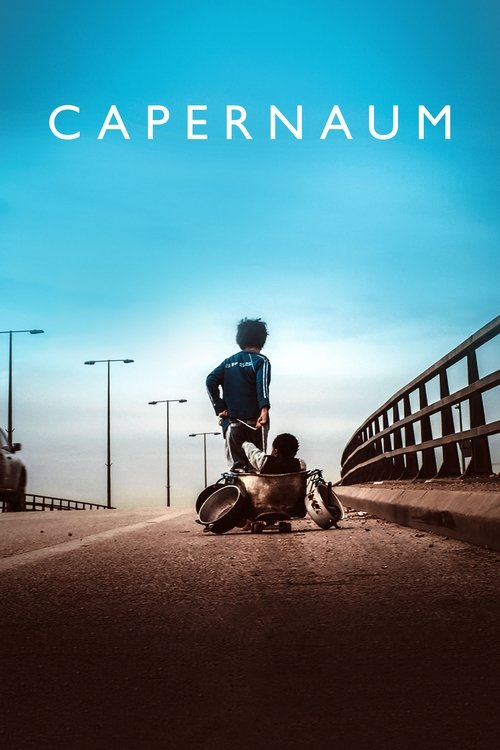
Capernaum
2018 · Directed by Nadine Labaki
Woke Score
CriticCritic Score
Audience
Woke
Critics rated this 3 points below its woke score. Among Woke films, this critic score ranks #44 of 88.
Representation Casting
Score: 85/100
Exclusively cast with marginalized actors, primarily non-professional children from impoverished Lebanese and refugee communities, centering their authentic lived experiences and voices.
LGBTQ+ Themes
Score: 0/100
No significant LGBTQ+ themes or representation present in the narrative, though refugee characters may include diverse sexualities not explicitly addressed.
Feminist Agenda
Score: 35/100
While the film depicts systemic failures affecting both genders, it lacks explicit feminist frameworks or critique of patriarchal structures, focusing instead on poverty as universal victimization.
Racial Consciousness
Score: 75/100
Deeply engaged with questions of racialized poverty and the exploitation of migrant workers and refugees, particularly those from African and Middle Eastern backgrounds.
Climate Crusade
Score: 5/100
Climate concerns are entirely absent from the film's thematic concerns or narrative.
Eat the Rich
Score: 70/100
The film presents capitalism and parental choice under poverty as inherently abusive, suggesting that reproduction under conditions of economic inequality constitutes a moral crime.
Body Positivity
Score: 0/100
No engagement with body positivity or disability representation; the film uses physical suffering and malnourishment primarily as visual markers of poverty.
Neurodivergence
Score: 0/100
No significant representation of or commentary on neurodivergence, though trauma and its psychological effects are depicted implicitly through behavior.
Revisionist History
Score: 25/100
While the film engages with Lebanon's contemporary refugee crisis and poverty, it does not substantially revisit or reframe historical narratives in revisionist terms.
Lecture Energy
Score: 80/100
The film operates almost entirely through preachy moral instruction, with its central lawsuit conceit functioning as an explicit argument about the immorality of procreation under poverty.


Synopsis
After running away from his negligent parents, committing a violent crime and being sentenced to five years in jail, a hardened, streetwise 12-year-old Lebanese boy sues his parents in protest of the life they have given him.
Consciousness Assessment
Capernaum presents itself as a moral indictment of systemic poverty and parental negligence, weaponizing the lived experiences of actual marginalized children as raw material for international film festival prestige. Director Nadine Labaki constructs a narrative of victimhood so complete, so utterly devoid of human agency or complexity, that the film functions less as social commentary and more as a carefully calibrated guilt mechanism for comfortable viewers. The casting of non-professional actors from genuinely impoverished backgrounds lends an authenticity that the film then exploits relentlessly, transforming their suffering into aesthetic experience. The central conceit, a child suing his parents for the crime of existence itself, represents a particular strain of progressive moralizing that mistakes rhetorical extremism for intellectual rigor.
The film's engagement with contemporary progressive sensibilities is pronounced and largely unambiguous. It centers the voices and experiences of those pushed to society's margins, particularly children and migrants, and builds its entire architecture around their victimization by systems indifferent to human dignity. The film interrogates parental responsibility through a framework of class consciousness, suggesting that poverty itself constitutes child abuse. Yet this interrogation operates entirely at the level of accusation. There is no examination of the structural forces that create such poverty, no exploration of how survival itself becomes complicity, no acknowledgment that the characters depicted are not simply objects of pity but complex human beings navigating impossible circumstances.
The film's relationship to exploitation deserves particular scrutiny. Labaki cast real children living in poverty to portray children living in poverty, a choice that collapses the distinction between representation and extraction. Doing so grants authenticity, but authenticity achieved through the systematic deployment of vulnerable subjects for artistic and commercial gain represents a specific form of contemporary progressive performance. The film won the Jury Prize at Cannes and achieved international acclaim precisely because it offered audiences a morally satisfying experience of witnessing injustice without requiring any examination of their own complicity in the systems that produce it.
Analysis generated by our Consciousness Algorithm
Critic Reviews
“A social-realist blockbuster – fired by furious compassion and teeming with sorrow, yet strewn with diamond-shards of beauty, wit and hope.”
“Capernaum, a sprawling tale wrenched from real life, goes beyond the conventions of documentary or realism into a mode of representation that doesn’t quite have a name. It’s a fairy tale and an opera, a potboiler and a news bulletin, a howl of protest and an anthem of resistance.”
“Zain Al Rafeea's naturalness, however uncanny, only makes the film's maneuverings seem all the more obvious.”
Consciousness Markers
Exclusively cast with marginalized actors, primarily non-professional children from impoverished Lebanese and refugee communities, centering their authentic lived experiences and voices.
No significant LGBTQ+ themes or representation present in the narrative, though refugee characters may include diverse sexualities not explicitly addressed.
While the film depicts systemic failures affecting both genders, it lacks explicit feminist frameworks or critique of patriarchal structures, focusing instead on poverty as universal victimization.
Deeply engaged with questions of racialized poverty and the exploitation of migrant workers and refugees, particularly those from African and Middle Eastern backgrounds.
Climate concerns are entirely absent from the film's thematic concerns or narrative.
The film presents capitalism and parental choice under poverty as inherently abusive, suggesting that reproduction under conditions of economic inequality constitutes a moral crime.
No engagement with body positivity or disability representation; the film uses physical suffering and malnourishment primarily as visual markers of poverty.
No significant representation of or commentary on neurodivergence, though trauma and its psychological effects are depicted implicitly through behavior.
While the film engages with Lebanon's contemporary refugee crisis and poverty, it does not substantially revisit or reframe historical narratives in revisionist terms.
The film operates almost entirely through preachy moral instruction, with its central lawsuit conceit functioning as an explicit argument about the immorality of procreation under poverty.