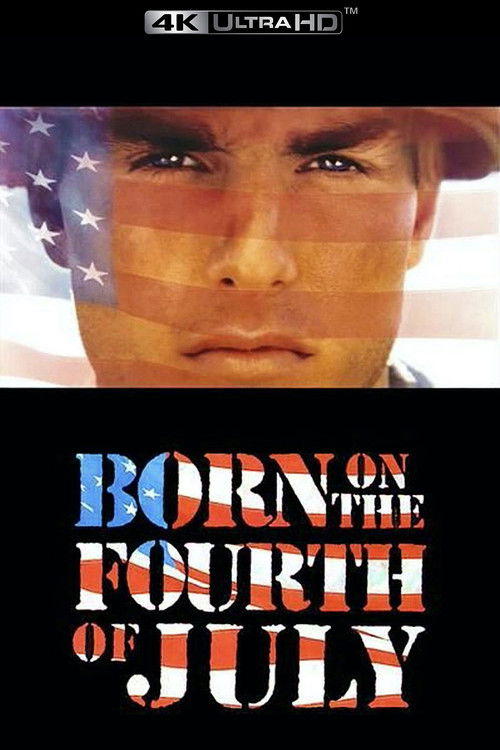
Born on the Fourth of July
1989 · Directed by Oliver Stone
Woke Score
CriticCritic Score
Audience
Ultra Based
Critics rated this 57 points above its woke score. Among Ultra Based films, this critic score ranks #485 of 1469.
Representation Casting
Score: 15/100
The cast includes some diversity, but representation is incidental to the narrative rather than deliberate. The story centers on a white male protagonist with minimal attention to the racial dimensions of Vietnam or activism.
LGBTQ+ Themes
Score: 0/100
No LGBTQ+ themes or representation. The film does not address sexual orientation or gender identity in any way.
Feminist Agenda
Score: 20/100
Implicit feminist critique through rejection of patriarchal militarism, but no explicit feminist agenda or female-centered narrative. Women appear largely as supporting characters to Kovic's journey.
Racial Consciousness
Score: 10/100
Minimal engagement with racial dimensions of Vietnam War or American activism. The film does not examine how race shaped the war or the movement against it.
Climate Crusade
Score: 0/100
No climate themes or environmental consciousness present in the film.
Eat the Rich
Score: 25/100
Critique of military-industrial complex and government betrayal of veterans suggests anti-capitalist sensibilities, though not explicitly framed in those terms. The focus is governmental rather than systemic economic critique.
Body Positivity
Score: 5/100
The film depicts disability with sympathy but centers on tragedy and loss rather than disability justice or body affirmation. Kovic's sexuality and bodily autonomy are treated as losses, not as part of a larger conversation about disability and desire.
Neurodivergence
Score: 0/100
No engagement with neurodivergence, mental health, or neurodiversity as contemporary cultural categories.
Revisionist History
Score: 30/100
The film presents an alternative perspective on Vietnam and American patriotism that challenges official narratives, though this is historical reframing rather than revisionist history in the contemporary sense.
Lecture Energy
Score: 15/100
Some preachy moments in which Kovic articulates anti-war positions, but the film privileges emotional experience and character development over explicit messaging or speeches.


Synopsis
Paralyzed in the Vietnam war, Ron Kovic becomes an anti-war and pro-human rights political activist after feeling betrayed by the country he fought for.
Consciousness Assessment
Born on the Fourth of July presents a genuine moral critique of American militarism and governmental betrayal, yet it operates within the political vocabulary of 1989 rather than contemporary progressive sensibilities. Oliver Stone's film is unquestionably serious about its subject matter, depicting Ron Kovic's transformation from patriotic soldier to anti-war activist with considerable emotional weight. Tom Cruise delivers a committed performance that captures both the physical devastation and psychological rupture of spinal injury, though the film's approach to disability remains centered on individual suffering rather than systemic injustice or disability justice frameworks.
The film's strength lies in its moral clarity and cinematographic sophistication, not in the deployment of modern cultural markers. Its anti-war stance and humanist critique of patriarchal militarism would have read as radical in 1989, but these emerge from a different era of progressive thought. There is minimal attention to racial representation, no LGBTQ+ content, no climate consciousness, no body positivity discourse, and no revisionist history. The film asks us to feel the moral wrongness of war, not to recognize the specific constellation of cultural awareness we measure here.
This is instructive: a film can be morally important, cinematically accomplished, and politically serious without registering highly on this particular scale. Born on the Fourth of July demonstrates that genuine progressive critique and contemporary progressive cultural markers are not synonymous. It is a film that matters for different reasons than those we are cataloging.
Analysis generated by our Consciousness Algorithm
Critic Reviews
“Nothing Cruise has done will prepare you for what he does in Born on the Fourth of July. His performance is so good that the movie lives through it. Stone is able to make his statement with Cruise's face and voice and doesn't need to put everything into the dialogue.”
“Some will find it overly long, but with such a pivotal performance by Cruise and a veritable platoon of Hollywood elite supporting, who can begrudge a bit more screen time?”
“But Stone has found in Cruise the ideal actor to anchor the movie with simplicity and strength. Together they do more than show what happened to Kovic. Their fervent, consistently gripping film shows why it still urgently matters.”
“Worst of all, the movie's conventional showbiz finale, brimming with false uplift, implies that the traumas of other mutilated and disillusioned Vietnam veterans can easily be overcome if they write books and turn themselves into celebrities.”
Consciousness Markers
The cast includes some diversity, but representation is incidental to the narrative rather than deliberate. The story centers on a white male protagonist with minimal attention to the racial dimensions of Vietnam or activism.
No LGBTQ+ themes or representation. The film does not address sexual orientation or gender identity in any way.
Implicit feminist critique through rejection of patriarchal militarism, but no explicit feminist agenda or female-centered narrative. Women appear largely as supporting characters to Kovic's journey.
Minimal engagement with racial dimensions of Vietnam War or American activism. The film does not examine how race shaped the war or the movement against it.
No climate themes or environmental consciousness present in the film.
Critique of military-industrial complex and government betrayal of veterans suggests anti-capitalist sensibilities, though not explicitly framed in those terms. The focus is governmental rather than systemic economic critique.
The film depicts disability with sympathy but centers on tragedy and loss rather than disability justice or body affirmation. Kovic's sexuality and bodily autonomy are treated as losses, not as part of a larger conversation about disability and desire.
No engagement with neurodivergence, mental health, or neurodiversity as contemporary cultural categories.
The film presents an alternative perspective on Vietnam and American patriotism that challenges official narratives, though this is historical reframing rather than revisionist history in the contemporary sense.
Some preachy moments in which Kovic articulates anti-war positions, but the film privileges emotional experience and character development over explicit messaging or speeches.