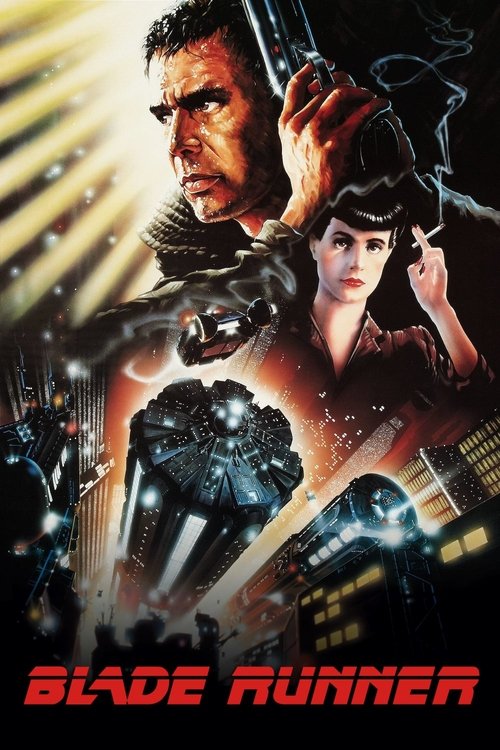
Blade Runner
1982 · Directed by Ridley Scott
Woke Score
CriticCritic Score
Audience
Ultra Based
Critics rated this 80 points above its woke score. Among Ultra Based films, this critic score ranks #276 of 1469.
Representation Casting
Score: 5/100
Cast is predominantly white and male. Female characters are present but largely passive or supporting. No intentional diverse representation evident.
LGBTQ+ Themes
Score: 0/100
No LGBTQ+ themes, characters, or representation present in the film.
Feminist Agenda
Score: 3/100
Female characters (Rachael, Pris) are primarily defined through their relationships to male characters and exist largely as romantic interests or objects rather than as autonomous agents.
Racial Consciousness
Score: 2/100
While Edward James Olmos appears in the cast, race is not engaged as a meaningful theme. The dystopian world is presented without racial specificity or commentary.
Climate Crusade
Score: 3/100
Environmental degradation is depicted as atmospheric world-building in the form of smog and urban decay, but this is not presented as political commentary on climate action or sustainability.
Eat the Rich
Score: 12/100
The replicant metaphor engages implicitly with themes of labor commodification and disposability. However, this emerges from the source material and film noir tradition rather than contemporary activist sensibilities.
Body Positivity
Score: 0/100
Body positivity is not a concern of the film. No engagement with diverse body representation or anti-diet culture messaging.
Neurodivergence
Score: 0/100
No representation of neurodivergent characters or engagement with neurodiversity as a theme.
Revisionist History
Score: 0/100
As a science fiction film set in the future, revisionist history is not applicable to its narrative concerns.
Lecture Energy
Score: 2/100
The film trusts its audience to interpret its philosophical and thematic concerns. It does not explicitly lecture or heavy-handedly explain its ideas to the viewer.


Synopsis
In the smog-choked dystopian Los Angeles of 2019, blade runner Rick Deckard is called out of retirement to terminate a quartet of replicants who have escaped to Earth seeking their creator for a way to extend their short life spans.
Consciousness Assessment
Blade Runner stands as a landmark of science fiction cinema, yet approaching claims of its social consciousness requires skepticism. The film does contain implicit commentary on labor, commodification, and the nature of humanity through its central conceit of replicants as disposable workers. However, these themes emerge from Philip K. Dick's 1968 source material and the existential preoccupations of noir cinema rather than from any deliberate engagement with contemporary progressive sensibilities. The film's dystopian Los Angeles functions primarily as a visual and atmospheric achievement, not as a platform for social advocacy.
The representation of women in Blade Runner reflects the era in which it was made. Female characters exist primarily in relation to the male protagonist's emotional and narrative arc. Rachael, despite being portrayed by Sean Young with considerable screen presence, serves as romantic interest and emotional catalyst rather than as an autonomous agent. The film makes no effort toward inclusive casting or intentional representation beyond what the story mechanically requires. Edward James Olmos appears in a supporting role, but race is not engaged as a thematic concern.
Blade Runner is fundamentally a work of philosophical science fiction that predates the cultural markers we now associate with social consciousness. Its sophistication lies in its visual language, its ambiguity about what constitutes humanity, and its implicit critique of industrial dehumanization. These are genuine artistic achievements, but they do not constitute progressive cultural awareness in the contemporary sense. The film asks profound questions but does not offer progressive answers. It remains a masterpiece of its era, untethered from and uninterested in the cultural conversations that would define the decades to follow.
Analysis generated by our Consciousness Algorithm
Critic Reviews
“The grafting of 40s hard-boiled detective story with SF thriller creates some dysfunctional overlaps, and the movie loses some force whenever violence takes over, yet this remains a truly extraordinary, densely imagined version of both the future and the present, with a look and taste all its own.”
“Most important, several elements -- the film's tough, new ending; a sly, fleeting dissolve of a unicorn, not in the original; and a brilliant, trompe d'oeil flicker of life in a shot of a still photograph -- bring Deckard's existential dilemma into focus. [11 Sept 1992]”
“May be the best "new" American movie released this year.”
“As before, the movie is more impressive for its finely detailed vision of Los Angeles as a futuristic slum than for its story, acting, or message. It's all downhill after the first few eye-dazzling minutes. [2 Oct 1992]”
Consciousness Markers
Cast is predominantly white and male. Female characters are present but largely passive or supporting. No intentional diverse representation evident.
No LGBTQ+ themes, characters, or representation present in the film.
Female characters (Rachael, Pris) are primarily defined through their relationships to male characters and exist largely as romantic interests or objects rather than as autonomous agents.
While Edward James Olmos appears in the cast, race is not engaged as a meaningful theme. The dystopian world is presented without racial specificity or commentary.
Environmental degradation is depicted as atmospheric world-building in the form of smog and urban decay, but this is not presented as political commentary on climate action or sustainability.
The replicant metaphor engages implicitly with themes of labor commodification and disposability. However, this emerges from the source material and film noir tradition rather than contemporary activist sensibilities.
Body positivity is not a concern of the film. No engagement with diverse body representation or anti-diet culture messaging.
No representation of neurodivergent characters or engagement with neurodiversity as a theme.
As a science fiction film set in the future, revisionist history is not applicable to its narrative concerns.
The film trusts its audience to interpret its philosophical and thematic concerns. It does not explicitly lecture or heavy-handedly explain its ideas to the viewer.