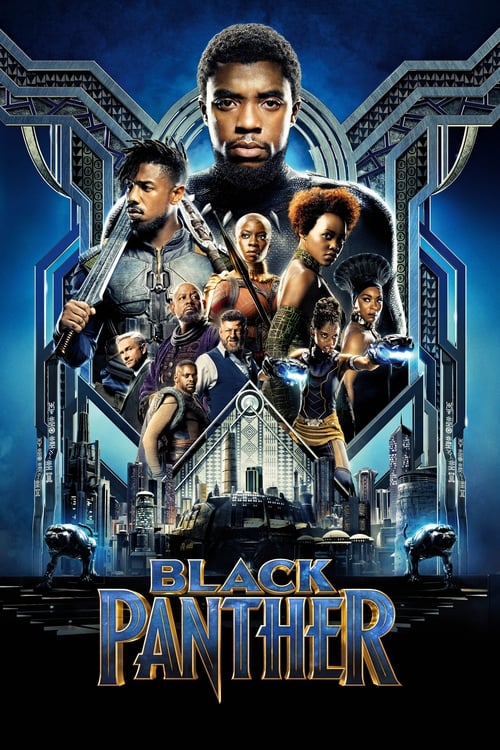
Black Panther
2018 · Directed by Ryan Coogler
Woke Score
Critic Score
Audience
Woke
Critics rated this 25 points above its woke score. Among Woke films, this critic score ranks #10 of 57.
Representation Casting
Score: 92/100
The film centers Black actors in all major roles and positions of authority. African and African diaspora talent occupy leadership positions, particularly the Dora Milaje and female characters, with no tokenization.
LGBTQ+ Themes
Score: 15/100
The film contains no explicit LGBTQ+ representation or themes. Sexuality remains entirely heteronormative throughout the narrative.
Feminist Agenda
Score: 70/100
Female characters exercise significant agency and power, particularly through the Dora Milaje and Nakia's advocacy for global engagement. However, romantic relationships remain central to female character development.
Racial Consciousness
Score: 88/100
The film centers African identity, Pan-African solidarity, and explicitly addresses colonialism and Western imperialism through Killmonger's perspective and Wakanda's isolationist policy.
Climate Crusade
Score: 5/100
Climate change receives no thematic attention. Environmental concerns do not factor into the narrative or ideological framework.
Eat the Rich
Score: 65/100
The film critiques imperialism and resource extraction through its Wakandan mythology, though it ultimately endorses monarchical capitalism and does not advocate systemic economic transformation.
Body Positivity
Score: 35/100
While the film features diverse body types among its ensemble, the focus remains on conventionally attractive, fit physiques, particularly among lead characters and warriors.
Neurodivergence
Score: 0/100
Neurodivergence receives no representation or thematic consideration within the film.
Revisionist History
Score: 20/100
While Wakanda itself is fictional, the film does not significantly rewrite actual historical events. It engages with colonialism thematically rather than revisionist historiography.
Lecture Energy
Score: 72/100
Multiple scenes function as direct political dialogue rather than organic character interaction, particularly conversations about global responsibility, imperialism, and Wakanda's obligations to oppressed peoples.


Synopsis
King T'Challa returns home to the reclusive, technologically advanced African nation of Wakanda to serve as his country's new leader. However, T'Challa soon finds that he is challenged for the throne by factions within his own country as well as without. Using powers reserved to Wakandan kings, T'Challa assumes the Black Panther mantle to join with ex-girlfriend Nakia, the queen-mother, his princess-kid sister, members of the Dora Milaje (the Wakandan 'special forces') and an American secret agent, to prevent Wakanda from being dragged into a world war.
Consciousness Assessment
Black Panther arrives as a film so thoroughly invested in its own cultural significance that one wonders if cinema itself has become a form of institutional critique. Ryan Coogler constructs Wakanda not merely as a setting but as a thesis statement, a nation that refutes the entire colonial apparatus through the simple act of existing. The film's central argument concerns itself with how a technologically superior African nation might respond to Western intrusion, and it pursues this question with the earnestness of a doctoral dissertation disguised as a superhero picture. Michael B. Jordan's Killmonger functions as the film's ideological fulcrum, his anti-imperialist perspective presented not as villainy but as a legitimate counterargument to T'Challa's isolationism, creating a narrative tension that operates primarily in the register of political philosophy.
The casting extends beyond mere representation into something resembling an assertion. Lupita Nyong'o, Danai Gurira, and Angela Bassett occupy positions of genuine authority and agency within the narrative structure. The Dora Milaje exist as fully realized warriors rather than supporting decoration. The film insists that African actors need not occupy subordinate roles in stories about African nations. Yet the film's progressive sensibilities remain bounded by the constraints of the Marvel apparatus. For all its ideological positioning, Black Panther ultimately resolves its central conflicts through violence and adherence to existing power structures, suggesting that even revolutionary cinema must occasionally bow to franchise requirements.
The film's lecture energy emerges most clearly in its conversations about global responsibility and economic justice. Nakia advocates for Wakanda's engagement with the world, particularly in support of oppressed peoples, while T'Challa initially resists this obligation. These scenes function as direct political argument instead of character development. The movie never quite achieves subtlety in its thematic explorations, preferring instead to state its positions with the clarity of a manifesto. It remains a film of genuine cultural consequence, though perhaps not always for the reasons its architects intended.
Analysis generated by our Consciousness Algorithm
Critic Reviews
“While the themes are deep, Black Panther is at the same time a visual joy to behold, with confident quirkiness (those aforementioned war rhinos), insane action sequences and special effects, and the glorious reveal of Wakanda, whose culture is steeped in African influences but which also offers a jaw-dropping look at what a city of the future could be.”
“Say this about Black Panther, which raises movie escapism very near the level of art: You've never seen anything like it in your life.”
“A film that fulfills the most rote demands of superhero spectacle, yet does so with style and subtexts that feel bracingly, joyfully groundbreaking.”
“On a pure pop level, as a piece of big-time mainstream entertainment, let us also celebrate this: Black Panther is one of the best superhero movies of the century.”
“Ryan Coogler's Black Panther is the film that will change everything. When you see it, you know that from here on in, everything will be different. Whilst a Marvel story through and through, fitting perfectly into the MCU post-Captain America: Civil War, Black Panther stands alone as a masterpiece of filmmaking.”
“Marvel's Black Panther is a milestone not only for its casting and director/co-writer Ryan Coogler's cine-griot myth building but because it's alive with fresh sights and sounds in a genre easily leaning on sameness.”
Consciousness Markers
The film centers Black actors in all major roles and positions of authority. African and African diaspora talent occupy leadership positions, particularly the Dora Milaje and female characters, with no tokenization.
The film contains no explicit LGBTQ+ representation or themes. Sexuality remains entirely heteronormative throughout the narrative.
Female characters exercise significant agency and power, particularly through the Dora Milaje and Nakia's advocacy for global engagement. However, romantic relationships remain central to female character development.
The film centers African identity, Pan-African solidarity, and explicitly addresses colonialism and Western imperialism through Killmonger's perspective and Wakanda's isolationist policy.
Climate change receives no thematic attention. Environmental concerns do not factor into the narrative or ideological framework.
The film critiques imperialism and resource extraction through its Wakandan mythology, though it ultimately endorses monarchical capitalism and does not advocate systemic economic transformation.
While the film features diverse body types among its ensemble, the focus remains on conventionally attractive, fit physiques, particularly among lead characters and warriors.
Neurodivergence receives no representation or thematic consideration within the film.
While Wakanda itself is fictional, the film does not significantly rewrite actual historical events. It engages with colonialism thematically rather than revisionist historiography.
Multiple scenes function as direct political dialogue rather than organic character interaction, particularly conversations about global responsibility, imperialism, and Wakanda's obligations to oppressed peoples.