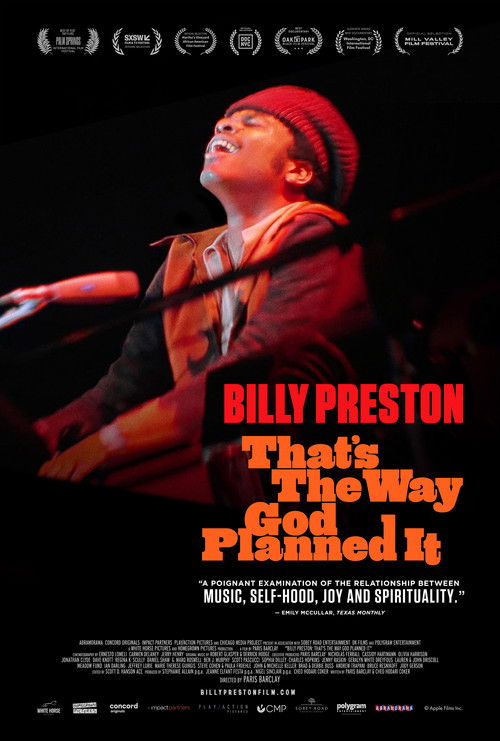
Billy Preston: That's the Way God Planned It
2026 · Directed by Paris Barclay
Woke Score
Critic Score
Woke
Critics rated this 12 points above its woke score. Among Woke films, this critic score ranks #27 of 57.
Representation Casting
Score: 70/100
The cast primarily features musicians and cultural figures, with deliberate inclusion of LGBTQ artists and Black performers who knew Preston. The film centers Black artists and their perspectives on Preston's life.
LGBTQ+ Themes
Score: 92/100
The documentary's central organizing principle is Preston's hidden identity as a gay Black man and the psychological toll of secrecy and compartmentalization. His sexuality is treated as fundamental to understanding his entire life and artistic output.
Feminist Agenda
Score: 35/100
The film includes women musicians who worked with Preston and acknowledges female artists like Aretha Franklin and Barbra Streisand, but does not appear to foreground gender analysis or feminist critique as a primary concern.
Racial Consciousness
Score: 75/100
The documentary explicitly engages with Preston's experience as a Black musician navigating predominantly white spaces in the music industry, and explores his identity as a Black gay man within religious and cultural contexts.
Climate Crusade
Score: 0/100
No climate themes present in this biographical music documentary.
Eat the Rich
Score: 25/100
The film engages with the music industry's exploitation and the commodification of artists, but does not pursue anti-capitalist critique as a central theme. The focus remains on Preston's personal struggles rather than systemic economic analysis.
Body Positivity
Score: 0/100
No body positivity themes are evident in this documentary about a musician's life and career.
Neurodivergence
Score: 15/100
The film may touch on Preston's well-documented struggles with substance abuse and addiction, which could relate to mental health, but does not appear to foreground neurodivergence as an explicit concern.
Revisionist History
Score: 60/100
The documentary presents a revised historical narrative of Billy Preston that centers aspects of his life previously suppressed or ignored, particularly his sexuality and the cost of hiding his identity within music history.
Lecture Energy
Score: 40/100
While the documentary addresses serious themes of identity and systemic oppression, its interview-based structure and focus on musical performance allow it to avoid excessive didacticism. However, the framing of Preston as a cautionary tale carries some instructional weight.
Synopsis
With his signature gospel sound on the Hammond B3, Billy Preston doublehandedly elevated the greatest artists of his time – from the Beatles to the Rolling Stones, from Aretha Franklin to Eric Clapton, from Ray Charles to Barbra Streisand to Sly and the Family Stone. In our film, we explore Billy's career and influence on generations of musicians, as he scored several number one hits of his own and became one of the most sought-after musicians in the world. He did all of this as a soul divided -- by his deep roots in the church, in constant conflict with his identity as a gay Black man, searching for a family of his own that would accept him for who he was.
Consciousness Assessment
Paris Barclay's documentary arrives as a belated corrective to decades of silence, centering the hidden life of Billy Preston with the gravity it deserves. Preston's contributions to popular music are beyond dispute, yet the film's primary concern is not musical legacy but rather the psychic toll of compartmentalization, the compartmentalization required of a Black gay man working within institutional Christianity and the entertainment industry of the mid-to-late twentieth century. The documentary does not treat this as mere biographical detail but rather as the organizing principle of Preston's entire existence, the central tragedy that shaped his music and his relationships.
The film's approach to Preston's sexuality and religious identity functions as its strongest thematic throughline. Rather than presenting these elements as separate biographical facts, Barclay frames them as mutually constitutive forces in perpetual collision. The material explores the specific pain of loving an institution (the church) that would have condemned him, a tension that no amount of musical achievement could resolve. This represents genuine engagement with systemic religious trauma as it intersects with racial and sexual identity, not mere identity representation for its own sake. The film also makes deliberate choices about who appears in Preston's story: the musicians featured are predominantly those with their own complicated relationships to identity and authenticity.
Yet the documentary carries the fingerprints of contemporary documentary practice in ways that merit examination. The framing of Preston as a "man nobody fully knew" risks turning his necessary privacy into a kind of romantic mystification of pain. There is something in the archival approach, the reliance on interviews and performance footage rather than dramatization, that maintains a certain distance from Preston himself. The film speaks about Billy Preston far more than it allows him to speak. This is perhaps unavoidable given his death in 2006, yet it remains a structural limitation worth noting. The result is a document of cultural awareness regarding systemic religious and sexual oppression, but one that occasionally substitutes revelation for understanding.
Analysis generated by our Consciousness Algorithm
Critic Reviews
“Barclay takes great care to show the weight of Preston's secrets throughout his life and doesn't shy away from the darker sides of Preston's life.”
“Paris Barclay's eye-opening documentary opens with that sequence, and it's cathartic to see it again.”
“Billy Preston: That's the Way God Planned It is a worthy homage to a fine musician and flawed man who deserved a far better fate than he received.”
“Director Paris Barclay pulls no punches in providing a 360-view of Preston as a man who faced obstacles and challenges and as a musician posthumously inducted into the Rock 'n Roll Hall of Fame.”
Consciousness Markers
The cast primarily features musicians and cultural figures, with deliberate inclusion of LGBTQ artists and Black performers who knew Preston. The film centers Black artists and their perspectives on Preston's life.
The documentary's central organizing principle is Preston's hidden identity as a gay Black man and the psychological toll of secrecy and compartmentalization. His sexuality is treated as fundamental to understanding his entire life and artistic output.
The film includes women musicians who worked with Preston and acknowledges female artists like Aretha Franklin and Barbra Streisand, but does not appear to foreground gender analysis or feminist critique as a primary concern.
The documentary explicitly engages with Preston's experience as a Black musician navigating predominantly white spaces in the music industry, and explores his identity as a Black gay man within religious and cultural contexts.
No climate themes present in this biographical music documentary.
The film engages with the music industry's exploitation and the commodification of artists, but does not pursue anti-capitalist critique as a central theme. The focus remains on Preston's personal struggles rather than systemic economic analysis.
No body positivity themes are evident in this documentary about a musician's life and career.
The film may touch on Preston's well-documented struggles with substance abuse and addiction, which could relate to mental health, but does not appear to foreground neurodivergence as an explicit concern.
The documentary presents a revised historical narrative of Billy Preston that centers aspects of his life previously suppressed or ignored, particularly his sexuality and the cost of hiding his identity within music history.
While the documentary addresses serious themes of identity and systemic oppression, its interview-based structure and focus on musical performance allow it to avoid excessive didacticism. However, the framing of Preston as a cautionary tale carries some instructional weight.