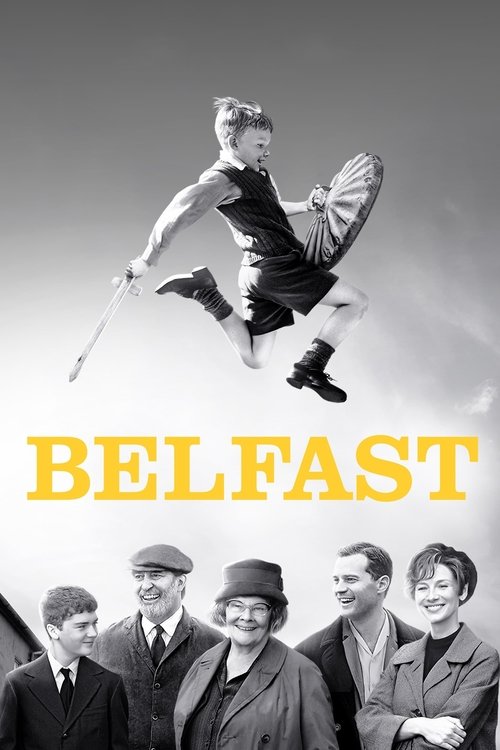
Belfast
2021 · Directed by Kenneth Branagh
Woke Score
CriticCritic Score
Audience
Ultra Based
Critics rated this 71 points above its woke score. Among Ultra Based films, this critic score ranks #469 of 1469.
Representation Casting
Score: 0/100
The cast is entirely white and reflects the historical demographics of 1960s Belfast without any deliberate diversification. No evidence of casting choices made for representation purposes.
LGBTQ+ Themes
Score: 0/100
No LGBTQ+ themes, characters, or representation present in the narrative. The film focuses on heterosexual family dynamics and a boy's innocent attraction to a girl.
Feminist Agenda
Score: 0/100
Female characters (Caitríona Balfe, Judi Dench) exist primarily as emotional support for the male protagonist. No feminist agenda or commentary on gender dynamics is present.
Racial Consciousness
Score: 0/100
The film does not engage with racial themes or consciousness. Set in 1960s Northern Ireland with an entirely white cast, racial dynamics are not addressed.
Climate Crusade
Score: 0/100
No climate-related themes, messaging, or environmental consciousness appears in the film. The narrative is entirely focused on personal and familial matters.
Eat the Rich
Score: 0/100
No critique of capitalism, wealth inequality, or systemic economic injustice is present. The film does not engage with economic themes beyond depicting working-class family life.
Body Positivity
Score: 0/100
No body positivity messaging or commentary on body image appears in the film. Physical appearance is treated without ideological framing.
Neurodivergence
Score: 0/100
No representation of neurodivergence, mental health awareness, or disability consciousness is evident in the narrative or characters.
Revisionist History
Score: 2/100
The film presents a highly selective, romanticized version of 1960s Belfast centered on innocent childhood rather than engaging with the complexity of sectarian conflict. It privileges nostalgic memory over historical interrogation.
Lecture Energy
Score: 0/100
The film trusts its audience to interpret its themes through visual and emotional storytelling. No preachy messaging, speeches, or explicit moral instruction is deployed.


Synopsis
Buddy is a young boy on the cusp of adolescence, whose life is filled with familial love, childhood hijinks, and a blossoming romance. Yet, with his beloved hometown caught up in increasing turmoil, his family faces a momentous choice: hope the conflict will pass or leave everything they know behind for a new life.
Consciousness Assessment
Kenneth Branagh's Belfast is a black-and-white nostalgic reverie, a semi-autobiographical meditation on childhood during the Troubles that treats its subject matter with the solemnity of a man recalling a lost world. The film concerns itself with the texture of memory, the innocence of youth interrupted by sectarian violence, and the universal anxieties of family and belonging. It is, in the most literal sense, apolitical, presenting the conflict as backdrop rather than as an object of moral instruction or ideological analysis.
The cast consists entirely of white Irish and British performers, which reflects both historical accuracy and a certain creative incuriosity about contemporary casting practices. Caitríona Balfe and Judi Dench provide maternal presence and gravitas, but neither character exists as anything other than emotional anchors for the male protagonist's journey. The film exhibits no consciousness of gender dynamics, representation, or any of the constellation of modern progressive sensibilities. It is a period piece in the truest sense, concerned with evoking 1960s Belfast as Branagh remembers it, not as contemporary filmmaking might interrogate it.
This is neither an indictment nor a compliment. Belfast is simply uninterested in the machinery of cultural consciousness that animates contemporary cinema. It prefers the company of old Hollywood formalism, the black-and-white palette, the orchestral score. It believes in the power of emotional sincerity and visual beauty as sufficient unto themselves. One might call this a kind of innocence, or perhaps a deliberate refusal. Either way, it stands apart from the contemporary landscape not through reactionary intent but through sheer aesthetic distance.
Analysis generated by our Consciousness Algorithm
Critic Reviews
“The parts of the movie that are going to resonate the most have the pacing they need to bring up one’s own memories of listening to a grandparent’s advice, of doing something you shouldn’t have to impress someone, or working up the nerve to talk to someone you liked. Perhaps these resurfaced memories are an unintended souvenir of visiting Branagh’s “Belfast,” but it’s one that may stick with moviegoers for quite some time after the credits roll.”
“Love letters to the past are always addressed to an illusion, yet this is such a seductive piece of myth-making from Branagh.”
“Belfast is deserving of double-digit Oscar nominations, from the picture itself to Branagh’s directing and writing to the editing and cinematography to any number of the performances, with Ciarán Hinds and Judi Dench near locks in the supporting categories. This is the best movie I’ve seen so far in 2021.”
“Even while understanding that much of Belfast is supposed to be from the perspective of Buddy (Jude Hill), a young boy who witnesses the beginning of Ireland’s “Troubles” in his working-class neighborhood (and serves as something of a stand-in for writer-director Kenneth Branagh), I still felt a type of artistic naivete at work—a belief that all you need is black-and-white cinematography and a cute kid to create something of deep meaning and emotion.”
Consciousness Markers
The cast is entirely white and reflects the historical demographics of 1960s Belfast without any deliberate diversification. No evidence of casting choices made for representation purposes.
No LGBTQ+ themes, characters, or representation present in the narrative. The film focuses on heterosexual family dynamics and a boy's innocent attraction to a girl.
Female characters (Caitríona Balfe, Judi Dench) exist primarily as emotional support for the male protagonist. No feminist agenda or commentary on gender dynamics is present.
The film does not engage with racial themes or consciousness. Set in 1960s Northern Ireland with an entirely white cast, racial dynamics are not addressed.
No climate-related themes, messaging, or environmental consciousness appears in the film. The narrative is entirely focused on personal and familial matters.
No critique of capitalism, wealth inequality, or systemic economic injustice is present. The film does not engage with economic themes beyond depicting working-class family life.
No body positivity messaging or commentary on body image appears in the film. Physical appearance is treated without ideological framing.
No representation of neurodivergence, mental health awareness, or disability consciousness is evident in the narrative or characters.
The film presents a highly selective, romanticized version of 1960s Belfast centered on innocent childhood rather than engaging with the complexity of sectarian conflict. It privileges nostalgic memory over historical interrogation.
The film trusts its audience to interpret its themes through visual and emotional storytelling. No preachy messaging, speeches, or explicit moral instruction is deployed.