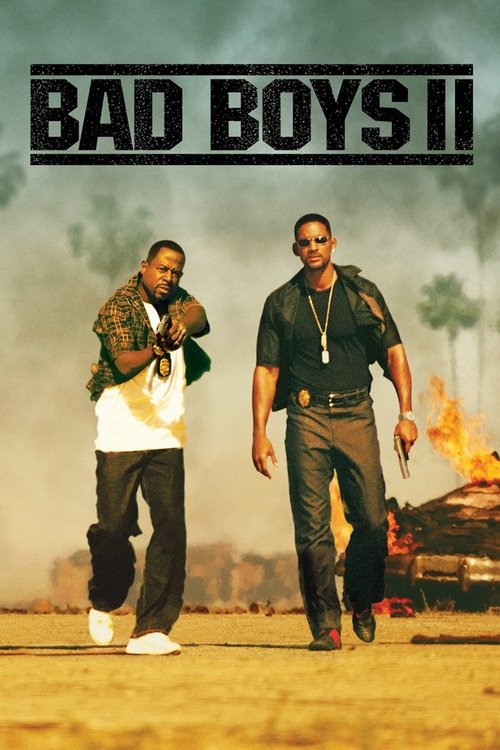
Bad Boys II
2003 · Directed by Michael Bay
Woke Score
CriticCritic Score
Audience
Based
Critics rated this 16 points above its woke score. Among Based films, this critic score ranks #340 of 345.
Representation Casting
Score: 45/100
Features Black protagonists in lead roles as competent police detectives with agency and authority. However, supporting cast includes ethnic caricatures and the narrative does not examine systemic issues within law enforcement.
LGBTQ+ Themes
Score: 0/100
No LGBTQ characters, themes, or representation present in the film. Sexual content focuses exclusively on heterosexual relationships and conquests.
Feminist Agenda
Score: 15/100
Gabrielle Union's character exists primarily as a romantic object to be pursued and protected by the male leads. Her agency is limited and her role reinforces traditional gender dynamics in action films.
Racial Consciousness
Score: 20/100
While the film features Black protagonists, it relies heavily on ethnic stereotyping of Cuban, Russian, and Haitian characters. No meaningful examination of systemic racism or racial justice appears in the narrative.
Climate Crusade
Score: 0/100
Climate themes are entirely absent from this action comedy about drug trafficking. Environmental concerns receive no attention whatsoever.
Eat the Rich
Score: 5/100
The film depicts drug lords as antagonists but offers no critique of capitalism or economic systems. Wealth and materialism are presented as desirable rather than problematic.
Body Positivity
Score: 0/100
The film adheres strictly to conventional action movie aesthetics with no representation of body diversity. Female characters are presented primarily for visual appeal within narrow beauty standards.
Neurodivergence
Score: 0/100
No neurodivergent characters or representation present. Mental health and neurodivergence are not addressed in any meaningful way.
Revisionist History
Score: 0/100
The film contains no historical narrative or revisionist historical elements. It is set in contemporary Miami with no engagement with historical events or reinterpretation.
Lecture Energy
Score: 10/100
The film is primarily concerned with entertainment and action sequences rather than delivering moral lessons. Minimal preachy energy, though occasional comedic references to social issues are handled with broad strokes.


Synopsis
Detectives Marcus Burnett and Mike Lowrey of the Miami Narcotics Task Force are tasked with stopping the flow of the drug Ecstasy into Miami. They track the drugs to the whacked-out Cuban drug lord Johnny Tapia, who is also involved in a bloody war with Russian and Haitian mobsters. If that isn't bad enough, there's tension between the two detectives when Marcus discovers that playboy Mike is secretly romancing Marcus' sister, Syd.
Consciousness Assessment
Bad Boys II arrives as a curious artifact of early 2000s blockbuster sensibilities, a film that seems almost deliberately indifferent to progressive social consciousness while simultaneously featuring Black protagonists in positions of authority and competence. Will Smith and Martin Lawrence carry the film with charisma and comedic timing, and the narrative does not require them to perform subservience or self-deprecation for white authority figures. Yet this baseline representation exists alongside a film saturated with caricature, objectification, and a casual approach to cultural stereotyping that would later become harder to defend. Michael Bay's direction emphasizes spectacle and excess over nuance, and the film's comedic register frequently relies on exaggerated ethnic characterizations of Cuban, Russian, and Haitian antagonists. The treatment of Gabrielle Union's character as primarily a romantic prize to be competed over and protected rather than a developed agent of her own narrative arc reflects the film's broader indifference to feminist concerns.
The film operates in a pre-2015 action comedy mode where social consciousness had not yet become a consideration for mainstream blockbuster filmmaking. There are no LGBTQ characters, no meaningful engagement with climate or economic justice themes, and no particular investment in neurodivergent representation. The violence, while cartoonish and excessive, does not critique police brutality or systemic injustice, treating the Miami police department as essentially heroic despite the film's own suggestions of casual corruption and misconduct. Body diversity is absent, with the film adhering to conventional action movie aesthetics. Revisionist history appears nowhere in the narrative, and the film's lecture energy remains mercifully minimal. What we have instead is a pre-woke entertainment product that happens to star Black protagonists in a context where that was itself somewhat unusual for the action genre, yet this casting choice does not extend to broader cultural consciousness or progressive values.
The film's score reflects its fundamental lack of engagement with contemporary progressive sensibilities, though its existence as a successful vehicle for Black action stars prevents it from scoring lower. It is a movie that does not ask difficult questions about representation, justice, or social structures. It simply explodes things and cracks jokes. That this was acceptable in 2003 tells us something about how rapidly cultural expectations have shifted.
Analysis generated by our Consciousness Algorithm
Critic Reviews
“Bay's movie is also a confident mega-production that feels it doesn't need to lean on its visual frills if it has Smith and Lawrence -- it's a natural-born buddy flick. ”
“Watching a Bruckheimer with natural comics like Smith and Lawrence makes it all go down easily. If you like this type of movie, that is. ”
“The bigger-than-big, rambunctious spectacle is way too much of a questionably good thing. ”
“This putrid action flick crawls along for two and a half hours before expiring in a septic field of bad one-liners, halfhearted catchphrases, obliterated cars, vicious slow-motion bullet penetration, graphic corpse mutilations played for laughs, and shamefully hollow bonding scenes between its two dyspeptic megastars.”
Consciousness Markers
Features Black protagonists in lead roles as competent police detectives with agency and authority. However, supporting cast includes ethnic caricatures and the narrative does not examine systemic issues within law enforcement.
No LGBTQ characters, themes, or representation present in the film. Sexual content focuses exclusively on heterosexual relationships and conquests.
Gabrielle Union's character exists primarily as a romantic object to be pursued and protected by the male leads. Her agency is limited and her role reinforces traditional gender dynamics in action films.
While the film features Black protagonists, it relies heavily on ethnic stereotyping of Cuban, Russian, and Haitian characters. No meaningful examination of systemic racism or racial justice appears in the narrative.
Climate themes are entirely absent from this action comedy about drug trafficking. Environmental concerns receive no attention whatsoever.
The film depicts drug lords as antagonists but offers no critique of capitalism or economic systems. Wealth and materialism are presented as desirable rather than problematic.
The film adheres strictly to conventional action movie aesthetics with no representation of body diversity. Female characters are presented primarily for visual appeal within narrow beauty standards.
No neurodivergent characters or representation present. Mental health and neurodivergence are not addressed in any meaningful way.
The film contains no historical narrative or revisionist historical elements. It is set in contemporary Miami with no engagement with historical events or reinterpretation.
The film is primarily concerned with entertainment and action sequences rather than delivering moral lessons. Minimal preachy energy, though occasional comedic references to social issues are handled with broad strokes.