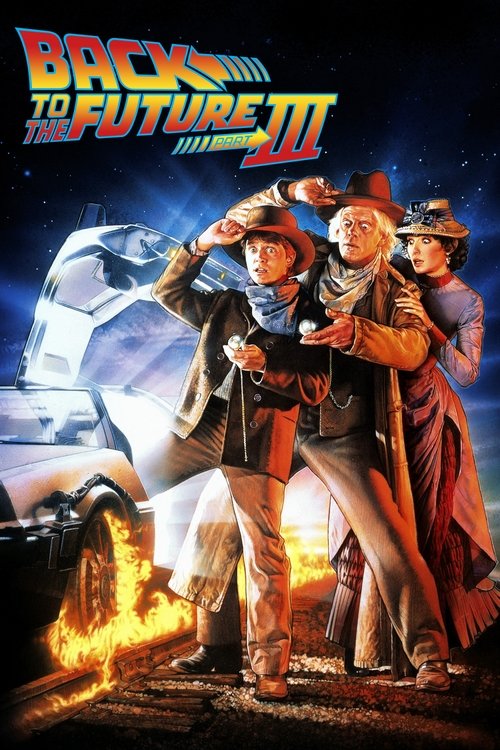
Back to the Future Part III
1990 · Directed by Robert Zemeckis
Woke Score
CriticCritic Score
Audience
Ultra Based
Critics rated this 51 points above its woke score. Among Ultra Based films, this critic score ranks #1053 of 1469.
Representation Casting
Score: 5/100
The cast is entirely white with no meaningful diversity. Clara Clayton is the sole significant female character, though she functions primarily as a love interest rather than a fully realized protagonist.
LGBTQ+ Themes
Score: 0/100
No LGBTQ+ representation or themes present. The film is entirely heteronormative in its romantic and social dynamics.
Feminist Agenda
Score: 10/100
Clara Clayton has agency in choosing her future, but her character arc culminates in romantic pairing with Doc. She is resourceful but remains secondary to the male protagonists' goals and adventures.
Racial Consciousness
Score: 0/100
The film treats 1885 as a historical backdrop stripped of its actual racial dynamics and violence. No engagement with the period's slavery legacy, Native American displacement, or systemic racism.
Climate Crusade
Score: 0/100
No environmental themes or climate consciousness appears in the film. The story is concerned solely with personal adventure and romantic resolution.
Eat the Rich
Score: 0/100
The film contains no critique of capitalism or class structures. Villainy is personal rather than systemic, and wealth is treated as a neutral plot device.
Body Positivity
Score: 0/100
No body diversity or body positivity messaging. The cast adheres to conventional Hollywood beauty standards of 1990.
Neurodivergence
Score: 0/100
No representation of neurodivergent characters or conditions. The film contains no engagement with disability or neurological difference.
Revisionist History
Score: 0/100
Rather than revisionist history, the film simply ignores history entirely, using 1885 as a fun-house setting rather than a period requiring historical honesty.
Lecture Energy
Score: 0/100
The film contains no preachy moments or expository dialogue about social issues. Its tone is consistently comedic and adventurous rather than instructional.


Synopsis
The final installment finds Marty digging the trusty DeLorean out of a mineshaft and looking for Doc in the Wild West of 1885. But when their time machine breaks down, the travelers are stranded in a land of spurs. More problems arise when Doc falls for pretty schoolteacher Clara Clayton, and Marty tangles with Buford Tannen.
Consciousness Assessment
Back to the Future Part III stands as a monument to pre-consciousness filmmaking, a 1990 blockbuster so thoroughly indifferent to social awareness that it functions as a kind of historical artifact. The film transports our heroes to 1885 for a western adventure devoid of any meaningful engagement with the historical period's actual complexities, much less modern sensibilities about representation or historical accountability. Mary Steenburgen's Clara Clayton exists primarily as a romantic interest, a well-meaning schoolteacher whose agency consists largely of being rescued and eventually paired off, the standard female character template of mainstream action cinema at the time.
The film's approach to its 1885 setting is purely aesthetic, treating the Old West as a playground of saloons, gunfights, and mechanical clock towers. There is no reckoning with the period's racial violence, land theft, or systemic injustice, nor should we expect such from a family-friendly time travel romp. More tellingly, the film shows no awareness that such reckoning might matter. The supporting cast is uniformly white, and the film's comedy derives primarily from fish-out-of-water situations and slapstick rather than any observation of social dynamics. The villains are villainous not because of any ideological dimension but because they are simply bad men in a bad town.
This is not a failing of the film so much as a reflection of its era and commercial purpose. Back to the Future Part III succeeded because audiences wanted a fun adventure, not a thesis on historical injustice. By contemporary standards, it registers as a period piece that has forgotten entirely that periods contained actual history, much less history worth interrogating.
Analysis generated by our Consciousness Algorithm
Critic Reviews
“Recovers the style, wit and grandiose fantasy elements of the original. The simplicity of plot, and the wide expansiveness of its use of space, are a refreshing change from the convoluted, visually cramped and cluttered second part.”
“From its opening shots, the film is like an invigorating elixir, a movie pick-me-up that delivers thrills and races your pulse but keeps your head in gear too. It's divinely frivolous, nearly perfect fun. ”
“Although I would rate Part III beneath Part I, the final installment does have the blessing of closure: There's something undeniably satisfying about seeing all those loose ends tied up. [25 May 1990, p.7]”
“Doc says: "I can't believe this is happening." …That sentence may be the only one uttered in the entire film that contains an ounce of true feeling. Certainly that was the thought on my mind as I watched this depressing rehash of material that seemed original just five years ago, when it was. And "I can't believe this is happening" seemed to be what most of the actors were thinking as they gamely trudged through their paces yet again. [31 May 1990, p.A12]”
Consciousness Markers
The cast is entirely white with no meaningful diversity. Clara Clayton is the sole significant female character, though she functions primarily as a love interest rather than a fully realized protagonist.
No LGBTQ+ representation or themes present. The film is entirely heteronormative in its romantic and social dynamics.
Clara Clayton has agency in choosing her future, but her character arc culminates in romantic pairing with Doc. She is resourceful but remains secondary to the male protagonists' goals and adventures.
The film treats 1885 as a historical backdrop stripped of its actual racial dynamics and violence. No engagement with the period's slavery legacy, Native American displacement, or systemic racism.
No environmental themes or climate consciousness appears in the film. The story is concerned solely with personal adventure and romantic resolution.
The film contains no critique of capitalism or class structures. Villainy is personal rather than systemic, and wealth is treated as a neutral plot device.
No body diversity or body positivity messaging. The cast adheres to conventional Hollywood beauty standards of 1990.
No representation of neurodivergent characters or conditions. The film contains no engagement with disability or neurological difference.
Rather than revisionist history, the film simply ignores history entirely, using 1885 as a fun-house setting rather than a period requiring historical honesty.
The film contains no preachy moments or expository dialogue about social issues. Its tone is consistently comedic and adventurous rather than instructional.