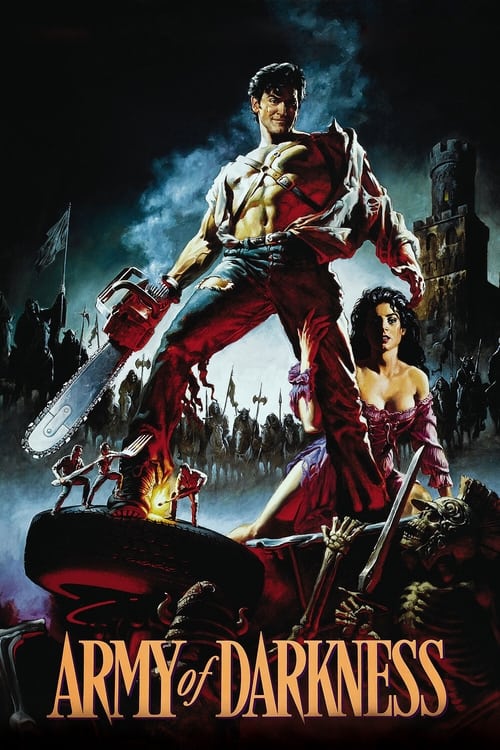
Army of Darkness
1992 · Directed by Sam Raimi
Woke Score
CriticCritic Score
Audience
Ultra Based
Critics rated this 57 points above its woke score. Among Ultra Based films, this critic score ranks #943 of 1469.
Representation Casting
Score: 0/100
The cast reflects the era's default casting patterns with no deliberate effort toward diverse representation. Characters are cast according to role requirements without contemporary consciousness.
LGBTQ+ Themes
Score: 0/100
No LGBTQ+ themes, representation, or subtext are present in the film. Romance is entirely heterosexual and incidental to the plot.
Feminist Agenda
Score: 5/100
Female characters are functional plot devices rather than developed protagonists, though they are not actively demeaned. Sheila participates minimally in the action, and Annie exists primarily for exposition.
Racial Consciousness
Score: 0/100
The film contains no exploration of racial themes or consciousness. The medieval setting and monster-centric plot preclude any engagement with contemporary racial discourse.
Climate Crusade
Score: 0/100
Environmental concerns are entirely absent from this fantasy-horror adventure. The film's focus on supernatural combat leaves no room for climate commentary.
Eat the Rich
Score: 0/100
While Ash works at a department store (S-Mart), this detail is merely worldbuilding. No critique of capitalism or wealth inequality is present or implied.
Body Positivity
Score: 0/100
The film contains no commentary on body image or body positivity. Physical appearance is treated as a conventional narrative element without deliberate messaging.
Neurodivergence
Score: 0/100
No representation or discussion of neurodivergence appears in the film. Ash's behavior is comedic rather than neurologically coded.
Revisionist History
Score: 0/100
The medieval setting is purely fantastical, not based on historical events or figures. No attempt at historical reinterpretation is made.
Lecture Energy
Score: 0/100
The film prioritizes entertainment and spectacle over exposition or moral instruction. No preachy moments or speeches about social issues occur.


Synopsis
Ash, a handsome, shotgun-toting, chainsaw-armed department store clerk, is time warped backwards into England's Dark Ages, where he romances a beauty and faces legions of the undead.
Consciousness Assessment
Army of Darkness is a 1992 comedy-horror film that concerns itself almost exclusively with the delivery of pratfalls and chainsaw-based mayhem. The film, directed by Sam Raimi as a vehicle for Bruce Campbell's rubber-faced charisma, occupies itself with the sort of anarchic slapstick that predates by decades the contemporary cultural anxieties we now measure in films. The plot, such as it is, involves a department store clerk transported to medieval England where he must battle the undead while romancing a local noblewoman, all executed with the deadpan commitment of someone who understands that the absurdity is the point.
The female characters exist in this film as functional plot devices rather than subjects of deliberate social statement. Embeth Davidtz's Sheila and Bridget Fonda's Annie Knowby serve as love interest and exposition respectively, roles that would have been equally unremarkable in any adventure film of the era. There is no attempt at either progressive representation or regressive caricature, merely indifference. The film's sensibilities are those of pure entertainment mechanics, untouched by any impulse toward social consciousness. Ash Williams remains the sole focus of Raimi's directorial attention, a wisecracking loner whose heroism emerges from circumstance rather than ideology.
What emerges is a film entirely innocent of the cultural markers we now scrutinize. The production design is thoughtful, the special effects were innovative, and Bruce Campbell's physical comedy remains genuinely skilled. Yet from the perspective of contemporary social consciousness, Army of Darkness reads as aggressively neutral, a work that neither advances nor resists modern progressive sensibilities because it predates them by sensibility if not by years. It is, in short, a film about monsters and one man's chainsaw, nothing more.
Analysis generated by our Consciousness Algorithm
Critic Reviews
“All sword and sorcery movies are parodies, but Sam Raimi's "Army of Darkness" is the best intentional parody that hardware-heavy genre has ever seen, piling conventions from other genres on top of it until the screen seems a multilayered deli delight...Entertaining and ingeniously resourceful, it's a virtuosic comic-strip movie. [19 Feb 1993, p.30]”
“It’s just pure pleasure for 81 minutes, and that’s it. ”
“Campbell is a whirlwind of action -- punching, kicking, pratfalling -- as well as a hilarious parody of a comic book hero. [12 March 1993, p.20]”
“A tedious mock-medieval adventure yarn that's easily the worst film so far this year...Without a single clever line of dialogue (by contrast, Arnold Schwarzenegger's one-liners rank with Oscar Wilde's) or a story of even marginal coherence, the movie relies entirely on visual overkill to bludgeon the viewer into a state of comatose submission. [19 Feb 1993, p.L23]”
Consciousness Markers
The cast reflects the era's default casting patterns with no deliberate effort toward diverse representation. Characters are cast according to role requirements without contemporary consciousness.
No LGBTQ+ themes, representation, or subtext are present in the film. Romance is entirely heterosexual and incidental to the plot.
Female characters are functional plot devices rather than developed protagonists, though they are not actively demeaned. Sheila participates minimally in the action, and Annie exists primarily for exposition.
The film contains no exploration of racial themes or consciousness. The medieval setting and monster-centric plot preclude any engagement with contemporary racial discourse.
Environmental concerns are entirely absent from this fantasy-horror adventure. The film's focus on supernatural combat leaves no room for climate commentary.
While Ash works at a department store (S-Mart), this detail is merely worldbuilding. No critique of capitalism or wealth inequality is present or implied.
The film contains no commentary on body image or body positivity. Physical appearance is treated as a conventional narrative element without deliberate messaging.
No representation or discussion of neurodivergence appears in the film. Ash's behavior is comedic rather than neurologically coded.
The medieval setting is purely fantastical, not based on historical events or figures. No attempt at historical reinterpretation is made.
The film prioritizes entertainment and spectacle over exposition or moral instruction. No preachy moments or speeches about social issues occur.