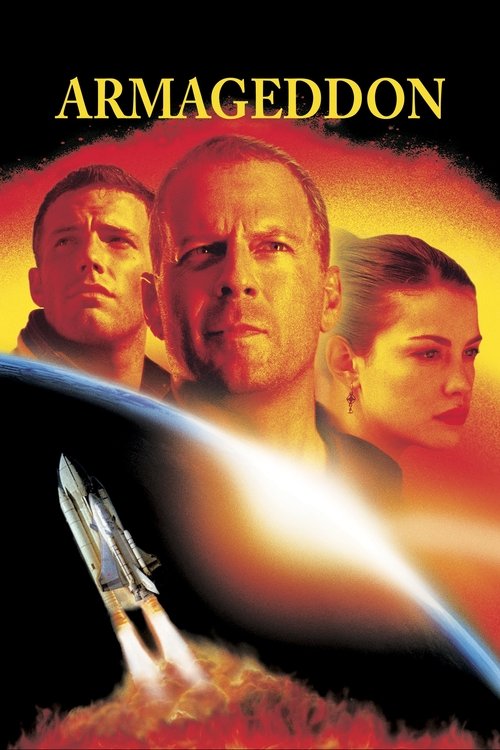
Armageddon
1998 · Directed by Michael Bay
Woke Score
CriticCritic Score
Audience
Ultra Based
Critics rated this 38 points above its woke score. Among Ultra Based films, this critic score ranks #1316 of 1469.
Representation Casting
Score: 15/100
The cast includes Michael Clarke Duncan and other minority actors in ensemble roles, but there is no deliberate strategy or commentary around representation. They simply exist in the background of a predominantly white action film.
LGBTQ+ Themes
Score: 0/100
No LGBTQ+ themes, representation, or subtext. The film is entirely heteronormative in its romantic subplot and crew dynamics.
Feminist Agenda
Score: 5/100
Liv Tyler's character exists primarily as a romantic prize and daughter to be protected. The central conflict involves her father and boyfriend negotiating her honor. There is no examination of female agency or autonomy.
Racial Consciousness
Score: 5/100
While the cast includes actors of color, the film contains no exploration of racial themes or consciousness. Minority characters are present but not acknowledged as such.
Climate Crusade
Score: 0/100
The asteroid threat is presented as a natural disaster requiring military-style heroic action, not as commentary on environmental systems or climate concerns.
Eat the Rich
Score: 0/100
The film presents NASA and government institutions as benevolent, heroic entities. There is no critique of corporate power or systemic inequality.
Body Positivity
Score: 0/100
The film celebrates conventional masculine physicality and attractiveness. There is no challenge to beauty standards or body diversity.
Neurodivergence
Score: 0/100
No representation of neurodivergent characters or discussion of neurodiversity.
Revisionist History
Score: 0/100
The film contains no historical narrative or revisionist elements. It is set in a fictional near-future scenario.
Lecture Energy
Score: 5/100
While the film occasionally delivers exposition about asteroid science and NASA procedures, it does not attempt to lecture the audience on social issues or progressive values.


Synopsis
When an asteroid threatens to collide with Earth, NASA honcho Dan Truman determines the only way to stop it is to drill into its surface and detonate a nuclear bomb. This leads him to renowned driller Harry Stamper, who agrees to helm the dangerous space mission provided he can bring along his own hotshot crew. Among them is the cocksure A.J. who Harry thinks isn't good enough for his daughter, until the mission proves otherwise.
Consciousness Assessment
Michael Bay's "Armageddon" stands as a monument to late-nineties blockbuster excess, a film so thoroughly committed to its own bombast that it remains almost entirely indifferent to contemporary social consciousness. The narrative orbits around a crew of blue-collar drillers conscripted into space heroism, a setup that offers precisely zero commentary on class, labor, or systemic inequality. Bruce Willis grunts. Ben Affleck broods over the honor of marrying the boss's daughter. The film treats this romantic subplot as a matter of patriarchal negotiation rather than any examination of female agency. Liv Tyler exists primarily as a plot device, a daughter to be protected, a prize to be won, a narrative excuse for emotional beats in the third act. This is not progressive cinema playing at inclusivity. This is cinema that has not yet learned the vocabulary of contemporary social consciousness.
The cast does include Michael Clarke Duncan, whose presence registers as a minority actor in an ensemble role without any particular fanfare or commentary. He is simply there, another crew member among the ensemble, which might generously be read as a form of casual racial representation, though one suspects this owes more to practical casting than any commitment to diversifying the space adventure genre. The film contains no discussion of climate, no examination of corporate malfeasance, no neurodivergent representation, no queer subtext, no feminist reckoning with its own narrative assumptions. It is fundamentally conservative in its social dimensions, though not self-consciously so. It simply does not care. It wants explosions. It wants sentiment. It wants earnestness applied to the preposterous. It delivers these things with impressive technical efficiency.
The film's complete absence of progressive sensibility is almost refreshing in its totality. There is nothing here to examine, no attempt at messaging, no box to check. This is a work that predates the cultural moment we are tasked with analyzing, a dinosaur preserved in amber, utterly innocent of the social debates that would come to define cinema of the subsequent decades. To score it is to acknowledge that it was made in a different era, when the very concept of social consciousness in blockbuster cinema was not yet a consideration. One does not fault a 1998 action film for lacking 2024's sensibilities. One simply notes their absence with the dispassion of an archaeologist cataloging artifacts.
Analysis generated by our Consciousness Algorithm
Critic Reviews
“It looks like a TV ad, or 200 of them strung together, with the same kind of gaudy virtuosity, lavish technique and expensive self-mockery tinging every shot.”
“The movie is ridiculous, but since the special effects are really quite impressive, that seems a small point.”
“So predictable it could have been written by a chimp who's watched too much TV, the huge movie is as dumb as it is loud, and it's way too loud. ”
Consciousness Markers
The cast includes Michael Clarke Duncan and other minority actors in ensemble roles, but there is no deliberate strategy or commentary around representation. They simply exist in the background of a predominantly white action film.
No LGBTQ+ themes, representation, or subtext. The film is entirely heteronormative in its romantic subplot and crew dynamics.
Liv Tyler's character exists primarily as a romantic prize and daughter to be protected. The central conflict involves her father and boyfriend negotiating her honor. There is no examination of female agency or autonomy.
While the cast includes actors of color, the film contains no exploration of racial themes or consciousness. Minority characters are present but not acknowledged as such.
The asteroid threat is presented as a natural disaster requiring military-style heroic action, not as commentary on environmental systems or climate concerns.
The film presents NASA and government institutions as benevolent, heroic entities. There is no critique of corporate power or systemic inequality.
The film celebrates conventional masculine physicality and attractiveness. There is no challenge to beauty standards or body diversity.
No representation of neurodivergent characters or discussion of neurodiversity.
The film contains no historical narrative or revisionist elements. It is set in a fictional near-future scenario.
While the film occasionally delivers exposition about asteroid science and NASA procedures, it does not attempt to lecture the audience on social issues or progressive values.