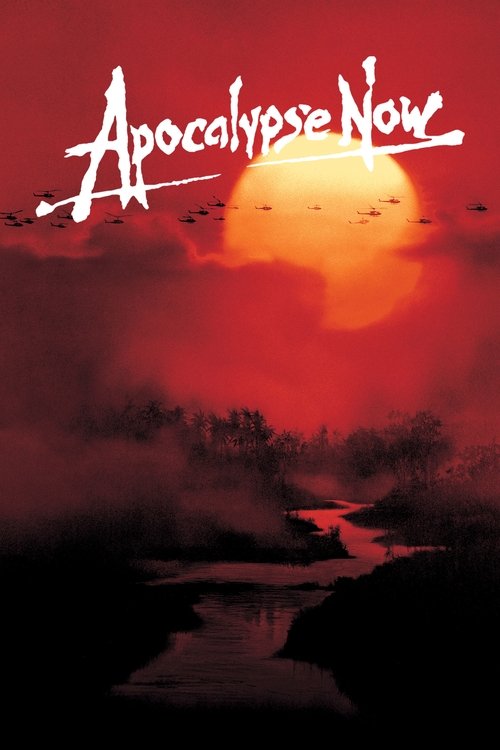
Apocalypse Now
1979 · Directed by Francis Ford Coppola
Woke Score
CriticCritic Score
Audience
Ultra Based
Critics rated this 90 points above its woke score. Among Ultra Based films, this critic score ranks #70 of 1469.
Representation Casting
Score: 5/100
The film features a predominantly white male cast in leading roles. Vietnamese people are portrayed as antagonists or background figures rather than as rounded characters with agency and perspective.
LGBTQ+ Themes
Score: 0/100
No LGBTQ+ representation or thematic content. The film contains no characters or storylines addressing sexual orientation or gender identity.
Feminist Agenda
Score: 2/100
Female characters are almost entirely absent from this male-centered military narrative. A brief appearance of a prostitute represents the extent of female presence in the film.
Racial Consciousness
Score: 8/100
The film depicts racism within military ranks as a historical fact, but does not attempt to center non-white perspectives or frame the war through a lens of systemic racial analysis.
Climate Crusade
Score: 0/100
No environmental themes or climate-related content. The film does not engage with ecological concerns or sustainability messaging.
Eat the Rich
Score: 15/100
The film critiques military-industrial power and imperial overreach, but this critique operates on philosophical and aesthetic grounds rather than through contemporary anti-capitalist messaging.
Body Positivity
Score: 0/100
No body diversity or body positivity messaging. The film does not engage with contemporary discussions of body representation.
Neurodivergence
Score: 0/100
No representation of neurodivergent characters or exploration of neurodivergence as a theme. The film does not address mental health or cognitive diversity.
Revisionist History
Score: 5/100
While the film presents a stylized, surreal interpretation of the Vietnam War, it does not reframe historical events through a contemporary progressive lens or attempt revisionist historical framing.
Lecture Energy
Score: 10/100
The film contains philosophical monologues, particularly from Marlon Brando's character, but these are diegetic character moments rather than the film lecturing audiences about contemporary social issues.


Synopsis
At the height of the Vietnam war, Captain Benjamin Willard is sent on a dangerous mission that, officially, "does not exist, nor will it ever exist." His goal is to locate - and eliminate - a mysterious Green Beret Colonel named Walter Kurtz, who has been leading his personal army on illegal guerrilla missions into enemy territory.
Consciousness Assessment
Apocalypse Now stands as a towering artistic achievement from an era before the current cultural moment, a film that grapples with American military overreach through surrealism and philosophical inquiry rather than through the contemporary social justice frameworks that would later define progressive cinema. Francis Ford Coppola's 1979 masterpiece critiques imperialism, institutional violence, and the corruption of power, yet it does so in a manner fundamentally alien to modern progressive sensibilities. The film treats these subjects as metaphysical and aesthetic problems, not as platforms for examining systemic oppression or amplifying marginalized voices. The near-total absence of female characters, the peripheral treatment of Vietnamese people as landscape rather than subjects, and the centrality of white masculine consciousness all mark this as a product of its era, crafted according to the artistic and cultural assumptions of the 1970s rather than those of the 2020s.
What makes Apocalypse Now instructive for our purposes is its demonstration of the distinction between moral seriousness and modern progressive cultural consciousness. A film can be profoundly critical of American power without engaging in the specific work of representation, intersectionality, and contemporary social consciousness that characterizes woke cinema. Coppola's film remains a meditation on the human capacity for corruption and the seductive nature of absolute power, delivered through male-centered military narratives and male philosophical monologues. The celebrated Marlon Brando sequences, for all their power, represent a distinctly pre-contemporary form of artistic expression.
This is not a film that has aged poorly in its social consciousness, because it was never primarily concerned with social consciousness in the modern sense. It is a work of artistic ambition and philosophical reach, operating in registers that predate the cultural categories we now use to measure films. Its low score reflects not a moral failing but a historical fact: it was made before these specific forms of cultural awareness became the baseline expectation for serious cinema.
Analysis generated by our Consciousness Algorithm
Critic Reviews
“Remember the weird beauty of the massed helicopters lifting over the trees in the long shot, and the insane power of Wagner's music, played loudly during the attack, and you feel what Coppola was getting at: Those moments as common in life as art, when the whole huge grand mystery of the world, so terrible, so beautiful, seems to hang in the balance.”
“As powerful as the movie remains and as much as I enjoyed this new cut, I have to say that the additional footage -- material that Coppola felt he had to excise 20 years ago to reach a commercial length -- has turned out to be something of a mixed blessing.”
“Coppola and Murch have balanced their new edit with grace notes of sweetness, elegance and eroticism, and the payoff is grand, providing both a reprieve from the multiple blitzkriegs and a break in the monotony of the cruise up the Nung.”
“The finished film remains a mess of tangled, turgid continuity and florid, mock-operatic style -- at best a collection of production numbers and set pieces waiting in rain for a story capable of accumulating suspense and meaning.”
Consciousness Markers
The film features a predominantly white male cast in leading roles. Vietnamese people are portrayed as antagonists or background figures rather than as rounded characters with agency and perspective.
No LGBTQ+ representation or thematic content. The film contains no characters or storylines addressing sexual orientation or gender identity.
Female characters are almost entirely absent from this male-centered military narrative. A brief appearance of a prostitute represents the extent of female presence in the film.
The film depicts racism within military ranks as a historical fact, but does not attempt to center non-white perspectives or frame the war through a lens of systemic racial analysis.
No environmental themes or climate-related content. The film does not engage with ecological concerns or sustainability messaging.
The film critiques military-industrial power and imperial overreach, but this critique operates on philosophical and aesthetic grounds rather than through contemporary anti-capitalist messaging.
No body diversity or body positivity messaging. The film does not engage with contemporary discussions of body representation.
No representation of neurodivergent characters or exploration of neurodivergence as a theme. The film does not address mental health or cognitive diversity.
While the film presents a stylized, surreal interpretation of the Vietnam War, it does not reframe historical events through a contemporary progressive lens or attempt revisionist historical framing.
The film contains philosophical monologues, particularly from Marlon Brando's character, but these are diegetic character moments rather than the film lecturing audiences about contemporary social issues.