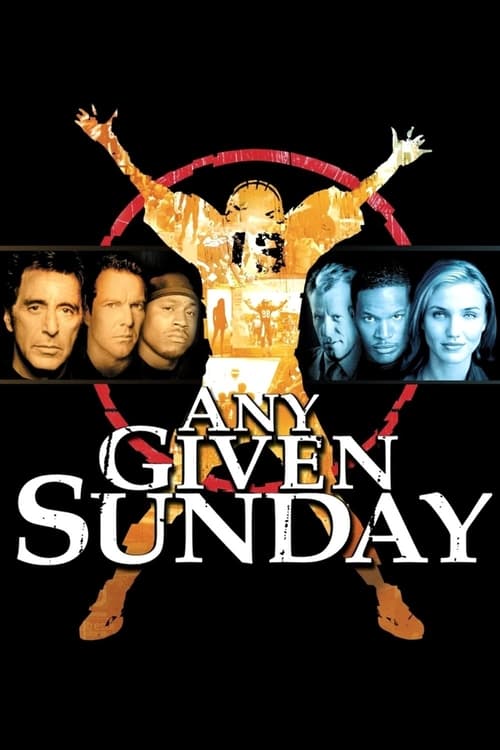
Any Given Sunday
1999 · Directed by Oliver Stone
Woke Score
CriticCritic Score
Audience
Based
Critics rated this 30 points above its woke score. Among Based films, this critic score ranks #285 of 345.
Representation Casting
Score: 35/100
Features a multiracial cast including Jamie Foxx, LL Cool J, and other Black athletes, but their inclusion appears motivated by verisimilitude rather than intentional progressive casting choices. The film reflects the demographic reality of professional football without interrogating the systems that shape that reality.
LGBTQ+ Themes
Score: 0/100
No LGBTQ+ themes, characters, or representation are present in the film. The narrative centers entirely on heterosexual male relationships and competition.
Feminist Agenda
Score: 25/100
Cameron Diaz plays a female co-owner who must succeed in a male-dominated business environment, which provides a nominal feminist gesture. However, the character succeeds by adopting masculine values rather than challenging them, and her arc does not meaningfully interrogate gender dynamics or power structures.
Racial Consciousness
Score: 0/100
Despite featuring Black athletes prominently, the film does not examine race, racism, or the historical and contemporary exploitation of Black bodies in professional sports. Racial consciousness is entirely absent from the narrative.
Climate Crusade
Score: 0/100
No climate-related themes or environmental consciousness present in the film. The narrative is entirely centered on professional football and business competition.
Eat the Rich
Score: 0/100
The film celebrates capitalist competition and the ruthlessness of business, presenting these values as necessary and inevitable rather than as systems worth critiquing. It offers no anti-capitalist perspective.
Body Positivity
Score: 0/100
The film is preoccupied with athletic male bodies and their physical conditioning. There is no exploration of body diversity, body acceptance, or body positivity beyond the fetishization of athletic performance.
Neurodivergence
Score: 0/100
No neurodivergent characters or themes are present. The film does not engage with disability, mental health, or neurodiversity in any meaningful way.
Revisionist History
Score: 0/100
The film is not concerned with historical events or narratives. It focuses on fictional contemporary characters within professional sports and does not engage in revisionist history.
Lecture Energy
Score: 15/100
Oliver Stone employs his characteristic stylistic bombast and occasional monologuing about competition and survival, but the film stops short of explicit preachiness. The messaging about capitalism and ambition remains implicit in the narrative structure rather than delivered through heavy-handed exposition.


Synopsis
A star quarterback gets knocked out of the game and an unknown third stringer is called in to replace him. The unknown gives a stunning performance and forces the aging coach to reevaluate his game plans and life. A new co-owner/president adds to the pressure of winning. The new owner must prove herself in a male dominated world.
Consciousness Assessment
Oliver Stone's "Any Given Sunday" arrives in 1999 with the swagger of a director convinced that professional football serves as a perfect metaphor for American capitalism, competition, and the relentless machinery of masculine ambition. The film attempts to inoculate itself against accusations of retrograde thinking by introducing a female owner character played by Cameron Diaz, one of the few women in a sea of muscular men grappling with injury, ego, and the business of sports. This gesture toward gender representation remains largely surface-level, however. Diaz's character exists primarily to navigate the male-dominated boardroom rather than to challenge any fundamental assumptions about power, labor, or gender dynamics within professional sports.
The film's assembly of Black athletes in prominent roles, including Jamie Foxx and LL Cool J, might initially suggest an engagement with questions of racial representation in professional football. Yet these performers inhabit their roles as athletes first, narrative agents second. The script does not interrogate the historical or contemporary realities of race in American sports, nor does it examine the exploitation of Black bodies in a billion-dollar industry. Their presence functions more as verisimilitude than as commentary. Stone seems interested in the physical spectacle and the psychological toll of competition rather than the structural inequalities that shape who gets to compete and under what terms.
The film's lack of any genuine progressive sensibility becomes clearer upon reflection. "Any Given Sunday" is a capitalist film about capitalism, interested in the aesthetics of power and dominance rather than their critique. It celebrates the ruthlessness of competition, the necessity of physical sacrifice, and the primacy of winning. The female owner's presence does not fundamentally alter this worldview. She must succeed in a male-dominated environment by adopting its values, not by transforming them. For a film so concerned with representation, it remains remarkably incurious about what representation actually means.
Analysis generated by our Consciousness Algorithm
Critic Reviews
“There's scarcely a scene in which the actors, action and sound track aren't cranked up to maximum intensity.”
“A kinetically charged gridiron drama that is enormous fun to watch.”
“Though there are helmets deeper than this movie, you do have to admire the level of screen showmanship .”
“A football film made by a man who apparently has seen little of the game outside of movies, and not very good ones at that.”
Consciousness Markers
Features a multiracial cast including Jamie Foxx, LL Cool J, and other Black athletes, but their inclusion appears motivated by verisimilitude rather than intentional progressive casting choices. The film reflects the demographic reality of professional football without interrogating the systems that shape that reality.
No LGBTQ+ themes, characters, or representation are present in the film. The narrative centers entirely on heterosexual male relationships and competition.
Cameron Diaz plays a female co-owner who must succeed in a male-dominated business environment, which provides a nominal feminist gesture. However, the character succeeds by adopting masculine values rather than challenging them, and her arc does not meaningfully interrogate gender dynamics or power structures.
Despite featuring Black athletes prominently, the film does not examine race, racism, or the historical and contemporary exploitation of Black bodies in professional sports. Racial consciousness is entirely absent from the narrative.
No climate-related themes or environmental consciousness present in the film. The narrative is entirely centered on professional football and business competition.
The film celebrates capitalist competition and the ruthlessness of business, presenting these values as necessary and inevitable rather than as systems worth critiquing. It offers no anti-capitalist perspective.
The film is preoccupied with athletic male bodies and their physical conditioning. There is no exploration of body diversity, body acceptance, or body positivity beyond the fetishization of athletic performance.
No neurodivergent characters or themes are present. The film does not engage with disability, mental health, or neurodiversity in any meaningful way.
The film is not concerned with historical events or narratives. It focuses on fictional contemporary characters within professional sports and does not engage in revisionist history.
Oliver Stone employs his characteristic stylistic bombast and occasional monologuing about competition and survival, but the film stops short of explicit preachiness. The messaging about capitalism and ambition remains implicit in the narrative structure rather than delivered through heavy-handed exposition.