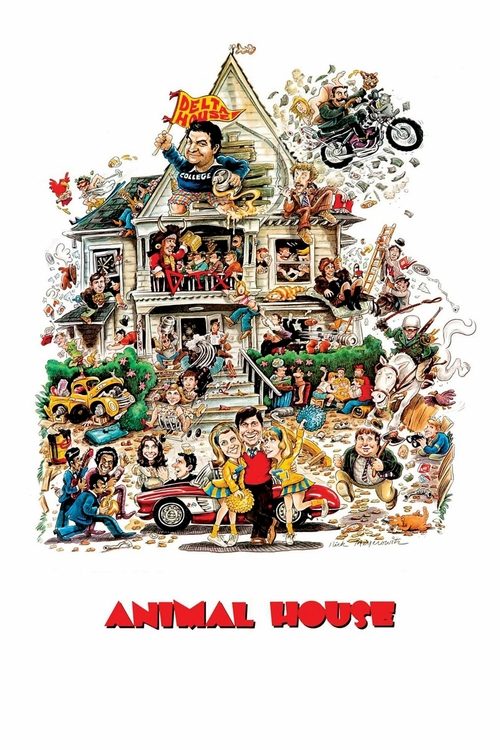
Animal House
1978 · Directed by John Landis
Woke Score
CriticCritic Score
Audience
Ultra Based
Critics rated this 75 points above its woke score. Among Ultra Based films, this critic score ranks #399 of 1469.
Representation Casting
Score: 5/100
The cast is uniformly white and male in prominent roles. Karen Allen appears as the sole significant female character, while the broader ensemble is entirely white. No attempt at diverse casting is evident.
LGBTQ+ Themes
Score: 0/100
The film contains no LGBTQ+ themes, representation, or acknowledgment. Sexual orientation and gender identity are not topics of concern in the narrative.
Feminist Agenda
Score: 3/100
Female characters serve primarily as romantic interests and comic props. Women are depicted as objects of pursuit rather than as agents with independent goals or significance to the plot.
Racial Consciousness
Score: 2/100
The film demonstrates no racial consciousness or consideration of racial dynamics. The cast is entirely white, and race is not addressed in any form within the narrative.
Climate Crusade
Score: 0/100
Environmental concerns are entirely absent from the film. Climate change and ecological awareness do not appear as themes or plot elements.
Eat the Rich
Score: 0/100
The film contains no anti-capitalist messaging or critique of economic systems. Class consciousness and wealth inequality are not examined.
Body Positivity
Score: 0/100
The film shows no interest in body positivity or acceptance of diverse body types. Comedy often derives from physical appearance and bodily humor with no progressive framing.
Neurodivergence
Score: 0/100
Neurodivergence is not represented or discussed. The film contains no characters explicitly portrayed as neurodivergent or any engagement with disability representation.
Revisionist History
Score: 0/100
The film makes no attempt to reinterpret historical events or challenge established historical narratives. It is set in 1962 but does not engage with historical reexamination.
Lecture Energy
Score: 5/100
While the film avoids preachy moralizing about social issues, the Dean character embodies institutional authority that the narrative positions for mockery. Some scenes contain implicit critique of institutional rigidity, though this is played for comedy rather than instruction.


Synopsis
At a 1962 College, Dean Vernon Wormer is determined to expel the entire Delta Tau Chi Fraternity, but those troublemakers have other plans for him.
Consciousness Assessment
Animal House is a 1978 comedy that exists in almost complete isolation from contemporary progressive cultural sensibilities. The film concerns itself with depicting fraternity antics in 1962, which allows it to serve as a document of masculine chaos unencumbered by any apparent concern for representation, diversity, or social consciousness. The female characters exist primarily as objects of desire and comic relief, with Karen Allen providing the sole female presence of any significance, and even she functions largely as a romantic interest rather than a fully realized character with her own narrative arc. The film's comedy derives from the violation of institutional authority, not from any interrogation of systemic power structures or social hierarchies. John Landis directs with the sensibility of someone making a film entirely for entertainment value, unconcerned with signaling any awareness of gender dynamics, racial representation, or cultural inclusivity. The cast is uniformly white and male in its leadership positions, which was entirely unremarkable in 1978 but would be considered an oversight by contemporary standards. The humor operates entirely within a framework of anarchic masculinity, with no counterbalancing progressive sensibility to be found. This is not a film that was ahead of its time socially, nor was it particularly backward for 1978. It is simply a film that makes no gesture toward the cultural consciousness that would become prevalent decades later. Animal House succeeded as entertainment precisely because it was unconcerned with such matters. The film's cultural impact and critical legacy rest entirely on its comedic audacity and influence on the comedy genre, not on any social commentary or progressive values. Viewed through the lens of contemporary cultural analysis, it reads as a historical artifact from an era with markedly different priorities and sensibilities.
Analysis generated by our Consciousness Algorithm
Critic Reviews
“The movie is vulgar, raunchy, ribald, and occasionally scatological. It is also the funniest comedy since Mel Brooks made "The Producers."”
“An unashamed sense of its own fantasy is coupled with classically mounted slapstick; nostalgia mixes with cynicism in seductive proportions; and John Belushi's central performance as brain-damaged slob-cum-Thief of Baghdad is wonderful.”
“Animal House is the sort of film you hate yourself for laughing at. It is so gross and tasteless you feel you should be disgusted but it's hard to be offended by something that is so sidesplittingly funny. [05 Aug 1978]”
Consciousness Markers
The cast is uniformly white and male in prominent roles. Karen Allen appears as the sole significant female character, while the broader ensemble is entirely white. No attempt at diverse casting is evident.
The film contains no LGBTQ+ themes, representation, or acknowledgment. Sexual orientation and gender identity are not topics of concern in the narrative.
Female characters serve primarily as romantic interests and comic props. Women are depicted as objects of pursuit rather than as agents with independent goals or significance to the plot.
The film demonstrates no racial consciousness or consideration of racial dynamics. The cast is entirely white, and race is not addressed in any form within the narrative.
Environmental concerns are entirely absent from the film. Climate change and ecological awareness do not appear as themes or plot elements.
The film contains no anti-capitalist messaging or critique of economic systems. Class consciousness and wealth inequality are not examined.
The film shows no interest in body positivity or acceptance of diverse body types. Comedy often derives from physical appearance and bodily humor with no progressive framing.
Neurodivergence is not represented or discussed. The film contains no characters explicitly portrayed as neurodivergent or any engagement with disability representation.
The film makes no attempt to reinterpret historical events or challenge established historical narratives. It is set in 1962 but does not engage with historical reexamination.
While the film avoids preachy moralizing about social issues, the Dean character embodies institutional authority that the narrative positions for mockery. Some scenes contain implicit critique of institutional rigidity, though this is played for comedy rather than instruction.