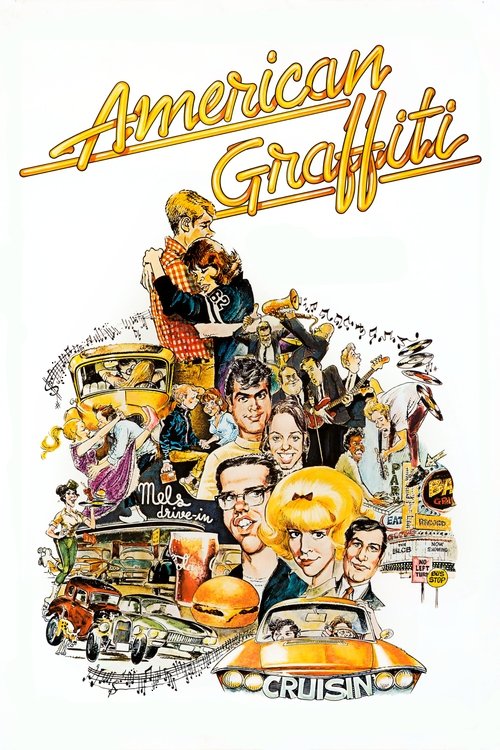
American Graffiti
1973 · Directed by George Lucas
Woke Score
CriticCritic Score
Audience
Ultra Based
Critics rated this 93 points above its woke score. Among Ultra Based films, this critic score ranks #31 of 1469.
Representation Casting
Score: 5/100
Nearly all-white cast reflects 1960s small-town America without representation of other racial or ethnic groups. Wolfman Jack appears as a radio voice, peripheral to the main narrative.
LGBTQ+ Themes
Score: 0/100
No LGBTQ+ themes, characters, or content. The film is entirely focused on heterosexual romance and male bonding.
Feminist Agenda
Score: 10/100
Female characters exist primarily as romantic interests for male protagonists. No feminist consciousness or critique of gender dynamics is present in the narrative.
Racial Consciousness
Score: 5/100
The film depicts a white American community without critical examination of race or racial dynamics. Its perspective is observational rather than analytical.
Climate Crusade
Score: 0/100
No climate-related themes or environmental consciousness appears in the film. Not applicable to this narrative.
Eat the Rich
Score: 0/100
The film celebrates car culture and consumer capitalism. There is no critique of economic systems or wealth inequality.
Body Positivity
Score: 5/100
Standard 1970s Hollywood aesthetic standards apply. No particular progressive body representation or inclusivity messaging.
Neurodivergence
Score: 0/100
No representation of neurodivergence or disability. Not a focus of the film's narrative.
Revisionist History
Score: 0/100
The film is nostalgic about the early 1960s but does not engage in modern revisionist historical framing or reinterpretation.
Lecture Energy
Score: 0/100
This is a narrative-driven comedy-drama with no preachy elements or educational messaging about social issues.


Synopsis
A couple of high school graduates spend one final night cruising the strip with their buddies before they go off to college.
Consciousness Assessment
American Graffiti is a masterwork of nostalgic filmmaking, and like most nostalgia, it is fundamentally a product of its moment. George Lucas captures the texture of early 1960s youth culture with meticulous attention to period detail, from the cars to the radio hits to the performative rituals of adolescent male bonding. Yet the film exists in a pre-conscious state regarding the social hierarchies it depicts. The narrative centers entirely on male characters and their romantic pursuits, with female characters functioning primarily as objects of desire or conquest. The world presented is almost exclusively white, a portrait of American teenage life that requires no justification for its homogeneity.
This is not a moral failing of the film, merely an observation about its cultural moment. Lucas was interested in capturing a world, not critiquing it. The lack of representational diversity, the unreflective gender dynamics, and the celebration of consumer car culture are all simply what this film is. It makes no claim to progressive sensibility and harbors no ambition toward social consciousness. We might appreciate the film's craft and cultural significance without pretending it contains values it does not possess.
The result is a film that scores remarkably low on modern measures of cultural awareness, not because it is hostile to such awareness, but because such awareness did not yet exist as a cultural framework. This is the proper context for understanding its near-total absence of what we now call progressive markers. It is a beautiful artifact from a different time.
Analysis generated by our Consciousness Algorithm
Critic Reviews
“On the surface, Lucas has made a film that seems almost artless; his teenagers cruise Main Street and stop at Mel’s Drive-In and listen to Wolfman Jack on the radio and neck and lay rubber and almost convince themselves their moment will last forever. But the film’s buried structure shows an innocence in the process of being lost, and as its symbol Lucas provides the elusive blonde in the white Thunderbird -- the vision of beauty always glimpsed at the next intersection, the end of the next street.”
“The ingeniously structured screenplay by Katz, Huyck and Lucas offers up a load of wonderful characters who whirl about in ducktail haircuts and shirtwaist dresses, lost in the obscenity of American culture. Thanks to some of the most spirited, daffy dialogue since Lubitsch, their sweetness is deliriously funny. No matter how high the dramatic stakes become, the movie never loses its sense of humor, and although it has a lot to say, it's gloriously free of pretensions. ”
“American Graffiti exists not so much in its individual stories as in its orchestration of many stories, its sense of time and place. Although it is full of the material of fashionable nostalgia, it never exploits nostalgia. In its feeling for movement and music and the vitality of the night—and even in its vision in white—it is oddly closer to some early Fellini than to the recent American past of, say, The Last Picture Show or Summer of '42.”
“There's a sense of beauty and dread that's cleverly injected into George Lucas' American Graffiti, a tone poem and ode to the music, cars and culture of the early '60s. On one level, the film is a staggeringly thoughtful slice of Americana – one night in the eyes of several young teens looking for love, adventure and fun. But on another level, there's a genuine sense of apprehension. The world is quickly catching up to our heroes, and soon they'll be flung head-first into Vietnam, the hippie movement, and a social revolution”
Consciousness Markers
Nearly all-white cast reflects 1960s small-town America without representation of other racial or ethnic groups. Wolfman Jack appears as a radio voice, peripheral to the main narrative.
No LGBTQ+ themes, characters, or content. The film is entirely focused on heterosexual romance and male bonding.
Female characters exist primarily as romantic interests for male protagonists. No feminist consciousness or critique of gender dynamics is present in the narrative.
The film depicts a white American community without critical examination of race or racial dynamics. Its perspective is observational rather than analytical.
No climate-related themes or environmental consciousness appears in the film. Not applicable to this narrative.
The film celebrates car culture and consumer capitalism. There is no critique of economic systems or wealth inequality.
Standard 1970s Hollywood aesthetic standards apply. No particular progressive body representation or inclusivity messaging.
No representation of neurodivergence or disability. Not a focus of the film's narrative.
The film is nostalgic about the early 1960s but does not engage in modern revisionist historical framing or reinterpretation.
This is a narrative-driven comedy-drama with no preachy elements or educational messaging about social issues.