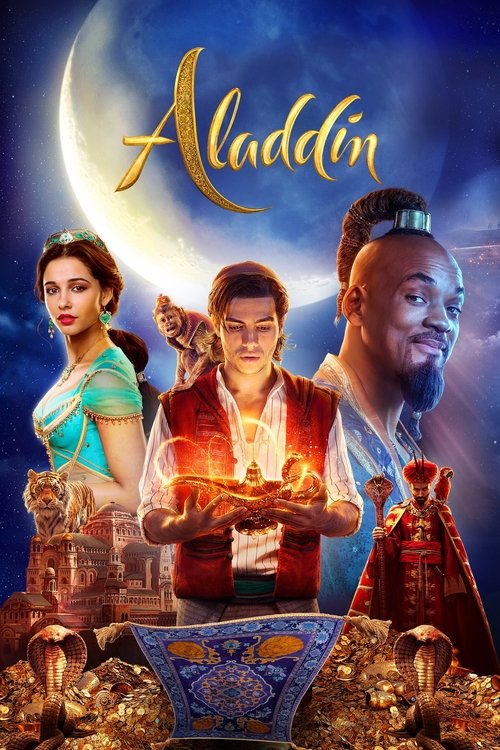
Aladdin
2019 · Directed by Guy Ritchie
Woke Score
CriticCritic Score
Audience
Woke-Adjacent
Critics rated this 44 points above its woke score. Among Woke-Adjacent films, this critic score ranks #20 of 151.
Representation Casting
Score: 68/100
The film features a diverse cast with Middle Eastern and South Asian actors in lead roles, notably Mena Massoud, Naomi Scott, and Navid Negahban. However, the casting remains limited to surface-level diversity without addressing historical whitewashing concerns entirely.
LGBTQ+ Themes
Score: 0/100
There are no LGBTQ themes, representation, or storylines present in the film. The narrative remains heteronormative and traditional in structure.
Feminist Agenda
Score: 35/100
Jasmine receives slightly more agency than her 1992 counterpart, speaking against patriarchal marriage expectations. However, her empowerment arc feels superficial and the core narrative still centers on winning a man and gaining status through him.
Racial Consciousness
Score: 15/100
While the film features diverse casting, it lacks any meaningful engagement with questions of colonialism, Orientalism, or systemic racism. The setting remains a generic fantasy backdrop without cultural specificity or critique.
Climate Crusade
Score: 0/100
There is no climate consciousness or environmental messaging in the film. The narrative does not engage with ecological themes whatsoever.
Eat the Rich
Score: 5/100
The film's central message celebrates wealth acquisition and status as ultimate rewards. Aladdin's transformation from street urchin to prince is presented as unambiguously positive, with no critique of class hierarchies.
Body Positivity
Score: 0/100
The film features conventionally attractive leads and makes no effort to present diverse body types or challenge beauty standards. No body positivity messaging is present.
Neurodivergence
Score: 0/100
There is no representation of neurodivergent characters or engagement with neurodivergence themes in the narrative.
Revisionist History
Score: 0/100
The film does not engage in historical revisionism of any kind. It remains a fantasy adaptation of a fairy tale without historical pretension.
Lecture Energy
Score: 25/100
While Jasmine delivers some dialogue about women's agency and choice in marriage, these moments feel inserted rather than woven naturally into the narrative. The film avoids heavy-handed messaging but also avoids genuine thematic depth.


Synopsis
A kindhearted street urchin named Aladdin embarks on a magical adventure after finding a lamp that releases a wisecracking genie while a power-hungry Grand Vizier vies for the same lamp that has the power to make their deepest wishes come true.
Consciousness Assessment
Disney's 2019 live-action Aladdin represents a carefully calculated exercise in progressive aesthetics divorced from progressive substance. The film casts Mena Massoud, Naomi Scott, and Navid Negahban in lead roles, creating the visual impression of cultural authenticity while the narrative remains fundamentally unchanged from its 1992 predecessor. This is representation as brand management, diversity as a checkbox rather than a commitment to meaningful storytelling.
The character of Jasmine receives the film's most transparent attempt at modernization. She now explicitly rejects forced marriage and expresses frustration at her lack of agency within the patriarchal structures of Agrabah. Yet these moments feel grafted onto a narrative that ultimately validates the very systems she critiques. She gains agency not through her own achievement but through romantic attachment to Aladdin, who himself ascends through magical intervention rather than merit. The film wants credit for feminist sensibility while maintaining a fundamentally conservative power structure.
What emerges most clearly from Aladdin is Disney's strategic navigation of contemporary cultural expectations. The film offers enough visual and casting-level diversity to satisfy surface-level criticism while avoiding any substantive engagement with the colonial fantasy elements inherent to the source material. There is no interrogation of Orientalism, no genuine reckoning with class hierarchies, no ideological challenge whatsoever. This is a film designed to appeal to audiences who wish to feel progressive without requiring them to think critically about power, representation, or the stories we tell ourselves about wish fulfillment and social mobility. It is, in other words, perfectly calibrated for maximum profit and minimum offense.
Analysis generated by our Consciousness Algorithm
Critic Reviews
“The movie that brought a hip new sensibility to animated features and which still stands up in the age of Pixar and DreamWorks thanks largely to a blistering improv turn from Robin Williams.”
“Aladdin is a film of wonders. To see it is to be the smallest child, open-mouthed at the screen's sense of magic, as well as the most knowing adult, eager to laugh at some surprisingly sly humor. ”
“Despite a similar setting-the never-never land of the Arabian Nights — the new movie is hipper, faster, more topical.”
“Aladdin is ultimately less offensive than patently ridiculous, mostly because its ethnic white noise is really just an excuse for Robin Williams—as a postmodern blabbermouthed genie who grants Aladdin three wishes—to put on the most elaborate, narcissistic circus act in the history of cinema.”
Consciousness Markers
The film features a diverse cast with Middle Eastern and South Asian actors in lead roles, notably Mena Massoud, Naomi Scott, and Navid Negahban. However, the casting remains limited to surface-level diversity without addressing historical whitewashing concerns entirely.
There are no LGBTQ themes, representation, or storylines present in the film. The narrative remains heteronormative and traditional in structure.
Jasmine receives slightly more agency than her 1992 counterpart, speaking against patriarchal marriage expectations. However, her empowerment arc feels superficial and the core narrative still centers on winning a man and gaining status through him.
While the film features diverse casting, it lacks any meaningful engagement with questions of colonialism, Orientalism, or systemic racism. The setting remains a generic fantasy backdrop without cultural specificity or critique.
There is no climate consciousness or environmental messaging in the film. The narrative does not engage with ecological themes whatsoever.
The film's central message celebrates wealth acquisition and status as ultimate rewards. Aladdin's transformation from street urchin to prince is presented as unambiguously positive, with no critique of class hierarchies.
The film features conventionally attractive leads and makes no effort to present diverse body types or challenge beauty standards. No body positivity messaging is present.
There is no representation of neurodivergent characters or engagement with neurodivergence themes in the narrative.
The film does not engage in historical revisionism of any kind. It remains a fantasy adaptation of a fairy tale without historical pretension.
While Jasmine delivers some dialogue about women's agency and choice in marriage, these moments feel inserted rather than woven naturally into the narrative. The film avoids heavy-handed messaging but also avoids genuine thematic depth.