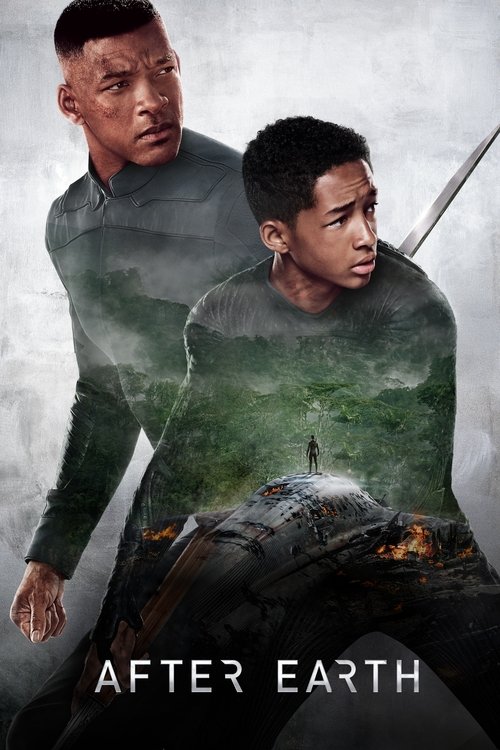
After Earth
2013 · Directed by M. Night Shyamalan
Woke Score
CriticCritic Score
Audience
Ultra Based
Critics rated this 15 points above its woke score. Among Ultra Based films, this critic score ranks #1415 of 1469.
Representation Casting
Score: 45/100
The film features Black leads in major roles, but this appears to be driven by Will Smith's desire to work with his son rather than conscious representation strategy. The casting choice is not thematized or explored within the narrative.
LGBTQ+ Themes
Score: 0/100
No LGBTQ+ representation or themes are present in this father-son survival narrative.
Feminist Agenda
Score: 0/100
The film centers entirely on male characters and a father-son relationship, with minimal female presence. No feminist themes or female agency in the narrative.
Racial Consciousness
Score: 15/100
While protagonists are Black, the film does not engage explicitly with racial identity or themes. Any afrofuturist elements are not overt in the narrative or messaging.
Climate Crusade
Score: 30/100
The plot involves environmental catastrophe forcing human evacuation from Earth, but this serves as background scaffolding rather than contemporary climate commentary or activism.
Eat the Rich
Score: 0/100
No anti-capitalist themes present. The film is a straightforward military and survival narrative without economic critique.
Body Positivity
Score: 0/100
No body positivity themes. The film features fit military soldiers in a survival scenario with no engagement with body diversity or acceptance.
Neurodivergence
Score: 0/100
No representation of or engagement with neurodivergence in the film.
Revisionist History
Score: 0/100
While set 1000 years in the future, the film does not engage in revisionist history or reframe historical events.
Lecture Energy
Score: 20/100
The film contains some moralizing about fear and parenting, particularly from Will Smith's character, but this remains relatively restrained and not heavy-handed compared to more preachy films.


Synopsis
One thousand years after cataclysmic events forced humanity's escape from Earth, Nova Prime has become mankind's new home. Legendary General Cypher Raige returns from an extended tour of duty to his estranged family, ready to be a father to his 13-year-old son, Kitai. When an asteroid storm damages Cypher and Kitai's craft, they crash-land on a now unfamiliar and dangerous Earth. As his father lies dying in the cockpit, Kitai must trek across the hostile terrain to recover their rescue beacon. His whole life, Kitai has wanted nothing more than to be a soldier like his father. Today, he gets his chance.
Consciousness Assessment
After Earth presents the curious case of a high-budget blockbuster that nominally features two Black leads yet engages almost not at all with questions of representation or cultural consciousness. Will Smith's vanity project, directed by M. Night Shyamalan, is fundamentally a father-son survival story dressed in science fiction trappings. The film's environmental backstory, in which Earth becomes uninhabitable and forces humanity's exodus to Nova Prime, serves as mere plot machinery rather than any meaningful commentary on climate or ecological catastrophe. It is, in other words, apocalypse as logistics problem.
The film's relationship to progressive sensibilities is largely incidental. Jaden and Will Smith occupy the screen as protagonists in a militaristic narrative centered on stoicism, discipline, and overcoming fear through masculine fortitude. Sophie Okonedo appears in supporting capacity, but the film remains fundamentally uninterested in gender dynamics or female agency. What modest philosophical content exists concerns parenting and emotional vulnerability, though even this moralizing arrives with minimal force. The film prefers spectacle and action sequences to sustained thematic engagement.
One must acknowledge that contemporary defenders have identified afrofuturist elements and emotional complexity that mainstream critics overlooked upon release, yet these readings remain largely interpretive. The film itself offers no explicit cultural consciousness, no interrogation of its own casting choices, and no commitment to the specific progressive markers that define contemporary social consciousness. It is a 2013 action film that happened to star Black actors, not a film that thought meaningfully about what that meant or why it mattered.
Analysis generated by our Consciousness Algorithm
Critic Reviews
“After Earth is ultimately too thin of a story to support all of its grandiose embellishments, but so what? It's better to try to pack every moment with beauty and feeling than to shrug and smirk. The film takes the characters and their feelings seriously, and lets its actors give strong, simple performances. ”
“Won't change your world, but it's attractive and Smith the Elder, lowering his voice to subterranean James Earl Jones levels, delivers a shrewd minimalist performance. His son may get there yet.”
“In truth, despite more corn than Mel Gibson grows on his farm in "Signs" (another Shyamalan effort), After Earth is worth a look.”
“Summer 2013 has its first bomb, and sadly, it’s landed right on Will Smith.”
Consciousness Markers
The film features Black leads in major roles, but this appears to be driven by Will Smith's desire to work with his son rather than conscious representation strategy. The casting choice is not thematized or explored within the narrative.
No LGBTQ+ representation or themes are present in this father-son survival narrative.
The film centers entirely on male characters and a father-son relationship, with minimal female presence. No feminist themes or female agency in the narrative.
While protagonists are Black, the film does not engage explicitly with racial identity or themes. Any afrofuturist elements are not overt in the narrative or messaging.
The plot involves environmental catastrophe forcing human evacuation from Earth, but this serves as background scaffolding rather than contemporary climate commentary or activism.
No anti-capitalist themes present. The film is a straightforward military and survival narrative without economic critique.
No body positivity themes. The film features fit military soldiers in a survival scenario with no engagement with body diversity or acceptance.
No representation of or engagement with neurodivergence in the film.
While set 1000 years in the future, the film does not engage in revisionist history or reframe historical events.
The film contains some moralizing about fear and parenting, particularly from Will Smith's character, but this remains relatively restrained and not heavy-handed compared to more preachy films.