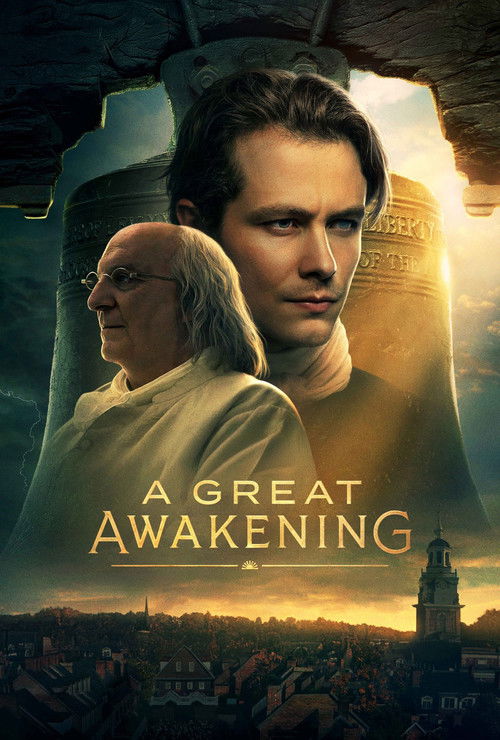
A Great Awakening
2026 · Directed by Joshua Enck · $4.9M domestic
Woke Score
CriticCritic Score
Ultra Based
Critics rated this 66 points above its woke score. Among Ultra Based films, this critic score ranks #608 of 1469.
Representation Casting
Score: 5/100
The historical setting (colonial 18th-century New England) and the film's apparent casting choices reflect a predominantly white ensemble. There is no discernible effort to diversify the cast beyond historical plausibility, and the film makes no apparent gestures toward representational inclusion.
LGBTQ+ Themes
Score: 0/100
A faith-based film centered on evangelical Christian revival contains no LGBTQ+ themes, characters, or acknowledgment. This is not a surprise to anyone.
Feminist Agenda
Score: 0/100
The narrative revolves entirely around the friendship of two prominent men, George Whitefield and Benjamin Franklin. Women do not appear to figure in the story in any meaningful capacity.
Racial Consciousness
Score: 10/100
The historical record notes that Whitefield was a plantation owner who preached to enslaved people while defending the institution of slavery. Whether the film addresses this dimension of his legacy in any substantive way is unclear, but the research suggests it does not. The score reflects the faint possibility of incidental acknowledgment.
Climate Crusade
Score: 0/100
Set in the 1730s and 1740s, the film has no conceivable framework for climate consciousness. The colonists were, broadly speaking, focused on other matters.
Eat the Rich
Score: 0/100
Benjamin Franklin, the film's co-protagonist, was an enthusiastic printer, entrepreneur, and capitalist. The film's framing of liberty as a spiritual and civic ideal contains no anti-capitalist critique whatsoever.
Body Positivity
Score: 0/100
No evidence of body positivity themes, which is consistent with a period drama produced by a Christian theatrical company for faith audiences.
Neurodivergence
Score: 0/100
No evidence of neurodivergence themes or characters. The 18th century did not have a particularly robust diagnostic vocabulary in this area.
Revisionist History
Score: 15/100
The film operates in the inverse of revisionist history: it frames the Great Awakening as a forgotten or suppressed founding narrative and positions religious revival as the true engine of American liberty. This is a form of historical reframing, though it runs counter to progressive revisionism and is better described as providentialist mythmaking.
Lecture Energy
Score: 20/100
The film's marketing language, including phrases like 'true liberty cannot only be written into law, it must be awakened in the hearts of the people,' carries a strong sermonizing register. The lecture energy here is substantial, though it emanates from a pulpit rather than a sociology seminar, which places it outside the standard woke taxonomy.
Synopsis
A GREAT AWAKENING tells the true story of an unlikely friendship between the Reverend George Whitefield and Benjamin Franklin that resulted in one of the most defining moments in American history. With the colonies on the brink of collapse, the Reverend George Whitefield ignites the first Great Awakening, uniting an entire generation with his thundering and faithful sermons and proclamations of liberty. In a miraculous turn of events, one of Whitefield's closest friends and greatest promoters becomes none other than Benjamin Franklin. With the nation's freedom hanging in the balance, the founders discover true liberty cannot only be written into law - it must be awakened in the hearts of the people.
Consciousness Assessment
Joshua Enck's "A Great Awakening" arrives in April 2026, timed with the precision of a commemorative coin to America's 250th anniversary, and it would like you to know that the nation was built not merely on constitutional documents but on the thundering sermons of George Whitefield. This is the film's central thesis, delivered with the confidence of a man who has never considered the possibility of a counterargument. It is, in the parlance of our cultural moment, the anti-woke film, and it is no less preachy for being so.
The film belongs to a genre that might be called Providentialist Cinema, a tradition in which American history is narrated as a sequence of divine interventions interrupted by the occasional founding father. Whitefield and Franklin make for an unlikely pair, as the marketing dutifully informs us, though the film appears less interested in the complexity of either man than in their utility as vessels for the thesis. Whitefield's documented status as a defender of colonial slavery, for instance, does not appear to trouble the narrative. History, in this framing, is a highlight reel.
Measured against our ten markers of contemporary progressive sensibility, "A Great Awakening" scores with remarkable consistency near the floor. It is not diverse, not feminist, not anti-capitalist, and not remotely interested in any of the preoccupations that animate the films this instrument was designed to evaluate. What it does share with those films is the lecture energy: a settled certainty that the audience needs to be told what to think, delivered through the mouths of historical figures who cannot object. The sermon, it turns out, is a format that transcends ideology. Only the content changes.
Analysis generated by our Consciousness Algorithm
Critic Reviews
“An imposing and impressive lead performance somewhat atones for an awkwardly structured script and a charisma-starved supporting cast in "A Great Awakening," the new film biography of the 18th century English preacher who lent The American Revolution some of his values and forward-thinking turns of phrase like — the film suggests — like "woke."”
“'A Great Awakening' is Sight & Sound at its finest. It is a masterful story of George Whitefield and Benjamin Franklin's unique friendship.”
“Arts and Entertainment A Great Awakening, Alana Gerlach, Benjamin Franklin, Brodie Kennedy, Caleb Hughes, Carson Burkett, Chris Faith, drama, George Whitefield, John Paul Sneed, Jonathan Blair, Joshua Enck, JT Schaeffer, movies,reviews, Tricia Bridgeman, Wes Wise April 2,2026”
“Review by Mark Dujsik | April 2,2026 Of all of Benjamin Franklin's many and assorted accomplishments, it seems odd that the makers of A Great Awakening have apparently determined that the most important of his works was a speech he gave to the Constitutional Convention in 1787.”
Consciousness Markers
The historical setting (colonial 18th-century New England) and the film's apparent casting choices reflect a predominantly white ensemble. There is no discernible effort to diversify the cast beyond historical plausibility, and the film makes no apparent gestures toward representational inclusion.
A faith-based film centered on evangelical Christian revival contains no LGBTQ+ themes, characters, or acknowledgment. This is not a surprise to anyone.
The narrative revolves entirely around the friendship of two prominent men, George Whitefield and Benjamin Franklin. Women do not appear to figure in the story in any meaningful capacity.
The historical record notes that Whitefield was a plantation owner who preached to enslaved people while defending the institution of slavery. Whether the film addresses this dimension of his legacy in any substantive way is unclear, but the research suggests it does not. The score reflects the faint possibility of incidental acknowledgment.
Set in the 1730s and 1740s, the film has no conceivable framework for climate consciousness. The colonists were, broadly speaking, focused on other matters.
Benjamin Franklin, the film's co-protagonist, was an enthusiastic printer, entrepreneur, and capitalist. The film's framing of liberty as a spiritual and civic ideal contains no anti-capitalist critique whatsoever.
No evidence of body positivity themes, which is consistent with a period drama produced by a Christian theatrical company for faith audiences.
No evidence of neurodivergence themes or characters. The 18th century did not have a particularly robust diagnostic vocabulary in this area.
The film operates in the inverse of revisionist history: it frames the Great Awakening as a forgotten or suppressed founding narrative and positions religious revival as the true engine of American liberty. This is a form of historical reframing, though it runs counter to progressive revisionism and is better described as providentialist mythmaking.
The film's marketing language, including phrases like 'true liberty cannot only be written into law, it must be awakened in the hearts of the people,' carries a strong sermonizing register. The lecture energy here is substantial, though it emanates from a pulpit rather than a sociology seminar, which places it outside the standard woke taxonomy.