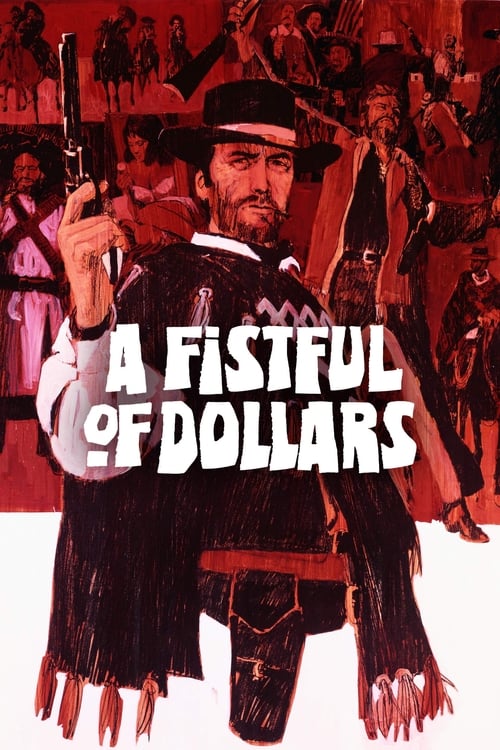
A Fistful of Dollars
1964 · Directed by Sergio Leone
Woke Score
Critic Score
Audience
Ultra Based
Critics rated this 63 points above its woke score. Among Ultra Based films, this critic score ranks #720 of 833.
Representation Casting
Score: 0/100
The cast is predominantly white and male. Mexican characters exist as background figures without narrative agency or development. No deliberate effort toward diverse representation is evident.
LGBTQ+ Themes
Score: 0/100
No LGBTQ themes, characters, or representation of any kind appear in the film.
Feminist Agenda
Score: 0/100
The film contains no feminist themes or critique. Female characters are minimal and serve purely functional roles in the male-centered narrative.
Racial Consciousness
Score: 0/100
The film employs a Mexican village setting with no examination of colonialism, racism, or systemic oppression. Mexican characters are props in a story about white male greed.
Climate Crusade
Score: 0/100
No environmental themes or climate consciousness appears in the film.
Eat the Rich
Score: 0/100
While the protagonist profits from chaos, the film presents this not as critique but as natural human behavior. No systemic critique of capitalism or wealth inequality is offered.
Body Positivity
Score: 0/100
The film presents the masculine form uncritically and without diversity in body types. No body positivity messaging is present.
Neurodivergence
Score: 0/100
No representation of neurodivergent characters or themes appears in the film.
Revisionist History
Score: 0/100
The film makes no attempt to reexamine historical events or narratives through a revisionist lens.
Lecture Energy
Score: 0/100
The film contains no didactic messaging or moralizing. It presents events with stylistic coolness rather than pedagogical intent.


Synopsis
The Man With No Name enters the Mexican village of San Miguel in the midst of a power struggle among the three Rojo brothers and sheriff John Baxter. When a regiment of Mexican soldiers bearing gold intended to pay for new weapons is waylaid by the Rojo brothers, the stranger inserts himself into the middle of the long-simmering battle, selling false information to both sides for his own benefit.
Consciousness Assessment
A Fistful of Dollars stands as a foundational work of cinematic language, though one entirely unburdened by the social consciousness that would come to preoccupy filmmakers decades later. Sergio Leone's 1964 masterwork concerns itself with the mechanics of greed, masculine violence, and the calculated exploitation of tribal conflict. Clint Eastwood's protagonist operates as a pure amoral agent of capitalism, playing factions against one another for personal profit. The film's only gesture toward what we might charitably call social awareness is its Italian production team's somewhat cynical deployment of a Mexican village setting as a backdrop for philosophical nihilism. The Mexican characters exist primarily as obstacles and economic units rather than as subjects of their own narrative.
The film contains no representation casting initiatives, no engagement with LGBTQ themes, no feminist content of any kind, and no commentary on systemic inequality that might be read as progressive. What the film does contain is a rather bleak vision of economic self-interest as the fundamental human motivation, which one might mistake for anticapitalist sentiment until one realizes the protagonist is rewarded for his ruthless pursuit of profit. The body of the lead actor is presented without irony or critique as the ideal masculine form. There is no acknowledgment of neurodivergence, no revisionist historical project, and no lecture energy whatsoever.
This is a work that predates the entire framework we use to assess modern progressive sensibilities, and it shows no strain in that predating. It is simply a film about the mechanics of power and money, told with stylistic brilliance and moral indifference. The film offers no engagement with any of the contemporary social consciousness markers one would examine in modern cinema.
Analysis generated by our Consciousness Algorithm
Critic Reviews
“Leone makes the borders of the frame feel limitless, his camera moves striking out unpredictably as if he could barely tame his vision. Ennio Moriconne's indelible score added a wild swagger to this oddball tale of a lone guman conniving plan to set two gangs of killers against one another.”
“This is a hard-hitting item, ably directed, splendidly lensed, neatly acted, which has all the ingredients wanted by action fans and then some.”
“Based on Kurosawa's Yojimbo, it sets a fashion in surly, laconic, supercool heroes with Eastwood's amoral gunslinger, who plays off two gangs against one another in a deadly feud.”
“Clearly, the magnet of this picture, which has been a phenomenal success in Italy and other parts of Europe, is this cool-cat bandit who is played by Clint Eastwood, an American cowboy actor who used to do the role of rowdy in the Rawhide series on TV. Wearing a Mexican poncho, gnawing a stub of cheroot and peering intently from under a slouch hat pulled low over his eyes, he is simply another fabrication of a personality, half cowboy and half gangster, going through the ritualistic postures and exercises of each.”
“The plot is simple and the Italian performances verge on the operatic, but Leone revitalizes the Western through a unique and complex visual style. The film is full of brilliant spatial relationships (extreme close-ups in the foreground, with detailed compositions visible in the background) combined with Ennio Morricone's vastly creative musical score full of grunts, wails, groans, and bizarre-sounding instruments. Aural and visual elements together give a wholly original perspective on the West and its myths.”
“The visual scheme of Leone's movie leaves no doubt as to his familiarity with Kurosawa's movie. Plopping Eastwood's roving gunman down in the middle of a dusty street with opposing gangs lodged at either end, Fistful replicates Yojimbo's visual plan to an almost distracting extent. The bigger problem with Fistful is that Leone is still attempting to work with a conventional plot, which never plays to his strengths.”
Consciousness Markers
The cast is predominantly white and male. Mexican characters exist as background figures without narrative agency or development. No deliberate effort toward diverse representation is evident.
No LGBTQ themes, characters, or representation of any kind appear in the film.
The film contains no feminist themes or critique. Female characters are minimal and serve purely functional roles in the male-centered narrative.
The film employs a Mexican village setting with no examination of colonialism, racism, or systemic oppression. Mexican characters are props in a story about white male greed.
No environmental themes or climate consciousness appears in the film.
While the protagonist profits from chaos, the film presents this not as critique but as natural human behavior. No systemic critique of capitalism or wealth inequality is offered.
The film presents the masculine form uncritically and without diversity in body types. No body positivity messaging is present.
No representation of neurodivergent characters or themes appears in the film.
The film makes no attempt to reexamine historical events or narratives through a revisionist lens.
The film contains no didactic messaging or moralizing. It presents events with stylistic coolness rather than pedagogical intent.