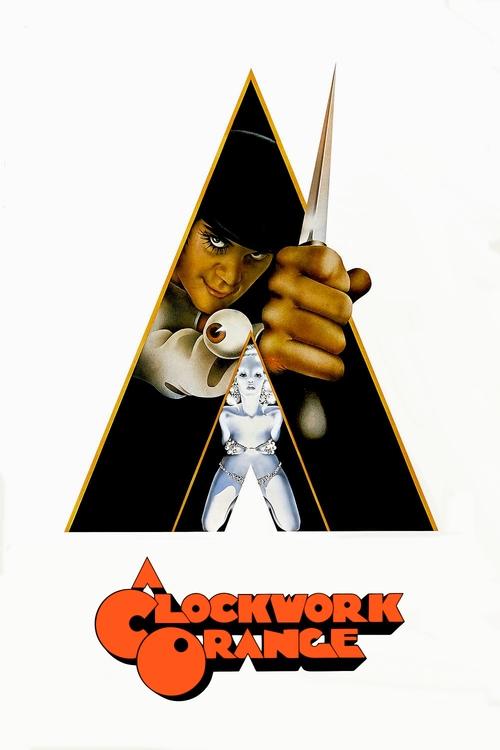
A Clockwork Orange
1971 · Directed by Stanley Kubrick
Woke Score
CriticCritic Score
Audience
Ultra Based
Critics rated this 73 points above its woke score. Among Ultra Based films, this critic score ranks #445 of 1469.
Representation Casting
Score: 5/100
Cast reflects conventional 1971 British cinema with no deliberate effort toward diverse representation. All major roles filled by white British actors in roles written without identity consciousness.
LGBTQ+ Themes
Score: 0/100
No LGBTQ+ themes or representation. The film contains no queer characters or sexuality exploration beyond heterosexual violence.
Feminist Agenda
Score: 3/100
Female characters exist primarily as victims of the protagonist's violence. The film does not critique this dynamic but uses it to establish Alex's monstrosity. No feminist agenda present.
Racial Consciousness
Score: 0/100
The film contains no exploration of race, racial dynamics, or racial consciousness. These categories are simply absent from the work.
Climate Crusade
Score: 0/100
No climate messaging or environmental consciousness. The dystopian setting serves narrative purposes, not environmental critique.
Eat the Rich
Score: 2/100
The film depicts a dystopian state but does not systematically critique capitalism or wealth inequality. Anti-capitalist elements are ambient rather than ideological.
Body Positivity
Score: 0/100
No body positivity messaging. Physical appearance is used for characterization and aesthetic effect without progressive intention.
Neurodivergence
Score: 2/100
Alex's sociopathy could be read as neurodivergence, but the film does not engage with this framework. His condition serves the narrative without contemporary understanding of mental difference.
Revisionist History
Score: 0/100
The film does not attempt to revise historical narratives or reclaim marginalized perspectives. It operates in speculative fiction, not historical reinterpretation.
Lecture Energy
Score: 5/100
The film presents complex philosophical ideas about free will and state power but does not deliver these as moral lectures. The ambiguity is intentional and sustained throughout.


Synopsis
In a near-future Britain, young Alexander DeLarge and his pals get their kicks beating and raping anyone they please. When not destroying the lives of others, Alex swoons to the music of Beethoven. The state, eager to crack down on juvenile crime, gives an incarcerated Alex the option to undergo an invasive procedure that'll rob him of all personal agency. In a time when conscience is a commodity, can Alex change his tune?
Consciousness Assessment
Stanley Kubrick's 1971 masterwork is a film about freedom, totalitarianism, and the philosophical question of whether a human being stripped of moral choice remains human. It is not a film about progressive social consciousness, despite its artistic brilliance and thematic ambition. Alex DeLarge's journey from amoral violence to state-enforced passivity serves Kubrick's examination of authority and individual autonomy, not contemporary cultural awareness.
The film's gender politics are unambiguously of their era. Sexual violence appears in the narrative not as critique but as documentation of the protagonist's monstrosity. The work contains no racial consciousness, no LGBTQ+ representation, no body positivity, no climate awareness, and no neurodivergence consideration. It does not attempt to revise history or deliver moral instruction about social categories. The anti-capitalist dimensions are negligible, functioning only as dystopian atmosphere rather than ideological statement.
What we have here is a work of genuine artistic significance that explores serious philosophical territory entirely outside the framework we are measuring. This is precisely the kind of film that reminds us why the distinction between moral seriousness and contemporary progressive sensibility matters. Kubrick made a masterpiece about freedom. He did not make a conscious intervention in modern social debates. The film deserves its canonical status, and it scores as it does because it simply was not designed to address these concerns.
Analysis generated by our Consciousness Algorithm
Critic Reviews
“A chilling classic, the movie is a scabrous satire about human deviance, brutality, and social conditioning that has remained a visible part of the ongoing public debate about violence and the movies.”
“Kubrick's liberal, anti-authoritarian reading of Anthony Burgess's very Catholic allegorical novel is morally confused but tremendously powerful... No serious moviegoer can afford to ignore it.”
“It demands thought, compels the attention, and refuses to be dismissed. And, for that reason, A Clockwork Orange must be considered a landmark of modern cinema.”
“Let me report simply that A Clockwork Orange manifests itself on the screen as a painless, bloodless, and ultimately pointless futuristic fantasy...The last third of the movie is such a complete bore that even audiences of confirmed Kubrickians have drowned out smatterings of applause with prolonged hissing.”
Consciousness Markers
Cast reflects conventional 1971 British cinema with no deliberate effort toward diverse representation. All major roles filled by white British actors in roles written without identity consciousness.
No LGBTQ+ themes or representation. The film contains no queer characters or sexuality exploration beyond heterosexual violence.
Female characters exist primarily as victims of the protagonist's violence. The film does not critique this dynamic but uses it to establish Alex's monstrosity. No feminist agenda present.
The film contains no exploration of race, racial dynamics, or racial consciousness. These categories are simply absent from the work.
No climate messaging or environmental consciousness. The dystopian setting serves narrative purposes, not environmental critique.
The film depicts a dystopian state but does not systematically critique capitalism or wealth inequality. Anti-capitalist elements are ambient rather than ideological.
No body positivity messaging. Physical appearance is used for characterization and aesthetic effect without progressive intention.
Alex's sociopathy could be read as neurodivergence, but the film does not engage with this framework. His condition serves the narrative without contemporary understanding of mental difference.
The film does not attempt to revise historical narratives or reclaim marginalized perspectives. It operates in speculative fiction, not historical reinterpretation.
The film presents complex philosophical ideas about free will and state power but does not deliver these as moral lectures. The ambiguity is intentional and sustained throughout.