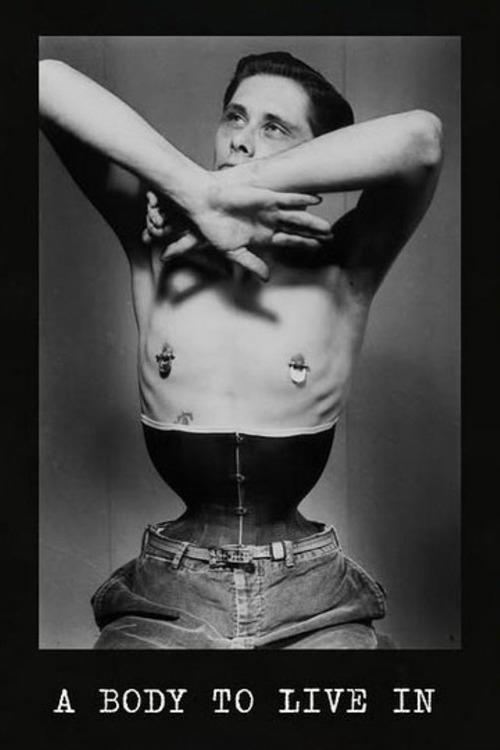
A Body to Live In
2025 · Directed by Angelo Madsen
Woke Score
Critic Score
Peak Woke
Critics rated this 10 points below its woke score. Among Peak Woke films, this critic score ranks #2 of 2.
Representation Casting
Score: 95/100
Entire film centers on queer and trans artists as primary subjects and voices. Director Angelo Madsen is trans, and the film was created from within these communities rather than as external documentation.
LGBTQ+ Themes
Score: 98/100
LGBTQ+ identity and sexuality are the film's central organizing principle. The modern primitives movement is explicitly framed as queer cultural practice and survival strategy within a homophobic society.
Feminist Agenda
Score: 85/100
Women artists like Annie Sprinkle and Cléo Dubois are featured prominently. Body autonomy and resistance to patriarchal control of female bodies are implicit throughout, though not explicitly theorized.
Racial Consciousness
Score: 55/100
The film includes acknowledgment of Musafar's appropriation of indigenous practices through archival footage of his confrontation with indigenous people, demonstrating some critical awareness without deeply centering indigenous perspectives.
Climate Crusade
Score: 0/100
Climate themes are entirely absent from the film, which focuses on queer history and bodily practice rather than environmental concerns.
Eat the Rich
Score: 70/100
The film documents practices of spiritual and bodily self-determination existing outside capitalist frameworks, though it does not explicitly theorize anti-capitalism or critique market commodification of these practices.
Body Positivity
Score: 88/100
The entire film is predicated on radical acceptance of diverse bodies, non-normative embodiments, and rejection of dominant beauty standards. Body modification is presented as legitimate self-expression.
Neurodivergence
Score: 0/100
No explicit engagement with neurodivergence as a category. Some practices may intersect with altered consciousness or pain management, but this is not thematically foregrounded.
Revisionist History
Score: 80/100
The film actively rewrites the historical record by centering queer and trans artists whose contributions have been systematically erased or marginalized in mainstream cultural history.
Lecture Energy
Score: 45/100
While the film presents clear arguments about the political significance of body modification and queer practice, it does so primarily through archival footage and artist testimony rather than didactic voiceover or explicit moralizing.
Synopsis
A BODY TO LIVE IN offers an uncompromising look at the rise of BDSM performance art, body modification and the 'modern primitives' cultural movement through the agonies and ecstasies of transgressive artist Fakir Musafar and the communities that surrounded him. Blending rare archival footage with the voices of queer and artistic trailblazers, the film shows how pain, ritual, and transformation became tools of identity, survival, and self-expression. Weaving from early experiments and secret gatherings to the emergence of a global subculture shaped by the AIDS crisis and spiritual reinvention, Director Angelo Madsen (NORTH BY CURRENT) reveals not just the story of one artist, but a collective history of bodies in revolt - asking what it truly means to live freely in one's own skin.
Consciousness Assessment
Angelo Madsen's "A Body to Live In" represents a kind of cultural document that arrives at precisely the moment when such documents have become indispensable to the historical record. The film traces the genealogy of body modification and BDSM practice as tools of liberation and self-determination within queer communities, treating this history with the solemnity reserved for liberation movements, which, in many respects, it was. The archival footage and testimony of artists like Fakir Musafar, Annie Sprinkle, and Ron Athey becomes a corrective against the erasure of queer cultural innovation, presenting these practitioners not as shocking provocateurs but as theorists of embodiment and freedom.
The film's formal commitment to its subject matter is notable. Rather than positioning the viewer as a voyeur peering into transgressive practice, Madsen centers the voices and perspectives of the artists themselves, allowing them to articulate the spiritual and political significance of their work. The AIDS crisis functions not as melodramatic backdrop but as the material context that accelerated the movement's urgency and shaped its spiritual dimensions. Cléo Dubois and others speak to how pain and ritual became mechanisms of survival and meaning-making in the face of systemic abandonment.
What results is a film that refuses the easy moralizing available to documentaries about marginalized communities. Madsen, himself a trans filmmaker embedded in these worlds for over fifteen years, demonstrates an insider's understanding that prevents slippage into condescension. The film acknowledges Musafar's complexities and contradictions, including his appropriation of indigenous practices, without using this as an excuse to dismiss his broader contributions. This nuance, this refusal to flatten human beings into heroes or villains, marks the film as serious cultural work.
Analysis generated by our Consciousness Algorithm
Critic Reviews
“A Body to Live In is unquestionably a film about transformation, not just of physical manifestation but of consciousness itself.”
“Mildly engaging and stylishly edited albeit hagiographic, repetitive and dry.”
“While a heady experience, this should only be viewed by those of an iron constitution and an insatiable curiosity of adult age.”
“While I don't expect a lot of viewers to give it a look, I did find the film's section on the AIDS crisis and the address of the modern primitivism movement's cultural appropriation issue interesting.”
“Yet, despite the intense acts depicted on the screen, A Body to Live In is a surprisingly smooth watch thanks to its careful attention to the intentionality of a trailblazer.”
“These interviews are intermixed in a nonchronological, collage-like structure, with images backed by disembodied voices and an incantatory soundtrack evocative of a Kenneth Anger film.”
Consciousness Markers
Entire film centers on queer and trans artists as primary subjects and voices. Director Angelo Madsen is trans, and the film was created from within these communities rather than as external documentation.
LGBTQ+ identity and sexuality are the film's central organizing principle. The modern primitives movement is explicitly framed as queer cultural practice and survival strategy within a homophobic society.
Women artists like Annie Sprinkle and Cléo Dubois are featured prominently. Body autonomy and resistance to patriarchal control of female bodies are implicit throughout, though not explicitly theorized.
The film includes acknowledgment of Musafar's appropriation of indigenous practices through archival footage of his confrontation with indigenous people, demonstrating some critical awareness without deeply centering indigenous perspectives.
Climate themes are entirely absent from the film, which focuses on queer history and bodily practice rather than environmental concerns.
The film documents practices of spiritual and bodily self-determination existing outside capitalist frameworks, though it does not explicitly theorize anti-capitalism or critique market commodification of these practices.
The entire film is predicated on radical acceptance of diverse bodies, non-normative embodiments, and rejection of dominant beauty standards. Body modification is presented as legitimate self-expression.
No explicit engagement with neurodivergence as a category. Some practices may intersect with altered consciousness or pain management, but this is not thematically foregrounded.
The film actively rewrites the historical record by centering queer and trans artists whose contributions have been systematically erased or marginalized in mainstream cultural history.
While the film presents clear arguments about the political significance of body modification and queer practice, it does so primarily through archival footage and artist testimony rather than didactic voiceover or explicit moralizing.