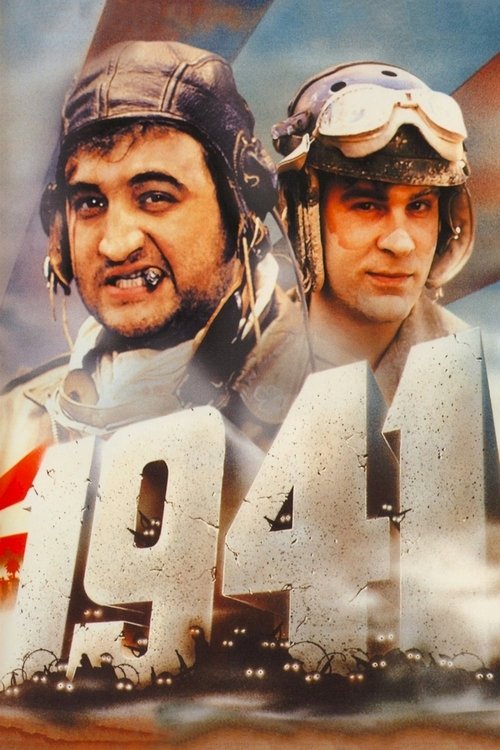
1941
1979 · Directed by Steven Spielberg
Woke Score
CriticCritic Score
Audience
Ultra Based
Critics rated this 30 points above its woke score. Among Ultra Based films, this critic score ranks #1410 of 1469.
Representation Casting
Score: 15/100
The film casts Toshirō Mifune as a Japanese submarine captain, which represents a notable choice to employ a respected Japanese actor in a significant role. However, the character exists primarily as a vehicle for comedy rather than as a fully realized human being worthy of audience empathy.
LGBTQ+ Themes
Score: 0/100
There is no evidence of LGBTQ+ themes, representation, or subtext in the film. The narrative concerns itself entirely with heterosexual romantic entanglements and military action.
Feminist Agenda
Score: 5/100
The film features female characters but treats them primarily as romantic interests and objects of male attention rather than as agents with their own narrative agency or consciousness. No feminist themes or perspectives emerge from the material.
Racial Consciousness
Score: 10/100
While the film depicts Japanese characters and the paranoia directed at them, it does not examine or critique the racism underlying the panic. The Japanese are presented as objects of fear rather than as subjects deserving of dignity or understanding.
Climate Crusade
Score: 0/100
Climate themes are entirely absent from this war comedy. The film contains no environmental consciousness or concern with ecological impact.
Eat the Rich
Score: 0/100
The film expresses no critique of capitalism, wealth inequality, or economic systems. Military institutions are satirized for their incompetence rather than for their role in perpetuating structural power.
Body Positivity
Score: 0/100
Body positivity is not a concern of the film. Physical comedy relies on conventional attractiveness and bodily humiliation without any attempt at inclusive representation.
Neurodivergence
Score: 0/100
There is no representation of neurodivergence or disability in any meaningful sense. Characters with unusual behavior are treated as comic types rather than as individuals with legitimate differences.
Revisionist History
Score: 5/100
The film takes considerable liberties with historical fact for comedic purposes, but this constitutes straightforward fictional adaptation rather than revisionist history designed to correct historical injustice or reframe oppressed narratives.
Lecture Energy
Score: 0/100
The film contains no preachy impulse or educational messaging. It aims purely for entertainment through slapstick and chaos, with no attempt to instruct the audience about social or historical matters.


Synopsis
In the days after the attack on Pearl Harbor, panic grips California, where a military officer leads a mob chasing a Japanese sub.
Consciousness Assessment
Spielberg's 1941 presents itself as a satire of mass hysteria and wartime paranoia, yet the film operates almost entirely in a cultural register that predates contemporary consciousness by decades. The narrative mechanics rely on broad physical comedy and ensemble chaos, with little concern for how the material might be interpreted through a modern lens. The Japanese submarine captain, portrayed by the distinguished Toshirō Mifune, exists primarily as a foil for American panic rather than as a character worthy of substantive engagement. The film treats the historical moment with a kind of deliberate frivolousness that suggests indifference to the human dimensions of the conflict.
What renders this film remarkable from a scoring perspective is its near-total absence of the cultural markers we now recognize as contemporary progressive sensibility. There are no meaningful attempts at representation beyond casting, no interrogation of systemic structures, and certainly no evidence of the educational impulse that characterizes modern social consciousness. The humor derives from slapstick and character types rather than from any satirical critique of prejudice itself. Even the film's treatment of military authority and civilian panic avoids any suggestion that these phenomena deserve serious analysis.
In the context of 1979, this represents merely a comedy about war and confusion. In the context of contemporary cultural awareness, it reads as a historical artifact of a moment when such subjects could be rendered as pure entertainment without irony or self-awareness. The film's complete lack of contemporary progressive sensibilities is not a mark against it in absolute terms, but rather an observation about the distance between 1979 and now.
Analysis generated by our Consciousness Algorithm
Critic Reviews
“Billed as a comedy spectacle, Steven Spielberg’s 1941 is long on spectacle, but short on comedy. The Universal-Columbia Pictures co-production is an exceedingly entertaining, fast-moving revision of 1940s war hysteria in Los Angeles spawned by the bombing of Pearl Harbor, and boasts Hollywood’s finest miniature and special effects work seen to date.”
“1941 is loaded with slam-bang sight gags and action, but comedy isn't director Steven Spielberg's forte and the movie isn't nearly as funny as it might have been.”
“1941 is less comic than cumbersome, as much fun as a 40-pound wrist-watch.”
“Not only is it mindless, it is also racist. Not only is it racist, it is also incompetent. Not only is it incompetent, it is also unfunny. [17 Dec 1979]”
Consciousness Markers
The film casts Toshirō Mifune as a Japanese submarine captain, which represents a notable choice to employ a respected Japanese actor in a significant role. However, the character exists primarily as a vehicle for comedy rather than as a fully realized human being worthy of audience empathy.
There is no evidence of LGBTQ+ themes, representation, or subtext in the film. The narrative concerns itself entirely with heterosexual romantic entanglements and military action.
The film features female characters but treats them primarily as romantic interests and objects of male attention rather than as agents with their own narrative agency or consciousness. No feminist themes or perspectives emerge from the material.
While the film depicts Japanese characters and the paranoia directed at them, it does not examine or critique the racism underlying the panic. The Japanese are presented as objects of fear rather than as subjects deserving of dignity or understanding.
Climate themes are entirely absent from this war comedy. The film contains no environmental consciousness or concern with ecological impact.
The film expresses no critique of capitalism, wealth inequality, or economic systems. Military institutions are satirized for their incompetence rather than for their role in perpetuating structural power.
Body positivity is not a concern of the film. Physical comedy relies on conventional attractiveness and bodily humiliation without any attempt at inclusive representation.
There is no representation of neurodivergence or disability in any meaningful sense. Characters with unusual behavior are treated as comic types rather than as individuals with legitimate differences.
The film takes considerable liberties with historical fact for comedic purposes, but this constitutes straightforward fictional adaptation rather than revisionist history designed to correct historical injustice or reframe oppressed narratives.
The film contains no preachy impulse or educational messaging. It aims purely for entertainment through slapstick and chaos, with no attempt to instruct the audience about social or historical matters.